
Cello: Parts, How It Sounds and How to Play
The cello is the low, warm voice of the violin family. You play it sitting down, with the instrument standing on the floor between your knees. Its big body and long strings give it a deep, resonant sound.
In this lesson
Meet the cello
The violin family has four members: violin, viola, cello and double bass. The cello is bigger than the viola and smaller than the double bass. It looks like a violin, but its sides are deeper for its size and its neck is shorter.
Its full name is violoncello, an Italian word that means 'little violone'. The violone was a common instrument in the 17th and 18th centuries that later grew into today's double bass. Cello is simply the short name.
The four strings are tuned C, G, D, A, starting two octaves below middle C. That is one octave lower than the viola. In the string section the cello plays the tenor part, and an orchestra usually has 8 to 12 cellos, with two players sharing one music stand.
- Family
- String instrument (violin family)
- Type
- Bowed string instrument; can also be plucked
- Strings
- C2, G2, D3, A3 (each a perfect fifth apart)
- Lowest note
- C2 (open C string, about 65 Hz)
- Range
- C2 to A5 (up to A7 with harmonics)
- Clef
- Mostly bass clef; because the range is so wide, tenor and treble clef are also used
- Transposing
- No (sounds as written)
- Size
- Body about 75 cm (sources measure 70 to 76 cm); about 120 to 125 cm long in all
- Bow length
- 71 to 73 cm
Parts of the cello
A cello is built mostly from two kinds of wood. The top is spruce (or pine); the back, the sides, the neck, the pegbox and the scroll are maple. The fingerboard is ebony and the bridge is maple. Today there are also cellos made of carbon fiber.
Some of the most important parts are hidden inside the body. You can only glimpse them through the f-holes.
Some parts sit inside or behind the instrument where the picture cannot show them; their numbers mark roughly where they are.
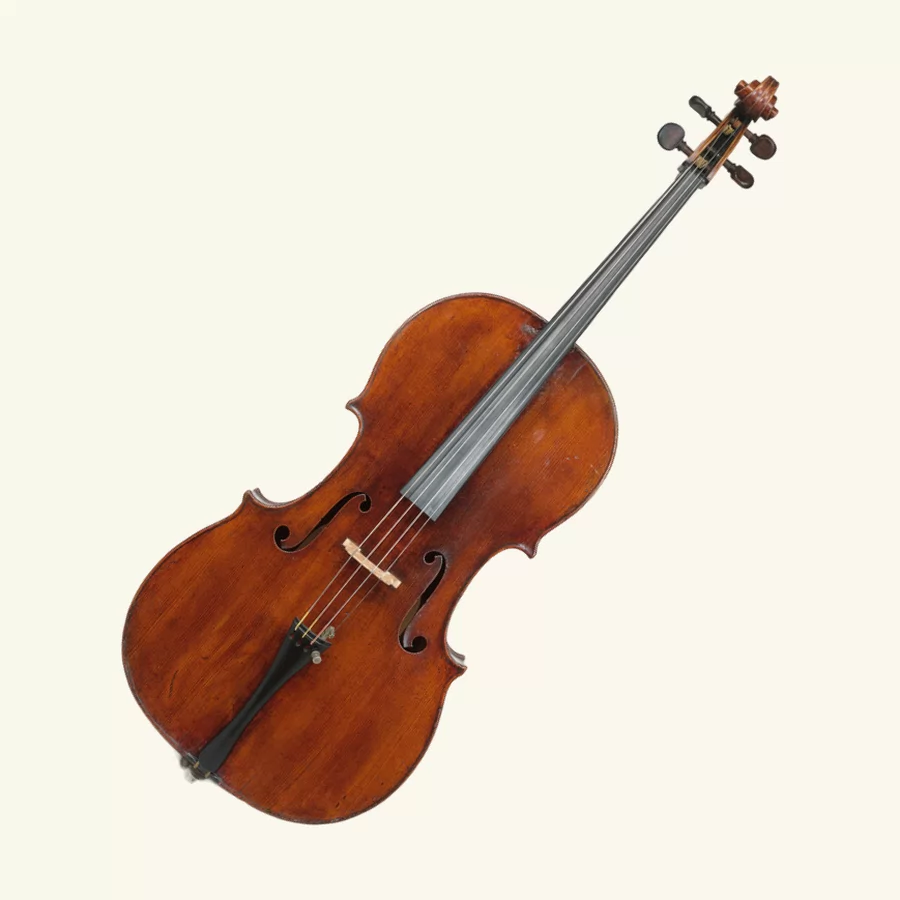
- 1Scroll scroll
The curled wooden end at the very top, carved from maple.
- 2Pegbox and pegs pegbox
The strings wind around the pegs here; turning a peg makes a string tighter or looser.
- 3Neck neck
The long handle your left hand moves along.
- 4Fingerboard fingerboard
A smooth ebony board with no frets; you press the strings down onto it to change the pitch.
- 5Top and f-holes top / f-holes
The arched spruce top; the part between the two f-holes vibrates most easily.
- 6Bridge bridge
Holds the strings up and passes their vibration to the body. It stays in place only by string pressure, not glue, and its curve lets the bow play one string at a time.
- 7Tailpiece and fine tuners tailpiece
Holds the ends of the strings; the small fine tuners make tiny tuning changes.
- 8Sound post sound post
A small wooden post inside, held by friction, not glue. It props up the top and links the vibration of the top and back.
- 9Bass bar bass bar
A narrow strip of wood along the underside of the top, on the side of the bridge's bass foot, that spreads the vibration over a large area of the top.
- 10Endpin endpin
The metal spike at the bottom that rests on the floor. A stopper screw holds it in place, and the tip may have a rubber foot.
How the sound is made
The bow is a stick strung with horse hair. Rosin makes the hair grab the string, pull it along, then let it slip back, again and again. It is like rubbing an eraser hard across a desk: it sticks, jumps, sticks, jumps. One stick-and-slip cycle lasts exactly as long as one vibration of the string.
Rosin is the secret. It makes the hair hold on tightly while it is sticking, but slide very easily once it slips. If grabbing and sliding felt the same, like a bow with no rosin, the string would just sigh instead of sing.
While you bow, the string is always shaped like two straight lines with a sharp corner between them. The corner races back and forth along the string, like a bead sliding on a wire. This shape gives the note a whole set of overtones, at 2, 3, 4 and more times the main pitch, which makes the sound rich.
A faster bow makes the string swing wider, so the note is louder. Pressing harder brings out more high overtones, so the sound turns brighter. Close to the bridge you need a little more pressure, and the range of pressure that still works gets narrower, like walking on a thinner path.
A string on its own is too thin to push much air, so it is almost silent. The bridge passes part of the vibration into the wooden top, much as a tuning fork rings louder when you touch its handle to a table. The sound post and bass bar spread that motion through the body, and the air inside the box resonates too. This works the same way across the whole violin family.
Sometimes a note sits very close to the main vibration of the body itself. The two fight each other and the note wobbles and stutters, a sound some people compare to a howling wolf, so it is called a wolf tone. Many cellos have one somewhere around E to F♯, often most noticeable on the C string. A small weight called a wolf eliminator can calm it, but it may also make the whole cello sound a little duller.
Try it: press a pencil eraser on a table and push it slowly. Feel it stick, jump, stick, jump? That is what the bow hair does to the string, dozens to hundreds of times a second.
How to play
Sit on the front edge of a chair with both feet flat on the floor; your left foot can be a little forward. Pull out the endpin so the edges of the cello rest against the inside of your knees and the top of the cello touches the middle of your chest. The C peg sits near your left ear. The endpin and your two feet make a triangle on the floor.
Hold the bow loosely. Your bent thumb goes in the little gap between the frog and the grip; your little finger and ring finger rest on the frog, your middle finger can touch the metal band, and your pointer finger lies lightly on the stick. The most important check is a relaxed, bent thumb.
Your left hand makes a C shape, as if you were holding a soda can. The thumb sits behind the second finger and points across the neck, not along it. Keep your elbow up but relaxed and keep your wrist in line with your arm. Pressing a finger down makes the vibrating part of the string shorter, so the note goes up.
To reach very high notes, your left hand moves toward the bridge into the high positions (a position is where your hand sits on the neck). Around 1740, cellists "discovered" that the thumb could press the strings too. This thumb position lets the left hand reach the high positions, especially on the A string.
To play louder, combine bow speed and bow pressure. Separate notes can be played on the string, which is strong but tiring and harder to keep together, or with the bow bouncing off the string, which rings more. Rocking your left finger, called vibrato, makes the overtones swell and fade, so the note sounds more alive. The Philharmonia Orchestra says a wide vibrato brings out the cello's deep voice and is perfect for a sad, wistful mood.
If you touch a string very lightly exactly halfway along, without pressing it down, you get a harmonic: a clear, high note one octave above the open string. Touching it at one quarter gives a note two octaves up.
Composers also ask for special sounds. Col legno means tapping the string with the wooden stick of the bow, which sounds like a little hammer. Sul ponticello means bowing close to the bridge, for a brighter but glassy, thin sound; sul tasto means bowing over the fingerboard, for a weaker, softer sound. In a Bartók pizzicato you pull the string up so it snaps back against the fingerboard with a loud crack, used as a percussion effect.
- Draw the bow across the string with steady speed. You hear a long note that lasts as long as the bow keeps moving.
- Pull the string with a finger instead of the bow. The note starts with a pop and fades away by itself.
- The open A string is A3. With a finger pressing the same string, the cello reaches A4, one octave higher.
- The low strings sound thicker and darker. Composers write sul C or sul G to ask you to stay on them.
Range and written music
The lowest note is the open C string, C2, about 65 Hz. Each string above it is a perfect fifth higher: G2, D3 and A3. Higher notes are played by pressing the strings further up the fingerboard. The cello's range runs from C2 to A5, and with harmonics it can reach A7.
Each string covers its own stretch: the C string about C2 to F3, the G string G2 to C4, the D string D3 to G4, and the A string A3 to A5.
The cello does not transpose: the written note is the note you hear. Its music is mainly written in bass clef, but because the range is so wide, tenor clef is used for higher passages and treble clef for very high ones. Players do not like switching clefs too often.
Watch out for one old habit. Some older scores wrote the cello's high notes in treble clef one octave higher than they actually sound. Today tenor clef is used for that range instead.
Listen
- Each step jumps up a perfect fifth. Notice how the sound gets lighter as you go up.
- Listen for the thick, dark buzz of the lowest note the cello can play on an open string.
- Same note, two ways: the bowed note holds steady, the plucked note pops and dies away.
- An open string, then a pressed note one octave higher. Can you hear that it is the same letter name?
History and family
The first cellos appeared in the 16th century. They often had five strings and mainly strengthened the bass line in groups. In Cremona, Italy, the maker Andrea Amati set the style and the building methods of the violin family.
One very old cello, the 'King', is a rare survivor from the middle of the 16th century. It was probably made before a royal order for King Charles IX of France, placed around 1561, and painted later. It began as a larger bass instrument and was later cut down to modern cello size. It is now in the National Music Museum in South Dakota.
Early cellos were big: the earliest had bodies about 80 cm long, bigger than today's standard, and all of the about 25 cellos known from before 1700 are large. Around 1660, strings wound with metal wire were invented, and in Bologna such strings may have helped the cello along: a shorter string could still be tight enough and answer quickly. Stradivari decided in 1700 to make cellos smaller, and from about 1707 he used the model now called forma B.
In the 17th century, cello plus harpsichord became the standard pair for playing the basso continuo, the bass part under the music. In the 17th and 18th centuries the cello replaced the bass viola da gamba as a solo instrument, and Haydn, Mozart and later composers gave it more to do.
Famous music for the cello includes Bach's six unaccompanied suites, Beethoven's five cello sonatas, concertos by Lalo, Dvořák, Saint-Saëns, Elgar and Barber, sonatas by Kodály and Debussy, and Villa-Lobos's Bachianas Brasileiras for eight cellos and soprano. Pablo Casals, Mstislav Rostropovich and Yo-Yo Ma are among its best-known players.
Strings changed too. Steel strings kept spreading, especially on the cello. By the 1950s most young American cello students used two steel and two silver-wound gut strings; later most players gave up gut, with only a few keeping wound gut on the lower three strings. A close relative, the tenor violin of the 16th to 18th centuries, sat in size between the viola and the cello.
- 16th centuryThe first cellos appear, often with five strings, to support the bass.
- c. 1505–1577Lifetime of Andrea Amati of Cremona, who set the style of the violin family.
- Mid-16th centuryThe 'King' cello is made, first as a larger bass instrument.
- c. 1660Metal-wound strings are invented.
- 17th centuryCello and harpsichord become the standard continuo pair.
- 1700Stradivari decides to make the cello smaller.
- c. 1707Stradivari starts using the forma B model.
- c. 1740Cellists discover that the thumb can press the strings, opening up thumb position.
- 1950sMost young American cello students use two steel and two silver-wound gut strings.
Getting started and care
Before playing, rub rosin evenly along the whole length of the bow hair. When you finish, always loosen the hair before the bow goes back in the case.
Yamaha's manual says the cello is adjusted before it leaves the factory, and if you feel it needs more adjusting, take it to your dealer, because some adjustments need specialist skills. Do not try to change it yourself.
- Keep the cello out of direct sun, very hot or cold places, high or low humidity, dust and strong shaking. Sudden temperature changes in particular can cause serious damage, so do not leave it in a car for long.
- Wipe it with a soft, dry cloth, and do not spray insect spray near it.
- Change only one string at a time. If all four come off, the bridge can fall and the tailpiece can come loose.
- Check the bridge while tuning or changing strings: it stands between the notches of the two f-holes, the side facing the tailpiece stands at a right angle to the top, and each string sits in its own groove.
- The endpin is sharp, so handle it with care, and tighten the endpin stopper firmly so the cello does not fall while you play.
- Keep your face away from the cello while tuning or changing strings; a string that breaks suddenly can hurt your eyes or face. Do not turn the fine tuners too loose or too tight, or you may damage the cello or get buzzing noises while you play.
- Cello | Britannica
- Violin | Britannica
- Wolf tone | Britannica
- Bows and strings (UNSW Music Acoustics)
- How does a violin work? (UNSW Music Acoustics)
- Strings, standing waves and harmonics (UNSW Music Acoustics)
- The Cello (HyperPhysics)
- KSU Masterclass: High School Orchestra, Violin and Cello
- Yamaha Viola / Cello Owner's Manual
- Cello (Philharmonia Orchestra)
- The Amati Family (The Met)
- The King Is in the Details (The Met)
- Museo del Violino, Cremona (Google Arts & Culture)
- The Strad: history of strings (Temple University PDF)
- Prout, The Orchestra, Vol. 1, Chapter IV (Timbre and Orchestration Resource)
- Cello (Vienna Symphonic Library)
Piano sound: Salamander Grand Piano by Alexander Holm (CC BY 3.0).