
Acoustic guitar: classical and steel-string, how they work
The acoustic guitar is a plucked string instrument: you pluck the strings with your fingers or a pick, and the hollow wooden body turns their shaking into sound you can hear. There are two main kinds: the classical guitar with nylon strings and the folk guitar with steel strings. They are tuned the same way, but they are built, feel and sound different.
In this lesson
Meet the acoustic guitar
A guitar's body has a 'waist', a part that curves inward in the middle, and its neck is divided by frets. Early guitars had four strings; six is now the standard. Guitars come in three basic types: nylon-string acoustic (classical and flamenco), steel-string acoustic (folk) and electric. This page is about the first two.
The biggest difference is the strings. On a classical guitar, strings 1–3 are single clear nylon strands and strings 4–6 have a core of about 200 nylon fibres wrapped in silver-plated copper wire. On a steel-string guitar, strings 1–2 are plain steel and strings 3–6 are wrapped in metal, often 80/20 bronze or phosphor bronze.
Steel strings are pulled much tighter: one normal-tension nylon set (D'Addario EJ45) totals 85.8 lb (38.9 kg) across six strings, while a 12–53 steel set (EJ16) comes to about 160 lb, roughly twice as much. Like a rubber band, the tighter a string is pulled, the harder it is to press down.
A nylon-string guitar is almost always quieter than a steel-string one, and its strummed sound is gentler; steel strings give a crisp tone. Nylon is used in classical, flamenco, Latin, bossa nova, jazz and pop; steel in folk, pop, rock, blues, country and bluegrass.
A classical neck is wider (52 mm at the nut on a typical Yamaha), half-round at the back, and joins the body at the 12th fret. A steel-string neck is narrower (43 mm), more triangular at the back, and usually joins at the 14th fret, so more of the fingerboard is easy to reach.
- Family
- String instrument (plucked)
- Classification
- Hornbostel–Sachs 321.322-5: necked box lute sounded by the bare fingers
- Strings
- 6; nylon on the classical guitar, steel on the folk guitar
- Sounding range
- E2 to C6 (20 frets)
- Clef
- Treble clef, written an octave higher than it sounds
- Transposition
- Sounds one octave lower than written
- Common sizes
- Classical: 650 mm string length (Yamaha C40II); steel-string: 25.4 in ≈ 645 mm (Martin D-28)
Parts of the guitar
From head to tail, an acoustic guitar is made of the parts below. The two kinds share most parts; they differ in the hidden bracing, in how the strings are fixed, and in the pickguard on steel-string guitars: classical strings are tied to the bridge, steel strings are held in it by small bridge pins.
Good tops are often bookmatched: one piece of wood is sawn into two sheets and opened like a book, so the grain on each side is a mirror image.
Some parts sit inside or behind the instrument where the picture cannot show them; their numbers mark roughly where they are.
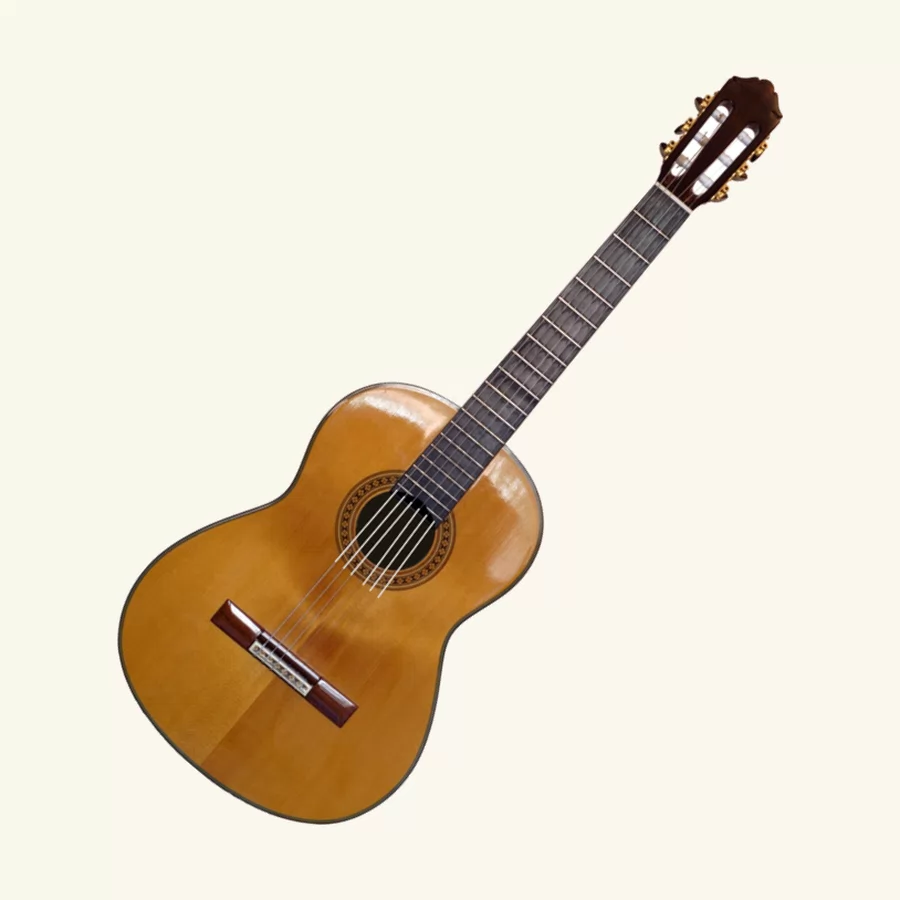
- 1Headstock and tuning keys headstock / tuning keys
Turning a key tightens or loosens a string, which is how you tune. Classical guitars mostly use open gears.
- 2Nut nut
The small strip that holds the strings at the head end, where an open string starts to vibrate. Now usually bone, hard plastic or brass.
- 3Neck neck
The long part your left hand holds. A steel-string neck hides an adjustable steel rod about 6 mm across that stops it bending.
- 4Fingerboard and frets fingerboard / frets
Where you press the strings, often ebony. When you press, the metal fret becomes the new end point; each fret toward the body raises the note a semitone.
- 5Top (soundboard) top / soundboard
The thin front board, often spruce or western red cedar, about 2.5–3 mm thick. The strings' vibration reaches it through the bridge, and the top pushes the air; the back is much less important acoustically.
- 6Sound hole and rosette sound hole / rosette
Connects the air inside the body with the air outside and helps make a low resonance; the ring around it is inlaid decoration.
- 7Pickguard pickguard
On steel-string guitars, a thin plate beside the sound hole that stops the pick scratching the top. The guitar in the picture is a classical guitar, which usually has none; the number shows where it sits on a steel-string guitar.
- 8Bracing bracing
Thin wooden bars glued inside the top. They hold the pull of the strings and shape the tone: fan-shaped on classical guitars, larger, stronger X bracing on most steel-string guitars.
- 9Bridge and saddle bridge / saddle
Hold the strings at the tail end and pass their vibration into the top. Bridges are hardwoods such as ebony or rosewood; saddles are often bone.
- 10Sides and back sides (ribs) / back
Form the edge and back of the body, often mahogany, rosewood or maple. The back matters much less to the sound than the top.
Where the sound comes from
A string is so thin that it barely pushes the air as it swings, so on its own it is very quiet. Wave a chopstick and you hardly feel a breeze; wave a fan and you do. The guitar passes the string's vibration through the saddle and bridge into the top, and the wide top can push a lot of air.
The body is not really an amplifier: all the energy comes from your pluck, and the body just turns string vibration into air vibration more efficiently, much like the cone of a loudspeaker. Roughly speaking, the high notes come mainly from the top driven by the bridge, while much of the low sound comes from the air inside the body, leaving through the sound hole.
The air inside resonates too. The air in the sound hole is pushed back and forth, like the hoot you get by blowing across an empty bottle; this is called Helmholtz resonance, and on a guitar it falls between F#2 and A2, depending on the instrument. A bigger sound hole gives more volume; a smaller one is quieter but rounder.
A string's pitch depends on four things: mass, tension, length and how it vibrates. Heavier, looser and longer strings sound lower. For the same length and tension, an octave lower needs four times the weight, so the low strings use a thin core wrapped in metal wire: heavier, but not too stiff.
When you press a string, the fret replaces the nut as the end point, the string gets shorter and the note rises. At the 12th fret the string is half as long, an octave higher; at the 7th it is 2/3, turning E into B; at the 5th it is 3/4, turning E into A. Each semitone multiplies the length by about 0.944, so the frets get narrower toward the body.
Where you pluck changes the tone: near the bridge sounds brighter, and plucking at one third of the string leaves out the 3rd, 6th, 9th… harmonics. A pluck toward the top starts loud and dies fast; a pluck parallel to the top is weaker but rings longer.
Just after a pluck the string has a sharp bend in it, full of high frequencies; these die away quickly, so after about a second the sound turns rounder. Nylon strings swing wide and need wider spacing, so classical necks are wider; steel strings pull so hard that the top needs bigger, stronger bracing.
Try this: play the open A string (5th string) and slowly move a piece of card back and forth in front of the sound hole. Listen to how the sound changes. You can also put your ear near the sound hole and softly sing low notes around F#2 to A2 to find the one that makes the body ring along.
How to play
The classical guitar is usually played sitting: your left foot on a footstool, the guitar's waist on your left leg, and the head on your left, raised to about eye level. Your right forearm is what touches the guitar; the right elbow rests on the side of the body, with the wrist and hand relaxed.
Your left thumb supports the back of the neck while the fingers stand up and press with their tips. Press just beside the fret on the head side, not on top of it, or the flesh of your finger stops the vibration and the note sounds muddy.
Classical players usually pluck with the thumb through the ring finger and normally do not use a pick; fingerings are marked p (thumb), i (index), m (middle) and a (ring). The steel-string guitar is great for accompanying your own singing, mostly with a pick, strumming or playing broken chords (the notes of a chord one by one).
When strumming, count out loud: first strum only beat 1, then half, quarter and eighth notes; strum the eighth-note 'and' upward, usually catching only the three high strings. Flamenco rasgueado uses all the fingers; a hammer-on sounds a note by tapping a left-hand finger onto the fingerboard and a pull-off by lifting it off; a capo clamps the neck so you can raise the key without changing chord shapes.
- Without pressing any fret, pluck strings 6, 5, 3 and 1: E2, A2, G3, E4. Listen to the soft nylon sound.
- The same four open strings on a steel-string guitar: E2, A2, G3, E4. Compare how crisp the start of each note is.
- On the classical guitar's 1st string, first the open E4, then the 12th fret, where the string is half as long: E5.
- On the steel-string guitar's 1st string, the open E4, then the 13th fret: F5. Twelve frets make an octave, one more adds a semitone.
Range and notation
Guitar music is written in the treble clef, but by convention it is written one octave higher than it sounds. Some scores put a small 8 under the treble clef to remind you that it sounds an octave lower.
For example, the open 5th string is written as A3 but sounds as A2 (110 Hz). The six open strings are written E3, A3, D4, G4, B4, E5 and sound as E2, A2, D3, G3, B3, E4. Neighbouring strings are mostly a perfect fourth apart; only G (3rd string) to B (2nd string) is a major third.
The lowest note is the open 6th string, E2 (about 82.4 Hz). The highest depends on the frets: on a 20-fret guitar the 1st string reaches C6, on a 19-fret guitar B5; in guitar notation that is E3 to C7. The 6th string is often tuned down a whole step to D (drop D), adding D2 at the bottom.
Listen
- First the classical guitar, then the steel-string. Both play E2; which one starts crisper and which one sounds gentler?
- This note is close to the body's air resonance (about F#2 to A2). Compare how long and how full the low note rings on each guitar.
- The classical G string is a single nylon strand; the steel-string G is wrapped in metal. Hear the difference in colour.
- The very start of the note is sharper; after about a second it turns rounder as the high frequencies die away.
- The classical guitar's E5 at the 12th fret, then the steel-string's F5 at the 13th fret.
History and family
The guitar appeared around Spain about 500 years ago (15th–16th century). Sixteenth-century guitars were much smaller than today's, with four courses (pairs of strings), gut strings and gut frets tied around the neck.
A fifth course was added around 1600, giving the 'Spanish guitar'. In the 18th century tied gut frets gave way to fixed ivory or metal frets, and later in the century a sixth course was added. Around 1800 the pairs became six single strings tuned E–A–D–G–B–E, still the tuning today.
Much of the modern classical guitar comes from the Spanish maker Antonio de Torres (1817–1892). He began building in the 1850s and made longer, wider bodies for a louder guitar. He did not invent fan bracing, but he perfected it and made it widespread.
The steel-string story is American. C. F. Martin opened his business in New York in 1833, and in the mid-19th century the Martin company developed X bracing, which later let guitars withstand the pull of steel strings. Touring players needed volume that could reach the back of a concert hall, so the company switched fairly quickly from gut to metal strings, and steel-string guitars spread in the early 20th century.
During the Second World War gut strings were scarce because gut was used for battlefield sutures. The New York maker Albert Augustine worked with the guitarist Segovia to develop nylon strings, released in the late 1940s.
The guitar's relatives include the lute, the vihuela (a larger cousin with more strings) and the flamenco guitar (thinner body, livelier and sharper sound that fades quickly), as well as the twelve-string guitar, the electric guitar and the South American charango. The four ukulele strings have the same intervals as guitar strings 1–4, though at different pitches.
- 15th–16th c.The guitar appears around Spain; 16th-century guitars have four courses and gut strings
- c. 1600A fifth course is added; the 'Spanish guitar'
- 1759Earliest known fan-braced guitar, attributed to Francesco Sanguino, Seville
- 18th c.Tied gut frets replaced by fixed frets; a sixth course added in the second half
- c. 1800Six single strings tuned E–A–D–G–B–E
- 1833C. F. Martin opens his business in New York
- 1850sAntonio de Torres begins building, shaping the modern classical guitar
- c. 1916The Dreadnought body shape appears
- late 1940sNylon classical guitar strings arrive
Getting started and care
When choosing your first guitar, hold it: your left hand should reach the far end of the fingerboard, or else choose a shorter string length; smaller players can use a 3/4 size. Nylon strings have lower tension than steel, and beginners often find them easier to play. Low action (the height of the strings above the fingerboard) is easier to press, but too low causes buzzing or notes that don't ring, so have a qualified repairer set it.
Guitars are made of wood; 45%–55% humidity is ideal, and air that is too dry can crack the wood and lift the bridge. Like a rubber band, nylon actually shrinks when it warms up (the Gough–Joule effect), so a classical guitar goes sharp in the heat, most of all on strings 2 and 3.
- Every time you finish, wipe off sweat and oil with a dry cloth made for instruments; don't use a silicone cloth, which can damage the finish.
- Change classical strings at least every 6 months, ideally every 3; steel strings every month or every few weeks if you play daily, or about every 3 months if you play less. Change all six together.
- Tune each string up to the note from below; tuning down to it tends to leave it out of tune.
- Put the guitar back in its case when you're not playing, and take the capo off rather than leaving it on in the case.
- Not playing a classical guitar for more than 2–3 weeks? Loosen the strings a few turns.
- Leave a bent neck, a lifting bridge or badly worn frets to a professional repairer; if the bridge is lifting, don't put new strings on until it has been repaired.
- UNSW Music Acoustics: Guitar acoustics, an introduction
- UNSW Music Acoustics: Anatomy of the guitar
- UNSW Music Acoustics: Strings, standing waves and harmonics
- Acoustical Society of America: Sandra Carral, plucking position and timbre
- MIMO Hornbostel–Sachs vocabulary: 321.322-5
- Britannica: Guitar
- The Met: The Spanish Guitar
- The Met: The Guitar
- Yamaha Musical Instrument Guide: Classical guitar
- Yamaha Musical Instrument Guide: Acoustic guitar
- Yamaha Hub: Nylon-string vs steel-string guitars
- Yamaha Hub: The basics of teaching classical guitar
- Martin Guitar: D-28 specifications
- Augustine Strings: About
- Taylor Guitars: Using a guitar humidifier
- D'Addario: EJ45 Pro-Arté nylon strings, normal tension
- D'Addario: EJ16 phosphor bronze strings, light 12–53
- Yamaha: C40II specifications
- Martin Guitar: Chris Martin on innovation and the forefathers
- Material Intelligence: Better guitar through chemistry
- Yamaha Hub: How to choose your first guitar
- Yamaha Musical Instrument Guide: Classical guitar care and maintenance
- Yamaha Musical Instrument Guide: Acoustic guitar basic care
- Yamaha Musical Instrument Guide: Treat your instrument with care
- Yamaha Musical Instrument Guide: Care techniques
- Yamaha Musical Instrument Guide: Time to master tuning
- Yamaha Musical Instrument Guide: Must-have accessories
- Fender: No Broken Necks, 4 guitar care do's and don'ts
Piano sound: Salamander Grand Piano by Alexander Holm (CC BY 3.0).