
Bass Guitar: Parts, How It Sounds and How to Play
The bass guitar is the lowest-sounding member of the guitar family. In most styles of music it is the 'foundation' instrument: together with the drums it holds up the rhythm and the harmony. Here you will see how it is built, how a vibrating metal string turns into sound from a speaker, and how to start playing.
In this lesson
Meet the bass guitar
The bass guitar, also called the electric bass, is a string instrument that is made louder with electricity. It usually has 4 to 6 thick strings. Yamaha explains that it was designed so you could play the low range of the double bass the way you play a guitar, plucking instead of bowing.
Most basses have 4 strings, and that is the usual choice for beginners. A 5-string bass usually adds a lower B string; a 6-string adds both a low B and a high C. Most basses have frets, but fretless basses have a smooth fingerboard, like a double bass or a violin.
The most common string length (from the nut to the bridge) is 34 inches, about 86 cm; 5- and 6-string basses often use 35 inches. Short-scale basses are about 30 inches (about 76 cm). Most bass bodies are solid wood, but there are also hollow and semi-hollow basses, plus acoustic-electric basses.
Some basses are passive and need no power. Active basses need power, usually from a battery in the instrument (a 9-volt battery is common), and often have bass, middle and treble tone controls.
- Family
- Guitar family (plucked strings)
- Classification
- Electro-acoustic chordophone (MIMO 513, classed like the electric guitar)
- Sounding range
- E1 to about G4 (4 strings, 24 frets)
- Clef
- Bass clef
- Transposition
- Sounds one octave lower than written
- Most common string length
- 34 in (about 86 cm)
Parts of the bass guitar
Bass strings are much thicker than guitar strings because they are tuned much lower. Thick strings pull hard on the neck and body, so a bass usually has a slightly bigger body, a thicker neck, a longer string length and bigger hardware than a guitar.
Bass strings have a steel core wrapped with steel or nickel wire. Flatwound strings have a smooth surface and a warm sound; roundwound strings feel rougher and sound brighter.
Some parts sit inside or behind the instrument where the picture cannot show them; their numbers mark roughly where they are.
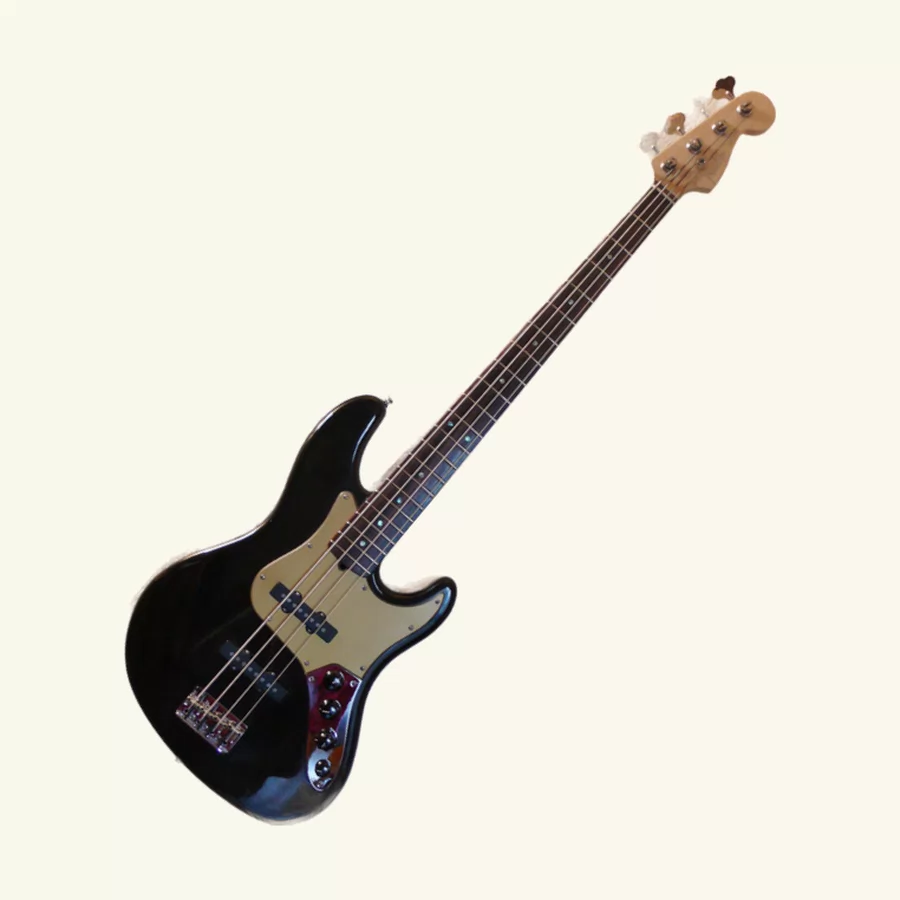
- 1Headstock headstock
The wider top end of the neck, where the strings are fixed to the tuners.
- 2Tuners tuning machines
Turn them to tighten or loosen a string; changing the pull changes the pitch.
- 3Nut nut
A grooved strip of hard plastic or bone that guides each string onto the neck.
- 4Neck and truss rod neck / truss rod
The long arm you hold; a metal rod inside stops it bending or twisting.
- 5Fingerboard fretboard
A thin strip of wood such as rosewood, maple or ebony, gently curved from side to side.
- 6Frets frets
Metal strips that divide the neck into half steps; most basses have 21, 22 or 24.
- 7Body body
Holds everything together; good solid bodies are often alder, maple, swamp ash or mahogany.
- 8Pickups pickups
Magnetic parts that turn string vibration into an electrical signal; most basses have two.
- 9Bridge and saddles bridge & saddles
Hold the string ends; saddles adjust string height and tuning accuracy higher up the neck.
- 10Controls and output jack controls & output jack
Knobs for volume and tone; a cable from the jack carries the signal to the amplifier.
Where the sound comes from
When you pluck a string, it swings back and forth very fast. A longer, heavier or looser string vibrates more slowly and gives a lower note. Think of a jump rope: a long, heavy rope swings slowly, while a short, tight one whips around fast.
A bass does not rely on a hollow box to get loud. Each pickup is a magnet wrapped with a coil of very thin wire. The steel or nickel string is magnetic, so as it moves it changes the magnetism through the coil, and that makes a tiny electrical voltage that wiggles in step with the string. It works a bit like a bicycle dynamo light, where moving a magnet near a coil makes electricity. The cable carries this signal to the amplifier, which makes it loud.
A single-coil pickup can also pick up a hum from the mains electricity around it. A humbucking pickup uses two coils wound in opposite directions so the hum cancels out. A split-coil pickup has two separate halves, one with reversed polarity: it sounds close to a single coil but stays quiet like a humbucker.
Where you pluck changes the tone. Plucking near the middle of the string (in an idealised model) gives fewer high overtones and a round sound; plucking nearer the bridge adds more high overtones and sounds brighter. Pickups work the same way: one near the neck sounds round and deep, one near the bridge sounds more edgy. It is like saying 'ooh' versus 'eee' with the same voice.
Try it: stretch a rubber band over an open box. Pluck it in the middle, then pluck it right next to the edge. The middle sounds rounder; near the edge sounds thinner and brighter. Then press the band down halfway along and pluck again: the shorter part sounds higher.
How to play
When you stand, wear a strap so the bass stays steady in the right playing position, and make sure the strap is firmly attached. One hand plucks the strings; the other presses the strings against the frets. (A right-handed player usually plucks with the right hand.)
There are three main ways to sound the string. Plucking with the fingers is the most common, and most players start with the index and middle fingers; it gives lots of changes in loudness and tone. A pick makes the start of each note brighter and a little rougher, and Paul McCartney, Duff McKagan and David Ellefson are among the players who use one. Slap (hitting a string near the bottom of the neck with the side of the thumb) and pop (pulling a string up with the index finger and letting go) sound brighter and more percussive than ordinary plucking.
To change pitch, press a different fret or a different string; each fret is one half step higher. The fretting hand can also make sounds by itself: a hammer-on is when a finger hammers down onto the string to make a new note without plucking. A slide moves along the string while pressing it. Touching the string lightly right above the 12th fret, without pressing it down, and plucking gives a bell-like natural harmonic.
In a band, the bass and drums form the rhythm section, so the bass should 'lock in' with the drums. A good first pattern is a low root note with the kick drum and the root an octave higher with the snare. Walking bass connects the roots of the chords with passing notes, a style from blues and jazz. A bass part is more 'economical' than a guitar part: don't let fills break the groove, and many good fills land on the root on beat one of the next bar.
- Pluck without pressing any fret: the whole string vibrates from the nut to the bridge. This is the lowest string, E1.
- Open G string first, then the same string pressed at the 14th fret: the vibrating part is shorter, so the note is 14 half steps higher (A3).
- Move from the A string to the D string: each neighbouring string is a perfect fourth higher.
Range and notation
Bass is written in the bass clef, but it sounds one octave lower than written, just like the double bass. For example, the note written on the first ledger line below the bass staff is E2, but the open E string actually sounds E1.
Standard tuning is E–A–D–G, an octave below the four lowest strings of a guitar, so the real pitches are E1 (about 41.2 Hz), A1 (55 Hz), D2 (about 73.4 Hz) and G2 (98 Hz). Each string is a perfect fourth above the one below it.
Because each fret adds one half step, the highest note depends on how many frets the neck has: 20 frets reach D♯4, 21 frets E4, 22 frets F4 and 24 frets G4. A 5-string bass with a low B goes down to B0 (about 30.9 Hz). On a 6-string bass, the high C string is C3 (worked out as a perfect fourth above G2). The deepest notes are clearer through headphones or bigger speakers.
Listen
- From lowest to highest; notice that every step is the same distance, a perfect fourth.
- About 41 vibrations per second. Use headphones or a bigger speaker to hear it clearly.
- A1 vibrates 55 times a second, A3 220 times: four times as fast, yet they share the same note name.
History and relatives
The double bass is big and hard to carry, and in bands that kept getting louder, with brass, drum kits and electric guitars, it became harder and harder to hear. In the 1930s the American musician and inventor Paul Tutmarc came up with an electric bass. His Audiovox Model 736 went on sale in the mid-1930s (around 1935–1936): it had a solid black walnut body, four strings, one pickup and 16 frets, which made playing in tune easier.
In October 1951 Fender began making Leo Fender's Precision Bass, the first commercially successful electric bass. It had a slab ash body, a one-piece maple neck with 20 frets, one pickup and a 34-inch string length that Leo Fender settled on after long experiments. Fender says it gave bassists something the double bass lacked: the precision of frets, plus the volume of amplification. The bassist in Lionel Hampton's band was one of the first to play it; in New York in the spring of 1952, critic Leonard Feather “heard a bass but couldn't see a bass player.” In 1957 it got a split-coil pickup and a new headstock, a design still used today.
Other basses followed: the short-scale Gibson Electric Bass (1953), which could even stand upright on an end pin; the Fender Jazz Bass (1960) with a slimmer neck and two pickups; Fender's first five-string, the Bass V (1965), whose fifth string was a high C; and the Ampeg AUB-1 (1966), one of the first fretless basses made for sale. Well-known players include James Jamerson, Paul McCartney, Jaco Pastorius (fretless), Carol Kaye, and Larry Graham, who is often credited with inventing slap.
Close relatives are the double bass (same tuning, and it can be bowed), the electric guitar (same kind of magnetic pickups; the bass's four strings are an octave below the guitar's four lowest), and the acoustic-electric bass.
- c. 1935–1936Paul Tutmarc's Audiovox Model 736 goes on sale
- 1951Fender Precision Bass: first commercially successful electric bass
- 1953Gibson Electric Bass, a short-scale violin-shaped bass
- 1957Precision Bass gets a split-coil pickup
- 1960Fender Jazz Bass, with two pickups
- 1965Fender Bass V, Fender's first five-string bass (high C)
- 1966Ampeg AUB-1, one of the first fretless basses made for sale
Getting started and care
Decide on your budget and what you want to play, then buy the best bass you can afford: a good instrument is easier to learn on. Yamaha and Fender both suggest starting with 4 strings, and Yamaha suggests frets, because playing in tune on a fretless bass is harder. If you are young or have small hands, try a short-scale bass of about 30 inches. The shape of the neck doesn't change the sound, only how it feels, so hold a few before you choose.
Besides the bass, you need a strap, a cable, an amplifier and an electronic tuner. An electric bass needs an amplifier to let you hear its real sound.
If the strings are too high the bass is hard to play; too low and you get a buzzing, metallic noise. Buzzing can also come from a lifted fret or a neck that has bowed up into a hump: string height you can adjust yourself, but those two need a repair shop. If notes high up the neck are out of tune, compare the 12th-fret harmonic with the fretted note at the 12th fret, and adjust the saddle (follow your owner's manual, or ask a shop if you're unsure).
- Keep the bass out of direct sun, heat and humidity, and never leave it in a car.
- After playing, wipe the strings, neck and bridge with a lint-free cloth. Clean it with a soft cloth; don't use thinners, solvents, cleaning fluids or chemical wet wipes.
- When you're not playing, put it on a sturdy stand or in its case; most broken necks come from falls or knocks.
- Change strings one at a time, tuning each new one before moving on, because the neck is under a lot of tension.
- Before cutting an old string, loosen it well first: a sudden loss of tension can damage the neck. Keep your face away when changing or adjusting strings, because a string can snap.
- Run a finger under each string: if you feel dirt, rust or flat spots worn by the frets, or the string won't come back to pitch, it's time to change it.
- An active bass runs on a battery, so keep an eye on it, and take the battery out if you won't play for a long time. A passive bass needs none.
- Adjusting the truss rod is best left to a shop if you've never done it.
- Bass guitar – Britannica
- Legendary Lows: The Precision Bass Story – Fender
- Standard Precision Bass – Fender
- How to Play Bass Guitar – Fender
- 5 Tips to Move from Guitar to Bass – Fender
- Bass Glossary: Slapping – Fender Play
- Glossary: Hammer-On – Fender Play
- How do I set up my bass guitar properly? – Fender Support
- How to Choose a Bass Guitar (PDF) – Yamaha
- Electric Bass Owner's Manual (PDF) – Yamaha
- Musical Instrument Guide: Electric bass playing – Yamaha
- Electric Guitar Pickup – HyperPhysics
- Fourier Analysis of the Guitar (PDF) – University of Illinois PHYS 406
- How to Read Notation to Play the Bass Guitar – Dummies (Wiley)
- Hornbostel–Sachs classification, MIMO 2011 revision
Piano sound: Salamander Grand Piano by Alexander Holm (CC BY 3.0).