
Flute: Parts, How It Sounds and How to Play
The flute uses no reed and no buzzing lips. You aim a thin stream of air at the edge of a hole, and the air inside the tube starts to sing. The flute family is the only one held sideways in a band, and its sound can be as pure as a whistle or bright enough to shine over a whole orchestra.
In this lesson
Meet the Flute
The flute is a woodwind. Most flutes today are made of metal, but the family is named for how it makes sound, not what it is made of: a column of air inside a tube vibrates.
In the Hornbostel–Sachs system (a numbering system for every instrument in the world), the flute is 421.121.12: an open side-blown flute with finger holes. The first 4 means an aerophone (sound made by air); the next steps narrow it down to edge-blown instruments and then to side-blown flutes.
The most common flute is the concert flute in C. It is about 67–68 cm long, and the inside of the tube is about 19 mm wide. Its family includes the piccolo (an octave higher), the alto flute in G (a perfect fourth lower) and the bass flute (an octave lower). The alto flute plays about three octaves, from G3 to G6. The bass flute has a tube about 130 cm long. Even bigger contrabass flutes play lower still.
- Family
- Woodwind (flute family)
- Classification
- Aerophone; side-blown flute (Hornbostel–Sachs 421.121.12)
- Sounding range
- C4 to about C7 (B3 with a B footjoint)
- Clef
- Treble clef
- Transposition
- Non-transposing (sounds as written)
- Common size
- About 67–68 cm long, bore about 19 mm
Parts of the Flute
A flute comes apart into three pieces: the headjoint, the body and the footjoint. To put it together, hold the tubes and slide them in. Never grab the keys.
There are two kinds of keys. Covered keys (the “German” style) have flat cups that are easy to seal, and usually come with an offset G key that sticks out a little to fit the left ring finger. Open-hole keys (the “French” style) are rings with a hole in the middle, like a doughnut. Covering them takes skill, but your fingertips can feel the air vibrating and you can slide between notes.
Neither kind is simply better. Each has its own strengths. Flutes are made of different materials too. A silver-colored flute may be silver-plated, nickel silver or sterling silver (92.5% silver). There are 9K, 14K and 18K gold flutes, platinum flutes, and wooden flutes made of grenadilla, a wood so heavy it sinks in water. A 14K gold flute weighs about 500 g, a sterling silver one about 440 g. Piccolos are usually grenadilla or composite; metal ones are the least common.
Some parts sit inside or behind the instrument where the picture cannot show them; their numbers mark roughly where they are.
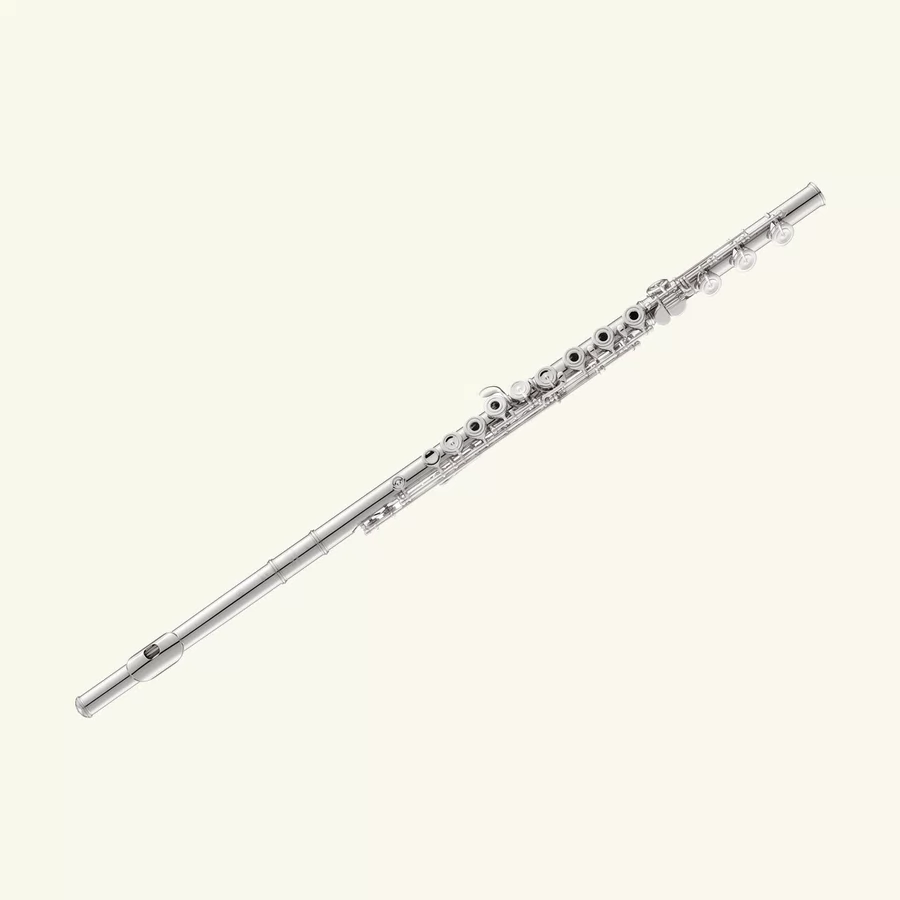
- 1Crown (head screw) crown
The cap at the closed end of the headjoint. Leave it alone: turning it can move the reflector inside.
- 2Cork and reflector cork & reflector
Hidden beside the embouchure hole, 17 mm from its center. It keeps the octaves in tune, especially the third octave.
- 3Headjoint head joint
The piece where the sound starts. It gets slightly narrower toward the crown end instead of being a perfect tube.
- 4Embouchure hole and lip plate embouchure hole
Your lower lip covers about the lower third of the hole, and the air hits the far edge. The shape of the hole’s cut changes how the flute feels to play.
- 5Body body
The middle piece, holding most of the tone holes and keys.
- 6Key system (Boehm system) keys
Linked keys let one finger close more than one hole. A split E mechanism makes the high E easier to play.
- 7Tone holes and pads tone holes & pads
Each extra open hole raises the pitch by one semitone. Pads seal the holes and should be dried after playing.
- 8Footjoint foot joint
The last piece, with keys for the lowest notes. A C footjoint goes down to C4; a B footjoint adds B3.
Where the Sound Comes From
Blowing across an empty bottle makes a note, and the flute works the same way. Your stream of air hits the far edge of the embouchure hole. The vibrating air in the tube pushes that stream out of the hole, then pulls it back in, over and over, like a flag flapping in the wind.
The flute works like a recorder. The difference is that a recorder has a fixed channel that aims the air for you, while on the flute your lips shape and aim the air. With no reed to help, a small change in the air’s direction changes the sound a lot.
The flute is open to the outside air at both ends: at the embouchure hole and at the far end. A tube open at both ends can sound a full ladder of notes at 2, 3, 4… times the lowest frequency. The longest sound wave it holds is about twice the flute’s length. A clarinet, closed at one end, has stronger odd-numbered overtones in its low register instead. Strictly, the pressure node sits a little beyond each open end, about 0.6 times the tube’s radius; this is called the end correction.
There are two ways to change the pitch. First, open a hole: it is like cutting the tube shorter, so the note goes up. On a Boehm flute each extra open hole raises the pitch by a semitone. Second, keep your fingers still and change how you blow: faster air, a smaller lip opening and a shorter distance to the edge make the note jump to a higher resonance. Holding the fingering for C4, you can play C4, C5, G5, C6, E6, G6, A♯6 and C7, like climbing the steps of one staircase. Older Baroque and Classical flutes also used cross-fingering: closing a hole below the first open one.
Why can’t the flute go up forever? A row of open holes acts like a sieve. Low sounds are reflected at the open holes and stay in the tube, but very high sounds get past them and keep traveling down the tube. On a Boehm flute this dividing line, the cutoff frequency, is a little above 2,000 Hz. Above it, the tube can’t hold the sound as well and the resonances get weaker.
Inside the headjoint, the short pocket of air between the cork and the embouchure hole acts like a small spring. Placing the cork 17 mm from the center of the hole, plus the slightly narrowing headjoint, keeps the octaves in tune; Boehm found this by trial and error. Played softly, the flute sounds almost like a pure sine wave (the simplest sound, with no overtones). The louder it gets, the less it sounds like one.
Try it: blow across the mouth of an empty glass bottle until you find the angle that makes a note. Pour in a little water so there is less air inside, then blow again. Did the note go up? Less vibrating air gives a higher note. Opening a tone hole on a flute does the same thing: it makes the vibrating air column shorter.
How to Play
The flute family is the only one in a band held sideways. Sit up tall and relax your shoulders and elbows. Rest the flute against the base of your left index finger, where it joins the hand, and watch where your thumbs go. Keep your wrists curved like the letter C, and don’t tilt your head toward the flute on your right. Some teachers suggest letting your arms slope down a little instead of holding them flat.
Cover about the lower third of the embouchure hole with your lower lip, keep your mouth centered, and blow toward the far edge as if smiling slightly. Turn the headjoint until the sound comes easily. Beginners often start with the headjoint alone. One teacher suggests blowing down toward your lap rather than straight across.
For high notes, make the lip opening smaller and the air faster. For low notes, open the lips more and slow the air. Rolling the headjoint in makes the pitch lower and rolling it out makes it higher, so a headjoint turned too far in tends to sound flat.
Start each note with your tongue, as if saying “too”; it sounds clearer than “foo.” For very fast notes, flutists use double tonguing (ta-ka, te-ke, tu-ku) or triple tonguing (te-ke-te, ta-ka-ta). Flutter tonguing rolls an R with the tip of the tongue, or in the throat like gargling, to make the note buzz.
Flutists are especially good at harmonics: using a low fingering to play a higher natural overtone, marked with a small circle above the note. Whisper tones are played with the lips barely open and very gentle air, letting single overtones sound by themselves; they can reach C8, the highest note a flute can make. Multiphonics use special fingerings to sound two or more notes at once. On an open-hole flute you can slowly uncover the holes and rings for a smooth glissando (slide); covered keys can slide too, but not as smoothly.
- Steady air, so the pitch and volume stay still: a straight, clean sound.
- Movements of the diaphragm, throat and lips make the note gently pulse. Hear it without vibrato first, then with it; on the flute the difference is especially clear.
- Touch the tongue as if saying “too” and let go at once, for short, separated notes.
- A smaller lip opening and faster air lift the sound into a higher register: A4 to A5 is exactly one octave.
Range and Notation
Flute music is written in the treble clef, and the flute does not transpose: a written C4 sounds as C4, middle C.
The lowest note is C4. With a B footjoint you also get B3, though the high notes respond a little less easily. Music usually goes up to about C7, roughly three octaves, and skilled players can reach D7 or even higher.
Each register has its own color. The low register (B3–B4) can sound dark and hollow. The middle register (C5–B5) is soft, light and bright. The high register (C6–D7) is brilliant, and can turn shrill. The lowest octave has the most tone colors, but when played very softly it does not carry far.
Other members of the family do transpose. The piccolo is written an octave lower than it sounds: a written D4 sounds as D5, and its sounding range is D5–C8. The alto flute sounds a perfect fourth lower than written: a written C4 sounds as G3.
Listen
- The bottom note of a flute with a C footjoint. Listen for its darker, hollow sound with few overtones.
- Soft, light and bright: the middle register of the flute.
- Near the top of the usual range. Brilliant, with a hint of sharpness.
- One flute across three octaves. Hear the color change from dark to bright.
History and Family
Side-blown flutes are very old. By the 2nd century BCE they were found in ancient Greece and Etruria, and later in India, China and Japan. The Chinese di goes back to about the 5th century BCE, and museums classify it in the same group as the Western flute (421.121.12), even though many di have an extra hole covered by a thin membrane. Until about the middle of the 18th century, “flute” in Europe often meant the recorder; the sideways one was called flauto traverso in Italian, “the flute held across.”
In the 16th century, flutes were made in sets in D, G and C. They had a cylindrical tube, one mouth hole and finger holes, and no keys, so only some semitones were possible. In the late 17th century the Hotteterre family made a flute with one key and a conical bore. For the first time almost every semitone could be played; today we call it the Baroque flute.
In 1681 a Hotteterre flute (range D4–G6) played in Lully’s opera orchestra, the flute’s first appearance in this kind of orchestra. Quantz (1697–1773) invented a tuning slide, tried tone holes of different shapes and sizes, and added another key. By around 1800 the flute already had several keys, and its foot reached down to C.
The big change came from Theobald Boehm (1794–1881) of Munich, a goldsmith’s son who became a Munich court musician in 1818 and opened a flute workshop in 1828. In 1832 he made the first flute with its holes placed by acoustics rather than by what was easy for the fingers; it still had a conical bore, with keys and ring keys. In 1847 he presented a cylindrical tube with a parabolic headjoint, felt pads in the key cups and larger holes. That is basically the modern flute, and it won many prizes, including at the 1855 Paris World’s Fair.
The piccolo grew out of the 17th-century military transverse flute. Beethoven used it for the storm in his Pastoral Symphony (1808), and Verdi for the lightning in Rigoletto (1851).
- c. 5th c. BCEThe Chinese di (according to Britannica)
- 2nd c. BCESide-blown flutes in ancient Greece and Etruria
- 16th c.Sets of flutes in D, G and C: cylindrical tube, finger holes, no keys
- Late 17th c.Hotteterre family: one key, conical bore (the Baroque flute)
- 1681The flute plays in Lully’s opera orchestra, its first time in such an orchestra
- c. 1800Several keys; foot extended down to C
- 1808Beethoven’s Pastoral Symphony uses the piccolo for the storm
- 1832Boehm’s first flute with holes placed by acoustics
- 1847Boehm’s cylindrical flute: basically the modern flute
- 1851Verdi’s Rigoletto uses the piccolo for lightning
- 1855Boehm flute wins a prize at the Paris World’s Fair
Getting Started and Care
The joints of a flute are metal sliding into metal, fitted to within a few thousandths of a millimeter. Never put cork grease or any oil on them: grease collects dust, which can damage the joints and in bad cases make them stick together. If a joint gets tight, wipe it clean inside and out with a cloth; if it is still tight, ask a music shop to look at it.
Because the flute is blown across the hole, about two thirds of your air goes outside the instrument, so it needs more air than even a euphonium or tuba. Flutists are also prone to neck pain and carpal tunnel problems, so watch your posture. Practice in front of a mirror: a triangle of moisture on the lip plate is a sign of a good sound.
- After playing, thread gauze through the cleaning rod, cover its metal tip and wipe the moisture out of each tube.
- If the pads are damp, put cleaning paper between pad and hole and press the key lightly a few times; move the paper and repeat 2–3 times, without letting it slip. Use powder paper if a pad sticks.
- Wipe the outside gently without pressing the keys. Silver turns dark when it combines with sulfur in the air; if dark spots won't come off with the polishing cloth, try a silver cloth. Playing every day also helps prevent tarnish.
- Each week, clean under the keys with a tone-hole cleaner. Each month, check for loose screws (have a shop adjust them) and put a tiny drop of key oil where keys move, press the keys a few times, then wipe off any extra.
- Don't turn the crown, and don't push hard inside the head joint with the cleaning rod: the reflector inside can move and the flute will be hard to play in tune. If it suddenly gets hard to play in tune, put the cleaning rod into the head joint and check that its line sits in the middle of the embouchure hole; if not, have a shop adjust it.
- Flute acoustics: an introduction (UNSW Music Acoustics)
- Flute C4 fingering (UNSW Music Acoustics)
- Concert flute (Vienna Symphonic Library Academy)
- Piccolo (Vienna Symphonic Library Academy)
- Flute family (Timbre and Orchestration Resource)
- Concert flute (Grinnell College Musical Instrument Collection)
- Flute: origins (Yamaha Musical Instrument Guide)
- Flute: how sound is produced (Yamaha Musical Instrument Guide)
- Flute: how to play (Yamaha Musical Instrument Guide)
- Flute: choosing keys (Yamaha Musical Instrument Guide)
- Flute: daily care (Yamaha Musical Instrument Guide)
- Flute: regular care (Yamaha Musical Instrument Guide)
- First-year flutes: keys to success (Yamaha Music Hub)
- Flute (Britannica)
- Theobald Boehm (Britannica)
- Alto flute (Grinnell College Musical Instrument Collection)
- Flute family relatives (Yamaha Musical Instrument Guide)
- Flute materials (Yamaha Musical Instrument Guide)
- Transverse flute; di (Horniman Museum)
- Di (Britannica)
- Yamaha Musical Instrument Guide: Check the reflective plate
Piano sound: Salamander Grand Piano by Alexander Holm (CC BY 3.0).