
Trumpet: parts, how the sound works and how to play
The trumpet is a brass instrument with a bright, powerful sound. It has no reed and no strings: its sound starts with your lips. This page shows its parts, where the sound comes from, and how to play it.
In this lesson
Meet the trumpet
The trumpet is a brass instrument. You press your lips against a cup-shaped mouthpiece and make them vibrate, and that starts the sound. Its body is one bent metal tube, with the mouthpiece at one end, a flaring bell at the other, and three spring-loaded valves in between.
Stretched out straight, the tube of a B♭ trumpet is about 1.4 to 1.5 metres long. Most of it is cylindrical, which means it stays about the same width, like a drinking straw, before it opens into the bell.
Trumpets come in several keys. B♭ is by far the most common, and C may be the second most common, used mostly in orchestras. Trumpets in D, E♭ and other keys are for special jobs. This page is about the B♭ trumpet.
- Family
- Brass
- Classification
- Hornbostel–Sachs 423.233.1: valve trumpet with a short air column (under 2 m)
- Sounding range
- About E3 to B♭5 in everyday use; skilled players go higher
- Written range
- About F♯3 to C6
- Clef
- Treble clef
- Transposition
- B♭ instrument: written C sounds B♭ (a major second lower)
- Tube length
- About 1.4–1.5 m if straightened
- Valves
- Three
Parts of the trumpet
The trumpet looks like it bends in every direction, but it is really one tube that winds from the mouthpiece to the bell. The parts below follow the path your air takes.
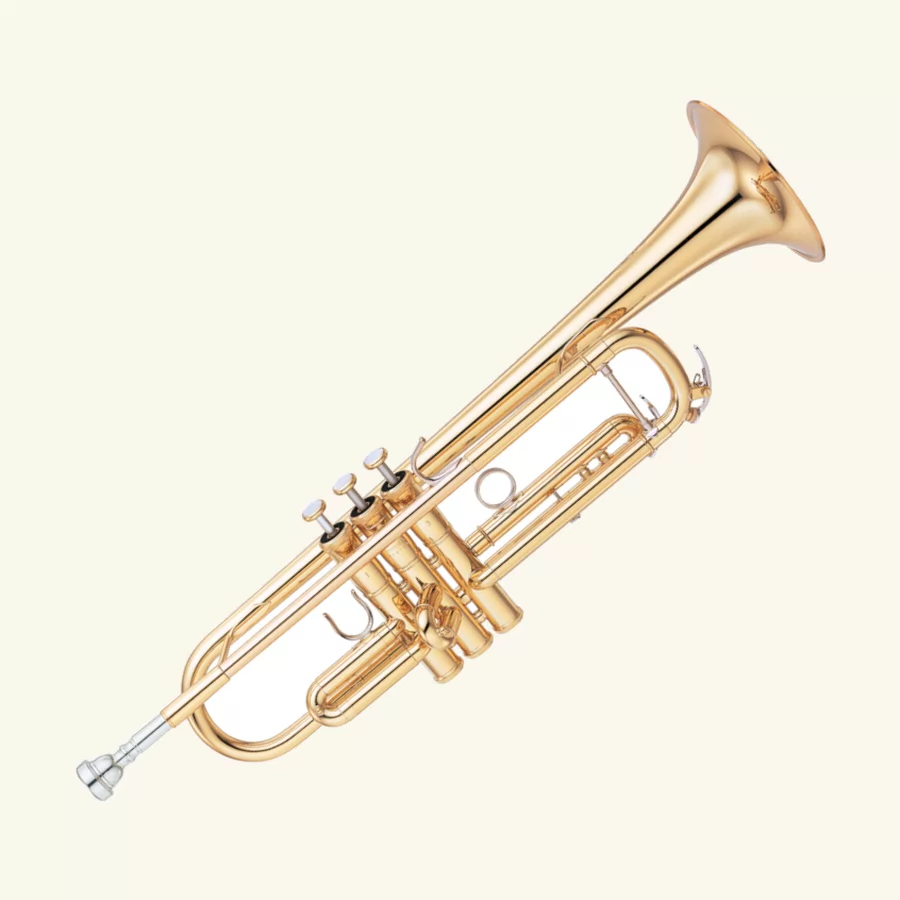
- 1Mouthpiece mouthpiece
Your lips vibrate on it. A deep cup gives a rounder sound, a shallow cup a brighter, sharper one.
- 2Leadpipe leadpipe
The first stretch of tube after the mouthpiece. Your right thumb rests under it, and it carries a small ring for the little finger.
- 3Valves 1, 2 and 3 piston valves
Pressing one sends the air through an extra loop, so the tube gets longer and the note gets lower.
- 4Valve casings valve casings
The tubes the valves slide up and down in. They need valve oil.
- 51st and 3rd valve slides with rings 1st / 3rd valve slides, triggers
Your left thumb pushes the 1st slide and your left ring finger the 3rd, to fine-tune a note.
- 6Main tuning slide main tuning slide
A bend of tube you slide in or out to tune the whole instrument.
- 7Water key water key
Lets out the water that collects inside the tube.
- 8Bell bell
Sends the sound out into the room and helps line up the low notes into a neat series.
Where the sound comes from
Your lips work like a tiny door that opens and shuts very fast. Each time it opens, a little puff of air goes in, and the air inside the tube starts to vibrate. Lips alone only make a buzz; the trumpet picks out certain notes from that buzz and sends them out of the bell.
A tube can only hold a set of notes steadily, called the harmonic series: a ladder of notes from low to high, with the rungs getting closer as you climb. A plain cylinder closed at one end would only give rungs 1, 3, 5, 7 and so on, like a ladder missing half its steps. The trumpet's mouthpiece and bell change the shape of the tube so that the second and higher resonances line up as 2, 3, 4, 5… and the ladder is complete.
Think of the bell as a ramp that slowly widens. Low notes have long waves, and they bounce back before they reach the very end of the bell, as if the tube were a little shorter. That pulls the low resonances into line. The bell also lets the high sounds out into the room.
With no valves pressed, written C4, G4 and C5 all use exactly the same fingering. Only your lips are different. Your lips can only stand on one rung of the ladder at a time: vibrate slower to step down, faster to step up.
The ladder has gaps between its rungs, and the valves fill them in, a bit like clipping an extra length onto a garden hose. Valve 1 lowers the note by a whole tone, valve 2 by a semitone, and valve 3 by a tone and a half (a minor third). Yamaha says the three extra loops add about 160, 70 and 270 mm. Together the three valves can lower a note by up to six semitones, so with the harmonic steps you can play every semitone.
To go down a semitone, the tube must get about 6% longer, so it works like a discount given in percent: the longer the tube already is, the more length you need. That is why valve combinations come out sharp, worst of all when valve 3 is involved. Players push the 1st or 3rd valve slide, or adjust with their lips, to bring the note back in tune.
When you play softly, your lips don't have time to close fully, so the sound is rounder. When you play loudly, your lips snap shut on every cycle, adding lots of high harmonics, and the sound turns bright and edgy. From soft to loud, the lowest harmonic rises only about 8 dB, while the 9th and higher harmonics rise by more than 45 dB. It is like clapping: a gentle clap is dull, a hard clap is a sharp crack.
Try it: close your lips gently and blow so they buzz. Relax, then tighten the corners of your mouth a little and hear the buzz go higher. Then roll a sheet of paper into a tube, buzz into one end, and listen to how the sound changes.
How to play
Hold the trumpet steady with your left hand: the ring finger goes in the 3rd-slide ring and the other fingers wrap around the valve casings. If there is a thumb ring on the 1st slide, your left thumb goes there. Your right hand rests lightly: the thumb under the leadpipe between valves 1 and 2, and the index, middle and ring fingers on valves 1, 2 and 3. Keep your shoulders relaxed.
Let your right little finger hover above the leadpipe ring instead of hooking it. Pulling the trumpet against your face with that finger lets pressure take the place of a good lip setting.
Take a deep breath, close your lips gently and breathe out steadily without puffing your cheeks. Start with the mouthpiece alone: if your lips buzz, you are doing it right. Don't press the mouthpiece hard against your lips while you play.
There are three ways to change the note: change harmonics by making your lips vibrate faster or slower (Yamaha practises low, middle and high with "toh", "tay" and "tee"); press valves to change the tube length; and use the slides and your lips to fix the tuning.
In a slur you don't tongue the next note; the air keeps flowing straight into it. A lip slur moves between neighbouring harmonics with the lips only, without changing fingering; going back and forth quickly is a lip trill.
Double tonguing ("ta-ka") and triple tonguing ("ta-ta-ka" or "ta-ka-ta") give very fast repeated notes. Flutter tonguing rolls an "rrr" while you blow and sounds rough and growly. The jazz shake is a very fast lip slur between the written note and the next harmonic up.
- Put the tip of your tongue just behind your upper front teeth and release the air as if saying "too". Every note gets a clear start. This short note sounds D5 (written E5).
- The faster your lips vibrate, the higher the note. Listen from the low register (sounding A3) to the middle (B♭4) to very high (C6).
- A mute placed in the bell makes the bell less efficient at sending sound out, and the tone changes. First the open note, then the same note with a Harmon mute.
- Vibrato is one of the trumpet's playing techniques. First a straight long note, then the same note with vibrato.
Range and notation
Trumpet music is written in the treble clef. The B♭ trumpet is a transposing instrument: the written note is a major second (two semitones) higher than the note you hear. Easy way to remember it: written C sounds B♭.
For example, written C5 sounds B♭4, and written C4 (the open second harmonic) sounds B♭3. The other way round: when a piano plays C, a B♭ trumpet must read a written D to match it. A C trumpet does not transpose: it sounds as written.
In everyday use the B♭ trumpet sounds from about E3 to B♭5, which is written F♯3 to C6. The lowest note uses all three valves: written F♯ below the treble staff, it sounds E3. Many professional players can extend the top much higher.
Below the lowest note there are "pedal notes". They don't match the trumpet's normal resonances, but good players can still make them sound.
Listen
- Down here the trumpet sounds darker and thicker.
- A note you can play with no valves pressed. Listen for the typical bright trumpet sound.
- A whole tone above the top of the everyday range (written C6). Hear how bright the high register is.
- The same B♭4 twice. Compare how the tone changes with the mute in.
- Listen to the clear start the tongue gives the note.
History and family
The trumpet's ancestors go back thousands of years. People on every continent made them from wood, bamboo, bark, clay, bone and metal, and they are thought to have been used in religious and magical rituals. Metal trumpets existed in Egypt in the second millennium BCE, as small ceremonial or military instruments that played only one or two notes. Tutankhamun's tomb held two trumpets, dating to at least 1323 BCE.
The ancient Greeks and Romans used trumpets for military signals; only in the Middle Ages did the trumpet become an important musical instrument. A medieval straight trumpet was nearly 2 m long. Around 1400 the tube was bent into an S shape, and around 1500 it became the long loop we know today.
These trumpets had no valves. They are called natural trumpets and could only play the notes of the harmonic series. By about 1600, court trumpeters could play melodies in the high "clarino" register, and they could change key by adding an extra length of tube called a crook. In 1638 G. Fantini published the first printed trumpet method.
To play every semitone, Anton Weidinger, a trumpeter in the Vienna court orchestra, added keys to the tube. Haydn and Hummel wrote concertos for this keyed trumpet, which became popular in Austria and Italy after 1801. Valves changed everything: around 1815 Heinrich Stölzel and Friedrich Blühmel in Berlin introduced them, and valved trumpets appeared in the 1820s. The Périnet piston valve, patented in Paris in 1838, developed Stölzel's design further. From the mid-19th century, B♭ and C trumpets became the main ones.
The cornet appeared in the 1820s; it has a deeper mouthpiece and a warmer sound. Early jazz used the cornet, and Louis Armstrong started on it before switching to the trumpet for good in 1926. Other relatives include the flugelhorn, piccolo trumpet, pocket trumpet and rotary trumpet. Around 1890 Victor Mahillon in Belgium made a D "Bach trumpet" for the high trumpet parts in Bach and Handel.
- 2nd millennium BCEMetal trumpets in Egypt play one or two notes
- by 1323 BCETwo trumpets placed in Tutankhamun's tomb
- c. 1400The straight tube is bent into an S shape
- c. 1500The trumpet takes on its long looped shape
- c. 1600Court trumpeters play melodies in the high clarino register
- 1638Fantini publishes the first printed trumpet method
- after 1801The keyed trumpet becomes popular in Austria and Italy
- c. 1815Stölzel and Blühmel in Berlin introduce valves
- 1820sValved trumpets and the cornet appear
- 1838The Périnet piston valve is patented in Paris
- c. 1890Mahillon makes the D "Bach trumpet"
- 1926Louis Armstrong switches from cornet to trumpet for good
Getting started and care
One view is that young players can start on the cornet: the distance from mouthpiece to bell is shorter, so your hands sit closer to your face and it feels less awkward to hold. If a normal trumpet feels too big, a pocket trumpet may be easier to play, but some models have a smaller bell or bore.
When you start, avoid puffing your cheeks, pressing the mouthpiece too hard against your lips, placing the mouthpiece far off to one side, and pulling the trumpet against your face with your little finger. Another common mistake is assuming the instrument comes perfectly in tune from the factory.
Water collects inside the tubing as you play. If it stays in a slide for a long time it can slowly corrode the metal, so clear it out after every session.
- After playing, hold down the matching valve and pull out a slide to pour out the water. A "pop" means you did it the wrong way.
- Let water out through the water key, then use a cleaning swab to clear water and dirt from inside the tubing.
- Oil the valves: unscrew the cap, slowly pull the valve halfway out without turning it, add 2–3 drops of valve oil, screw the cap back on, and press the valve up and down two or three times.
- Wipe the outside lightly with a polishing cloth before putting the trumpet in its case.
- Valves can get sticky if they are not oiled properly, so clean and oil them regularly.
- Silver plating turns dark even if you wipe it daily. It is a natural reaction with sulphur in the air and in sweat, and does not affect playing.
- Most mutes make the trumpet play sharp, and some make it flat. Learn how each of your mutes affects your tuning: adjust the main tuning slide during rests, or, if there is no time, use the valve slides or your lips.
- Britannica: Trumpet
- Britannica: Valve (music)
- UNSW Music Acoustics: Brass instrument (lip reed) acoustics
- Yamaha Musical Instrument Guide: Trumpet origins
- Yamaha Musical Instrument Guide: Trumpet family
- Yamaha Musical Instrument Guide: How the trumpet makes sound
- Yamaha Musical Instrument Guide: Playing the trumpet
- Yamaha Musical Instrument Guide: Trumpet maintenance
- JMU Brass Pedagogy: Basic articulation
- Yamaha Music Hub: What's the difference between a trumpet and a cornet?
- Grinnell College Musical Instrument Collection: Trumpet
- JMU Brass Pedagogy: Trumpet set-up
- JMU Brass Pedagogy: Why the math doesn't add up
- UTC: Special considerations for trumpeters
- Vienna Symphonic Library: Trumpet in C
- Britannica: What is the oldest brass instrument?
- Yamaha Musical Instrument Guide: Trumpet trivia (keyed trumpet)
- JMU Brass Pedagogy: Partials and overtones
- JMU Brass Pedagogy: Adding the mouthpiece
- JMU Brass Pedagogy: Intonation and ranges
Piano sound: Salamander Grand Piano by Alexander Holm (CC BY 3.0).