
Clarinet: parts, how it sounds and how to play
The clarinet is a woodwind that makes its sound with a single reed, and its voice runs from warm and dark to bright and clear. Its most unusual trick: press one key and the note jumps up a twelfth, not an octave like a flute. This page is mostly about the most common one, the B♭ clarinet.
In this lesson
Meet the clarinet
The clarinet belongs to the woodwind family. A reed sits on the mouthpiece, and the body is a tube that stays mostly the same width all the way down, a cylinder. Keys and tone holes along the tube change the note.
The clarinet is really a whole family. The B♭ clarinet is the most used, about 66 cm long. Orchestras also need the A clarinet, about 71 cm long, which uses the same fingerings and the same mouthpiece. The small E♭ clarinet is about 49 cm long and sounds a fourth higher than the B♭, while the bass clarinet is about twice as big and sounds an octave lower.
Each one sounds a little different. The B♭ clarinet is glossy, bright, rich and clear. The A clarinet is softer and less forceful. The C clarinet is brighter, colder and harder, and is rarely used today.
- Family
- Woodwind (single reed)
- Type
- Hornbostel–Sachs 422.211.2: single reed, cylindrical bore, finger holes
- Sounding range
- D3 to B♭6 (written E3 to C7)
- Clef
- Treble clef
- Transposition
- B♭ clarinet: sounds a major second (a whole step) lower than written
- Common sizes
- B♭ about 66 cm; A about 71 cm
Parts of the clarinet
A clarinet comes apart into five pieces: mouthpiece, barrel, upper joint, lower joint and bell. Before you play, you fit them together one by one and then put the reed on.
The body is made of African blackwood (grenadilla), hard rubber or metal; grenadilla is the most common clarinet wood today. Clarinets are also made of ABS resin, a plastic that is very strong and stands up well to changes in humidity.
Some parts sit inside or behind the instrument where the picture cannot show them; their numbers mark roughly where they are.
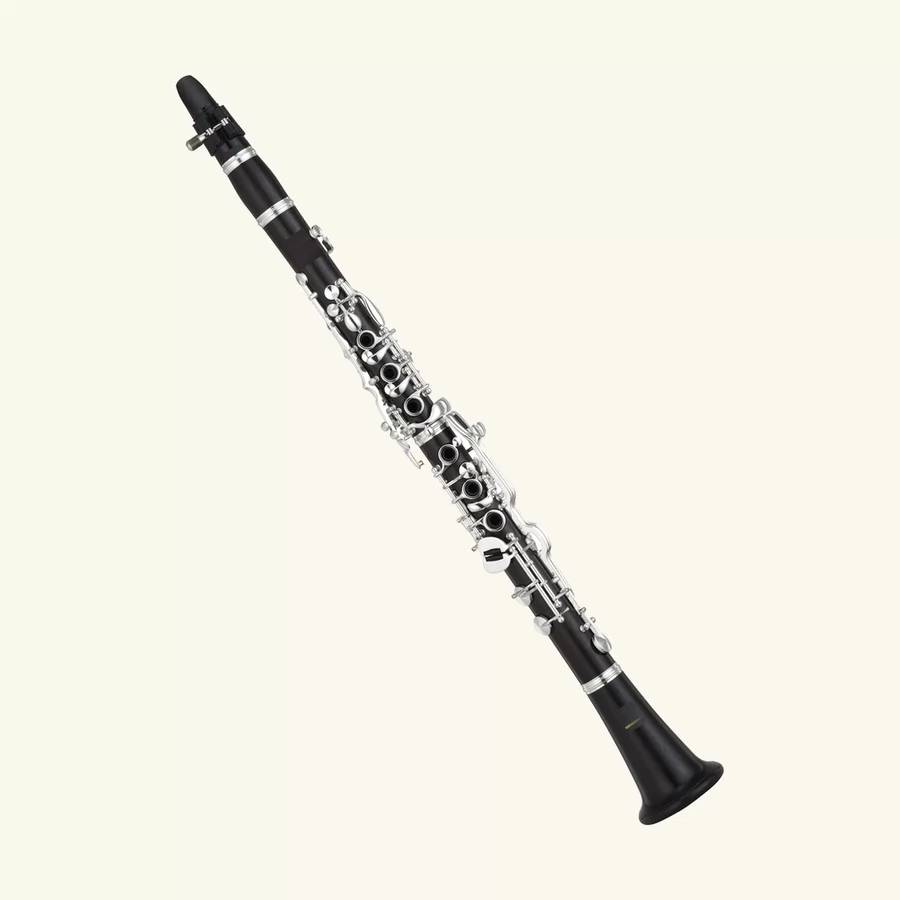
- 1Reed reed
A thin blade of cane (Arundo donax). It is the sound's on-off switch: blown by your breath, it opens and closes very fast.
- 2Ligature ligature
The clamp that holds the reed on the mouthpiece. Set the reed in place and line up the ligature before you tighten it.
- 3Mouthpiece mouthpiece
The beak-shaped tip that goes in your mouth, made of hard rubber (ebonite) or cocus wood.
- 4Barrel barrel
The short piece under the mouthpiece that bulges like a little barrel. It joins the mouthpiece to the upper joint.
- 5Tenon corks tenon cork
Rings of cork on each joint where the pieces slide together. Grease them a little before you assemble; the cork wears out and needs replacing every year or two.
- 6Upper joint upper joint
The piece your left hand plays. It has the register key, pressed with the left thumb, that makes the note jump a twelfth.
- 7Tone holes and keys tone holes & keywork
About 24 tone holes run along the body. The standard Boehm clarinet has 17 keys and 6 rings; keys are nickel silver, brass, silver or gold.
- 8Lower joint lower joint
The piece your right hand plays. On the back is the thumb rest, where your right thumb holds up the whole instrument.
- 9Bell bell
The flared end. It helps the sound get out of the tube, and for the lowest notes it works like extra tube length.
Where the sound comes from
When you play, you blow air that is only a little above the pressure of the air around you, about 3% more. The reed works like a tiny door that swings by itself: your breath pushes it toward the mouthpiece and narrows the gap. The reed flaps between open and shut so fast that a steady stream of air turns into quick puffs, and that shaking is the sound.
Blow hard enough and the reed is pushed completely shut, so no air gets through at all. It is like squeezing a garden hose flat: the water stops. That is why a high note that will not come out is often not a lack of air.
The mouthpiece end is almost sealed by the reed, and the bell end is open, so the clarinet acts like a tube closed at one end and open at the other. In a tube like that, the longest sound wave is about four times the tube's length, a bit like a long rope only fitting one big slow swing. That longest wave gives the lowest note: sounding D3 (written E3).
Every musical note hides a row of quieter, higher notes called overtones. On the clarinet's low notes, the 1st, 3rd and 5th members of that row (the odd ones) are especially strong and the even ones are weak, like a comb with every other tooth cut short. That gives the low register its hollow sound. Around the middle (the throat notes) the even ones matter more, and once the register key is open the difference almost disappears, so the sound turns bright and clear.
Pressing the register key opens a small hole about one third of the way along the closed part of the tube. The note then jumps to three times the frequency: a twelfth higher, which is an octave plus a perfect fifth. Think of a jump rope with someone lightly pinching it one third of the way along, so it swings in three loops instead of one.
Starting from the bell end, each tone hole you open moves the vibrating part closer to the mouthpiece, as if you trimmed about 6% off the tube, and the note rises one half step.
The throat notes have only two resonances in the tube that line up well, so they are easier to bend out of tune, and they sound a little weaker and duller. In the famous upward slide that opens Rhapsody in Blue, experts tune the resonance inside their mouth to be as strong as the tube's, or stronger, for the last octave (written C5 to C6, sounding B♭4 to B♭5). It is a bit like changing the shape of your mouth to change the note when you whistle.
Try it: in "Listen" below, play B♭3 and then F5. On a clarinet they share the same fingering; the only difference is the register key. Now count up from B♭3 on a keyboard: F5 is not just one octave up (that would be B♭4), you go on up to the next F. That is a twelfth.
How to play
Keep your shoulders relaxed and your fingers gently curved. Only your right thumb holds the clarinet up, resting under the thumb rest in a natural C shape; don't keep it bent backward. Face straight ahead and don't puff out your cheeks. The angle between the clarinet and your body changes the tone: a smaller angle sounds more focused, but your lower lip may press too hard.
The most common way to form your mouth is the single-lip embouchure: your lower lip gently covers your bottom teeth, and your top teeth rest firmly on the mouthpiece. Take in just the right amount of mouthpiece, like using a straw: too little and it is hard to get a sound, too much and the sound breaks up. Some players use the double-lip embouchure instead, with the lower lip over the bottom teeth and the upper lip over the top teeth. Some teachers start with double-lip and switch to single-lip once it is steady.
Your fingers cover and uncover tone holes and ring keys to change the length of the tube. Press the register key with your left thumb and the same fingering sounds a twelfth higher: written C4 becomes written G5 (sounding B♭3 becomes F5). For the very highest notes, the hole under your left first finger is also used as a register hole.
To bend a note, change where your tongue sits (the closer the middle of your tongue is to the reed, the lower the note), not by dropping your jaw. A clarinet note can only bend downward: about a quarter tone in the low register, and up to about a half step in the middle register. For high notes, don't bite down, which squeezes the reed shut; teachers suggest pushing the clarinet up with your right thumb and pointing your chin down instead.
There is much more to explore. Legato changes notes with the fingers only, no tongue, and slurred leaps of a third to a sixth are typical clarinet writing. A trill or tremolo swaps two notes fast; a glissando slides by partly covering holes or changing fingerings; flutter tonguing rolls an R while you blow; multiphonics use special fingerings to sound two or more notes at once. Double and triple tonguing are rarely used, because the reed gets in the tongue's way.
- Touch the tip of the reed lightly with the tip of your tongue, saying "da" rather than "ta", so each note starts clearly. Here, short tongued notes on sounding F4 (written G4).
- The same fingering without and with the register key: sounding B♭3 (written C4), then F5 (written G5).
- With every hole covered the whole tube sounds, giving the lowest note, sounding D3 (written E3).
Range and written music
Clarinet music is written in the treble clef. The B♭ clarinet is a transposing instrument: what you hear is a whole step (a major second) lower than what is written. So a written C4 sounds as B♭3, and a written D4 sounds as C4.
The B♭ clarinet is written from E3 to C7 and sounds from D3 to B♭6; in the orchestra it usually goes no higher than sounding G6. Other family members transpose differently: the A clarinet sounds a minor third lower than written and the E♭ clarinet a minor third higher. The bass clarinet sounds a major ninth lower when written in treble clef and a major second lower in bass clef, and reaches down to sounding B♭1.
The range splits into registers with different colors (sounding pitch, written in brackets): the low chalumeau register D3–E4 (E3–F♯4) is dark, full, soft and warm; the throat register F4–A♭4 (G4–B♭4) is a little weaker and duller; the clarinet register A4–F6 (B4–G6) is bright, glossy and focused; the top notes G♯6–B♭6 (A♯6–C7) are shrill and piercing.
Listen
- A dark, hollow low note. In the low register the odd overtones are especially strong.
- Sounding B♭3 (written C4), then F5 (written G5): the same fingering plus the register key. The note leaps a twelfth and the tone gets brighter.
- Short tongued notes in the throat register. Listen for a lighter, slightly duller sound.
- A note in the clarinet register: bright, glossy and focused.
History and family
The clarinet grew out of the chalumeau, a single-reed instrument that usually had 8 finger holes and a range of only about one octave. It could play almost only low notes.
Around 1700, in the early 18th century, the Denner family of Nuremberg added two keys to the chalumeau. The credit usually goes to the father, Johann Christoph Denner (1655–1707), who is generally regarded as the inventor of the clarinet. The name clarinet means "little trumpet", perhaps because of its bright high notes. Two-key clarinets stayed in use until about 1770.
The clarinet was the last woodwind to join the orchestra, in the Viennese Classical period of the later 18th century. In 1791 Mozart wrote his Clarinet Concerto in A major, K. 622, for the clarinettist Anton Stadler; he finished it on 7 October, and it was first played in Prague on 16 October. It was written for a basset clarinet that reached four half steps lower. The original manuscript is lost, and the versions that survive rewrite the solo so an ordinary A clarinet can play it.
In 1812 Iwan Müller brought out a thirteen-key clarinet, a milestone for all modern clarinet keywork, and the thumb rest became standard after him.
In the early 1840s the Paris clarinettist Hyacinthe Klosé and the maker Louis-Auguste Buffet borrowed the ring keys Theobald Boehm had invented for the flute, and patented their clarinet in 1844. It is called the Boehm system because of Boehm's idea, but Boehm did not design it himself. The Boehm system is now the most common in the world; German-speaking countries use the 22-key Oehler system that Oskar Oehler developed in 1900.
In 1838 Adolphe Sax made a bass clarinet with large keys and a straight body, the kind used today. Rhapsody in Blue was first performed in New York on 12 February 1924. Its opening was written as a fast scale, but the clarinettist Ross Gorman jokingly played it as a long slide in rehearsal; Gershwin liked it, and the slide stayed.
- About 1700The Denner family of Nuremberg adds two keys to the chalumeau
- 1791Mozart finishes the Clarinet Concerto K. 622 for Anton Stadler
- 1812Iwan Müller's thirteen-key clarinet
- 1838Adolphe Sax's straight bass clarinet
- 1844Klosé and Buffet patent the Boehm-system clarinet
- 1900Oskar Oehler's 22-key German-system clarinet
- 1924Rhapsody in Blue opens with its clarinet slide
Getting started and care
The B♭ clarinet is the most used kind: in solos, orchestras and bands. A plastic (ABS resin) clarinet is very strong and doesn't mind changes in humidity; a wooden one can crack when temperature or humidity changes suddenly. Some teachers suggest that if your hands are still small and not yet strong, you can stay longer on the smaller E♭ clarinet instead of playing the B♭ with a support.
Reeds come in strength numbers, and most students start at 2.5. To choose, wet them all and try them one by one, picking the ones that respond easily without much effort; at first, ask someone who plays to pick out the best and the worst, then try them yourself to feel the difference. When you reach high G and above, if a note won't come out and you can't even hear air, the reed is closing off completely, and more air won't fix it; try a reed half a strength harder. If you can hear air, you probably don't have enough mouthpiece in your mouth.
A wooden clarinet needs the most care in winter. When a cold clarinet is suddenly filled with breath at about 36–37°C, the inside warms while the outside is still cold, and it can crack, just as a cold glass can crack when hot water is poured in. The upper joint near the mouthpiece is the most likely to crack. Warm the clarinet inside your coat or against your body until it is near room temperature before you play. Look it over for cracks now and then, and take any crack to a repairer quickly, because cracks slowly spread.
- Put a little cork grease on the tenon corks before assembling, and wipe off the extra before you put it back in the case so it doesn't collect dust.
- After playing, take the reed off the mouthpiece, dry the mouthpiece and put them away.
- Gently pull a clean swab through from the bell upward to remove moisture; if it sticks, pull slowly and never yank.
- Water collects easily at the joints, which can cause cracks, so dry them with a cloth.
- Wipe the outside to remove sweat marks without pressing on the keys, and keep the clarinet out of direct sun, hot cars and away from heaters.
- For the first two weeks with a new wooden clarinet, don't play more than 20–30 minutes at a time.
- UNSW Music Acoustics: Clarinet acoustics, an introduction
- UNSW Music Acoustics: The clarinet glissando in Rhapsody in Blue
- Vienna Symphonic Library: Clarinet
- Vienna Symphonic Library: Bass clarinet
- Yamaha Musical Instrument Guide: How to play the clarinet
- Yamaha Musical Instrument Guide: Clarinet structure and origins
- Yamaha Musical Instrument Guide: Choosing a clarinet
- Yamaha Musical Instrument Guide: Clarinet maintenance
- Yamaha Music Educators Hub: Clarinet pedagogy
- Selmer: Clarinet care
- E. Michael Richards: The Clarinet of the Twenty-First Century, chapter 1
- HSLU Clarinet didactics wiki: Holding the clarinet
- Mozarteum Köchel catalogue: Clarinet Concerto in A, K. 622
- Boston Symphony Orchestra: Mozart Clarinet Concerto
- Ravinia Festival 2018 program book: Rhapsody in Blue
- Horniman Museum: Clarinet (object 14.5.47/30)
- The Met: Clarinet in D (2010.185)
- Gregory Barrett, NIU School of Music: Development of the clarinet
- The Instrumentalist: Embouchure and oral cavity development for clarinetists
- Yamaha Musical Instrument Guide: The modern clarinet
- Yamaha Musical Instrument Guide: How to choose a reed
- Yamaha Musical Instrument Guide: Care after playing
- Yamaha Musical Instrument Guide: Seasonal care
Piano sound: Salamander Grand Piano by Alexander Holm (CC BY 3.0).