
Electric guitar: how it is built, how it sounds, how to play
An electric guitar has six strings like any guitar, but on its own it is hardly loud at all. Pickups on its body turn the shaking strings into electricity, and an amplifier turns that electricity into the sound you hear. Because the sound becomes electricity first, it can be made louder, distorted or changed into all kinds of new colours.
In this lesson
Meet the electric guitar
The electric guitar is a plucked string instrument: you pluck a string with a pick or a finger and it vibrates. The difference is that the vibration is turned into an electric current, and a separate amplifier (an amp plus a loudspeaker) makes the sound. The first electric guitars were hollow, just like acoustic guitars. Today the most common kind has a solid body, because the sound comes from the pickups and the amp, not from a hollow body resonating.
There are also semi-acoustic and hollow electric guitars. Their bodies are hollow, sometimes with a solid wooden block down the middle to hold the pickups and bridge. They sound warmer, but unplugged they are still not loud enough. Another relative is the lap steel (or Hawaiian guitar), laid flat and played with a slide, and the electric guitar's story starts there.
The original 1914 Hornbostel–Sachs system for sorting instruments had no electric instruments; the 2011 MIMO revision added electrophones and put the electric guitar in group 513, electro-acoustic chordophones. By its shape, though, it still belongs with ordinary guitars in group 321.322, necked box lutes.
- Family
- String instrument (plucked, electrically amplified)
- Classification
- Electro-acoustic chordophone, 513 (by shape the same as a guitar, 321.322)
- Sounding range
- E2 to D6 (22 frets) or E6 (24 frets), worked out from the number of frets
- Clef
- Treble clef
- Transposition
- Sounds an octave lower than written
- Common layout
- 6 strings, open strings E2–A2–D3–G3–B3–E4; usually 21, 22 or 24 frets
The parts of an electric guitar
From the headstock to the tail, every part does one of two jobs: it sets how long and how tight the vibrating string is, or it turns the vibration into electricity. Each string is stretched between the nut and the bridge, and the distance between them sets the pitch of the open string. The body is usually one or more pieces of solid wood, most often alder, ash, maple or mahogany.
Sizes differ from model to model. A Fender Player II Stratocaster has a 25.5-inch (648 mm) scale length and 22 frets; a Gibson Les Paul Standard 60s has a 24.75-inch (628.65 mm) scale and 22 frets; an Ibanez RG550 has 24 frets. On some guitars, such as the Telecaster, the neck is bolted to the body with screws, which keeps costs down and makes repairs easier.
A cable plugs into the guitar's output jack and runs to an effects pedal or an amp.
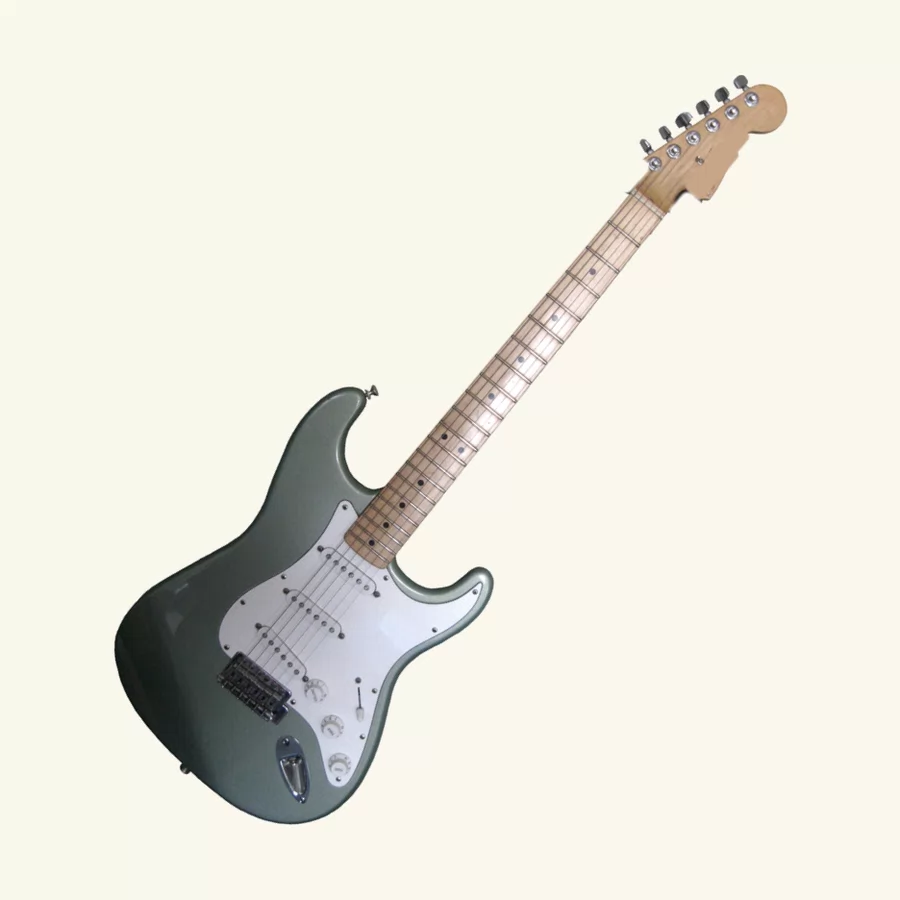
- 1Headstock headstock
The end of the neck, where the tuning machines are mounted.
- 2Tuning machines tuning machines / tuners
Turning one winds the string around a post; tighter means higher. Good ones do not slip when you let go, and some lock the string in place.
- 3Nut nut
A small grooved strip that holds the strings, often hard plastic, bone or a synthetic material. Electric players bend strings a lot, so it must be slippery or the string sticks and goes out of tune.
- 4Neck and fingerboard neck / fingerboard (fretboard)
Where your fretting hand presses the strings. Pressing shortens the part that vibrates, so the note goes up.
- 5Frets frets
Metal strips set into the fingerboard that fix the pitch when you press a string. Their positions are cut precisely by computer-controlled tools.
- 6Body body
Usually solid wood. On a solid-body guitar the sound does not depend on the body resonating.
- 7Pickups pickups
A magnet wrapped in thin copper wire. When a string vibrates above it, the pickup puts out an electric signal.
- 8Pickup selector switch pickup selector switch
Chooses which pickups you hear. A Stratocaster has 5 positions: one pickup, or two together.
- 9Volume and tone controls volume / tone controls
Knobs that adjust the volume and the tone.
- 10Bridge bridge / tremolo (vibrato) bridge
Holds the other end of the strings. A tremolo bridge can move, so a bar can change the string tension and the pitch.
Where the sound comes from
Pluck a string and it swings back and forth. Its pitch depends on three things: length, tension and weight. Press it against a fret and it gets shorter, so it sounds higher; turn the tuner to tighten it and it sounds higher too. With the same length and tension, a heavier string sounds lower, just as a stretched rubber band sounds higher the tighter you pull it.
The frets follow a rule of cutting off about 1/18 of the string length that is left. Each fret raises the note by about 98.9 cents, very close to an equal-tempered semitone of 100 cents, which is why the frets get closer together as you go up, like a staircase whose steps keep getting narrower. Neighbouring strings are a perfect fourth apart, except for the third string (G3) and the second string (B3), which are a major third apart.
The steel strings of an electric guitar are attracted by magnets. A pickup is a magnet wrapped in a coil of fine wire. When a steel string vibrates near the magnet, it changes the magnetic flux through the coil, and by Faraday's law that makes a changing voltage. A bicycle dynamo light works on the same idea: move a magnet and a coil against each other and you get electricity.
That electric signal then goes to the amp. The preamp raises the pickup's signal to line level, which is good for shaping the tone and adding effects; the power amp's master volume sets how loud the speaker plays. Think of it as first making a whisper clear, then handing it to a megaphone.
A string does not just swing as one piece; it also vibrates in two, three, four parts and more at the same time. Those are its harmonics, and each one has points that hardly move, called nodes. If a pickup sits right under a node of one harmonic, that harmonic is suppressed, and the plucking point works the same way, so plucking near the bridge sounds brighter and plucking farther away sounds warmer. It is like a jump rope: the spots in the players' hands barely move while the middle swings widely.
That is why where a pickup sits changes the sound: on a guitar with two humbuckers, the bridge pickup is usually brighter and punchier, and the neck pickup warmer and smoother.
A single-coil pickup is one coil around one magnet: bright and clear, but it easily picks up hum from the mains power (60 Hz in places such as Taiwan and the United States). A humbucker uses two coils wound in opposite directions with opposite magnetic polarity, so outside interference shows up in the two coils roughly equal and opposite and cancels out. It is like two people pushing a door from opposite sides: it does not move.
There are other kinds of pickups too. A P-90 is a single coil with a wider bobbin: more aggressive, with higher output and less hum. Ceramic magnets sound bright and strong, while alnico sounds warmer and more vintage. Most pickups are passive and need no power; active pickups run on a battery in the guitar and give a stronger signal, and a coil split switch turns off one coil of a humbucker so it works like a single coil.
An amp can only amplify so much. Push it past that limit and the tops of the wave get clipped off, and that is distortion. A tube amp gradually rounds the peaks off, while a solid-state amp chops them flat at its supply voltage, which sounds harsher. Distortion adds lots of harmonics, so the sound gets thicker, and the gain knob on an amp controls how much distortion you get: like pouring water into a cup that is too small, whatever is over the top spills away.
Because the sound is electricity, it can pass through effects pedals before the amp. A compressor turns the loud parts down; chorus makes one part sound like two players; delay gives echoes you can hear separately, while reverb uses copies too close together to tell apart, like singing in a bathroom. A common order is distortion first, chorus and delay in the middle and reverb last, but there is no absolute rule.
Try it: stretch a rubber band around an open box. Pluck it right in the middle, then pluck it close to one end. Plucked near the end, it sounds sharper and brighter, for the same reason an electric guitar sounds brighter when you pick near the bridge.
How to play
Most players use a pick. Hold it between the thumb and the side of the index finger, with the index finger pointing toward the tip without sticking out. Grip it firmly but not too hard: too tight and your hand cramps, too loose and the pick wobbles or even flies away. Let more of the pick show for strumming and less for accurate single notes.
Tune before you play. In standard tuning the six strings are E, A, D, G, B, E from low to high, and nearly all the chords and techniques you learn at first use it. Your other hand presses strings just behind a fret: the string gets shorter, and each fret toward the body raises the note by a semitone.
A few techniques make the notes sing. To bend, you push a string up or pull it down; either way the pitch goes up, because the string gets tighter, and bending is easier on an electric than on an acoustic. Vibrato is a tiny bend, about a quarter tone, made again and again, like the wobble in a singer's long note; it adds sustain and expression.
A hammer-on is when a fretting finger strikes the string onto a fret like a little hammer to sound a note; a pull-off is when the finger flicks the string as it lets go, moving to a new pitch. Both change the note with only the fretting hand, and they are often used together. To slide, you play a note and glide your finger along the same string to another fret, or wear a metal slide on a finger.
The picking hand can change the sound too. For palm muting, rest the edge of your palm on the strings near the bridge so notes come out short and choppy (staccato). If the guitar has a tremolo bridge, pressing or pulling the bar makes the pitch dip and rise, and a double-locking tremolo can change the pitch a lot and still come back in tune.
- Pluck the thickest string without pressing anything: E2, the lowest note in standard tuning.
- The open sixth string E2, then the open fifth string A2: neighbouring strings a perfect fourth apart.
- On the same first string: open E4, then pressing the 17th fret gives A5, 17 semitones higher.
Range and written music
Guitarists read the treble clef. But guitar music has a little secret: the notes on the page sound an octave lower. Some music puts a small 8 under the treble clef as a reminder; a lot of music leaves it out, but the sound is still an octave lower.
For example, the open sixth string is written as E3, the E below middle C, which sits below the third ledger line under the staff. What you actually hear is E2, about 82.4 vibrations a second (worked out from A2 = 110 Hz). The six open strings sound E2, A2, D3, G3, B3 and E4.
How high you can go depends on the frets. The first string, E4, goes up one semitone per fret, so 22 frets reach D6 and 24 frets reach E6 (worked out from the fret count). Harmonics and bends can go higher still.
Guitar music often comes with tablature as well: six lines that stand for the guitar's six strings.
Listen
- Straight from the pickup, with no amp and no effects. This is the raw sound of the string before the amp shapes it.
- Tuned to 110 vibrations a second. Compare it with E2: a perfect fourth higher.
- The middle of the guitar. From here to the next string up is a major third instead of a fourth.
- Two octaves above the lowest string. Listen for how thin and bright it is.
- The first string at the 17th fret. The string is short, so the note is high and fades quickly.
History and family
In the 1920s, George Beauchamp, a steel guitar player in Los Angeles, wanted a louder string instrument. In 1931, with help from Adolph Rickenbacker, he made the first true electric guitar, and that year the two started a company called Ro-Pat-In, soon renamed Electro String. Because of its shape, the guitar was nicknamed the Frying Pan.
Harry Watson carved the wooden prototype in a few hours; the production version was cast aluminium. The patent was filed in 1934 and granted only in 1937, and the patent office at first could not decide whether it was an electrical device or a musical instrument.
Gibson brought out its first electromagnetic pickup in 1935 and fitted it to the ES-150 in 1936. The jazz guitarist Charlie Christian made it famous: with amplification, guitarists could step forward as soloists.
Les Paul built a solid-body electric guitar in 1941 and took the idea to Gibson in 1945. In 1950 Fender introduced the Esquire and the Broadcaster (renamed the Telecaster in 1951), usually counted as the first mass-produced solid-body electric guitars. In 1951 Gretsch objected to the name Broadcaster, and early that year the guitars were called the Nocaster.
Gibson's first solid-body, the Les Paul, came out in 1952, and in 1954 Fender introduced the three-pickup Stratocaster. To get rid of hum, Seth Lover at Gibson invented the humbucker, used first on the ES-175 in February 1957. In the 1960s, makers began adding effects such as tremolo, wah-wah and distortion to the preamp.
The electric guitar has many relatives. In the same group 513 are the electric violin and electric pianos such as the Neo-Bechstein and the Yamaha Electric Grand. The Fender Precision Bass, introduced in 1951, was the first commercially successful electric bass.
- 1931George Beauchamp and Adolph Rickenbacker make the Frying Pan
- 1935Gibson's first electromagnetic pickup
- 1936Gibson fits the pickup to the ES-150
- 1937Beauchamp's patent is granted (filed 1934)
- 1941Les Paul builds a solid-body electric guitar
- 1946Gibson introduces the P-90 single-coil pickup
- 1950Fender Esquire and Broadcaster (renamed Telecaster in 1951)
- 1951Fender Precision Bass, the first commercially successful electric bass
- 1952Gibson Les Paul, Gibson's first solid-body
- 1954Fender Stratocaster, with three pickups
- 1957The humbucker appears first on the Gibson ES-175 (patent granted 1959)
- 1977The Stratocaster switch goes from 3 to 5 positions
Getting started and care
Your first electric guitar should feel comfortable and be easy to play; if it does not, you may not want to practise. Sit down with it: your fretting hand should reach the far end of the fingerboard. If it cannot, choose a shorter scale length, which also has less string tension and is easier to press. The most common problem on a new guitar is action (string height) that is too high, and it is best to have a qualified guitar technician adjust it.
An electric guitar really needs an amp. A starter set often includes the guitar, a tuner, a strap, a cable, a gig bag, picks and a small practice amp, and many practice amps have a headphone jack for quiet practice.
Wiping the strings after each session makes them last longer, and regular cleaning keeps sweat, dust and oil from spoiling the look and feel. Guitars like about 45–55% humidity and about 18–24 °C; sudden changes can make the wood warp or crack and cause fret buzz. If a guitar has been sitting in a car, do not open the case right away in an air-conditioned room.
Wood swells and shrinks with the seasons, so the action often needs a seasonal adjustment, and switching to a different string gauge usually means adjusting the truss rod inside the neck. If you are not comfortable making these adjustments, leave them to a qualified technician; Fender suggests a check about every 6 months. There is no fixed schedule for new strings: change them when they are worn, rusty or grimy, or no longer sound bright.
- Hear a hum through the amp? Single-coil pickups pick up mains noise easily; humbuckers greatly reduce it.
- A buzzing sound when you press a note can mean the action is too low, or the temperature and humidity changed too fast.
- Out of tune after bending? The nut may not be slippery enough, so the string sticks.
- Strings: generally, lighter ones are easier to press and bend and sound brighter, but break more easily; heavier ones give more volume and sustain.
- Picks: thin picks usually suit strumming; thicker picks suit electric rhythm and lead playing.
- Hold the pick firmly but not too tightly: too tight can cause cramping, too loose and it wiggles or even flies out of your hand.
- If the action is too high, or the neck has too much bow, the strings sit far from the fingerboard and are hard to press.
- Fender notes that when a guitar goes from somewhere hot into a cold room, the wood shrinks as it cools and the pitch can drop noticeably: tune again.
- Electric guitar (Britannica)
- Fender Telecaster (Britannica)
- Electric Guitar Pickups (HyperPhysics)
- Guitar (HyperPhysics)
- Electric Guitar Effects (HyperPhysics)
- Classification of instruments (MIMO / Hornbostel–Sachs)
- Electric guitar construction (Yamaha)
- A Guide to Electric Guitar Pickups (Yamaha Hub)
- Rickenbacker legacy
- The history of Gibson electric guitar pickups
- How to Solo on Guitar (Fender)
- Guitar care dos and don'ts (Fender)
- Reading clefs (Open Music Theory)
- Tone and Sound on Your Guitar, Part 2 (Yamaha Hub)
- Get a Grip: How to Hold a Pick (Fender)
- Mass Effects: How to Compose an Effective Effects Pedal Chain (Fender)
- Gibson Les Paul Models: Everything You Need to Know (Gibson)
- US 2,089,171 Electrical stringed musical instrument (Google Patents)
- US 2,896,491, Magnetic pickup for stringed musical instrument (Seth E. Lover, Google Patents)
- Mohamad, Dixon & Harte, Pickup Position and Plucking Point Estimation on an Electric Guitar (ICASSP 2017, QMUL)
- Yamaha Hub: How to choose your first guitar
- Fender Support: How often should I have a set-up adjustment done?
- Fender Support: How often should I change my strings?
- Fender: Electric Guitar String Buyer's Guide
- Fender: A Guitar Amp Buying Guide for Beginners
Piano sound: Salamander Grand Piano by Alexander Holm (CC BY 3.0).