
Piano: How It's Built, How It Sounds, How to Play
A piano's sound comes from strings, but what sets them ringing is a row of little hammers. Press a key and a hammer strikes a string: press gently and the sound is soft; press hard and it is loud and strong. This page shows what is hidden inside a piano and how to start playing.
In this lesson
Meet the piano
The piano is a stringed instrument with a keyboard. When you press a key, the action (the whole set of levers that passes your movement to the hammer) throws a felt-covered hammer against metal strings. Because it can play soft or loud depending on how you press, it was called the pianoforte: piano means soft, forte means loud. In 1711 Scipione Maffei called it a 'harpsichord with soft and loud', the first time the later name appeared.
Its sound comes from strings, so it belongs with the string instruments. But the strings are struck by hammers, just like a hammered dulcimer, so it is a little like a percussion instrument too. In the Hornbostel–Sachs system it sits among the zithers in the chordophone group: struck with hammers and played from a keyboard.
There are two main kinds. A grand piano has its strings parallel to the floor and is roughly 1.5 m to a bit over 2.7 m long; an upright piano stands its strings up vertically to save space. A modern piano has 88 keys: 52 white and 36 black, about 7¼ octaves.
- Family
- Keyboard instrument (also a string instrument)
- Classification
- Chordophone, zither type, struck with hammers, with keyboard (H–S 314.122-4-8)
- Sounding range
- A0 to C8 (88 keys)
- Clefs
- Grand staff (treble + bass clef)
- Transposition
- Non-transposing (sounds as written)
- Common sizes
- Grand about 1.5–2.7+ m long; uprights come as spinet, console and studio
Parts of the piano
A piano has more than ten thousand parts, and most of them are in the action. The list below follows the path of the sound: from your finger, to the hammer, to the strings and the soundboard.
All the strings together pull on the frame with roughly 20 tonnes of force (sources give 18 to 30 tonnes, depending on the piano). Each string is pulled to roughly 80–90 kg. That is why a piano needs a cast-iron frame.
Take the Steinway Model D, a common concert grand: 274 cm long, 156 cm wide and 483 kg. Its rim is 17 layers of hard maple bent together into one piece (a Steinway patent of 1878). The keys are European spruce, the longest 62.2 cm; the soundboard is Sitka spruce, 9 mm thick in the middle and 6 mm at the edges; the hammers are wool felt over hornbeam wood.
Some parts sit inside or behind the instrument where the picture cannot show them; their numbers mark roughly where they are.
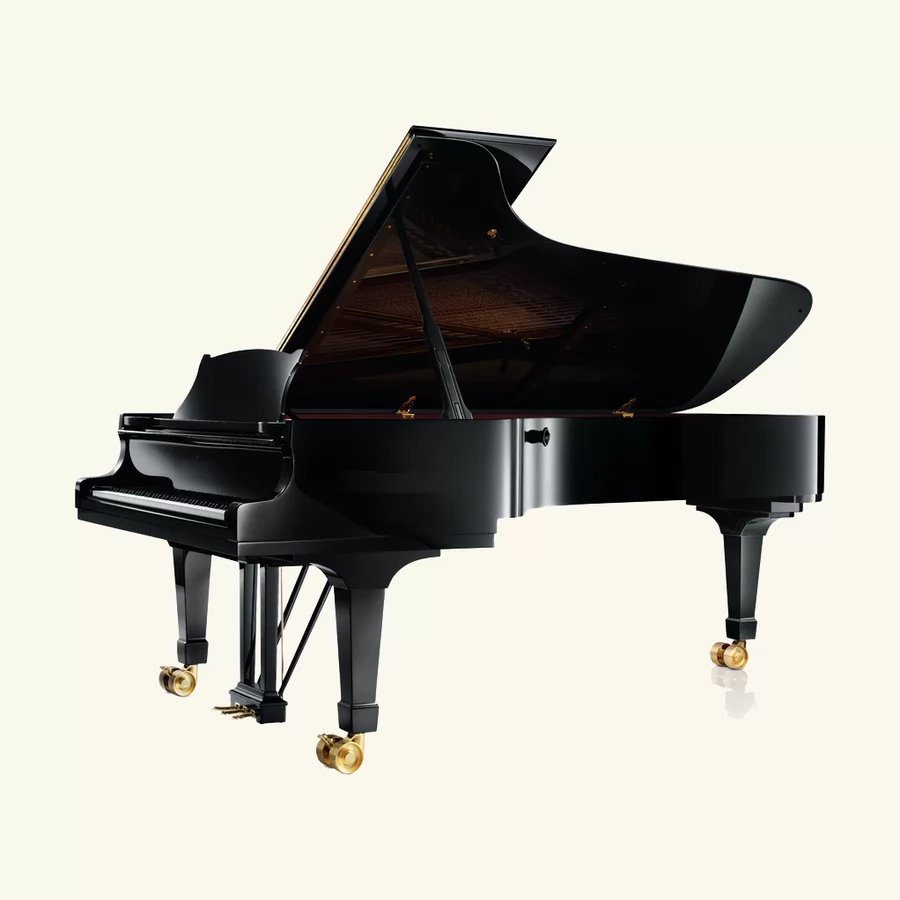
- 1Keys keys
Small levers you press with your fingers; they pass the movement inside.
- 2Action action
The set of levers that turns a key press into a hammer stroke; its escapement lets the hammer bounce away at once.
- 3Hammer hammer
A wooden hammer covered in felt that strikes the string.
- 4Damper damper
Presses down on the string from above when you let go of the key, so the sound stops.
- 5Strings strings
Steel strings; the bass strings are wound with copper. About 220–240 in all.
- 6Tuning pins tuning pins
Steel pins that hold one end of each string; turning them tunes the note.
- 7Frame (plate) frame / plate
A big cast-iron frame that holds the pull of all the strings.
- 8Bridge bridge
A wooden strip that holds one end of the strings and carries their vibration to the soundboard.
- 9Soundboard soundboard
A large spruce board that turns the strings' small vibration into a big sound.
- 10Pedals pedals
A grand has three: soft on the left, sostenuto in the middle, sustain on the right.
Where the sound comes from
Press a key and the hammer strikes the string. But a string on its own is very quiet, like a single stretched rubber band. One end rests on the bridge, which is glued to the soundboard, so the vibration passes into the big board, and the board pushes the air. It is like putting a phone in an empty bowl: the bowl vibrates too and the sound grows.
The cleverest part of a piano is that the hammer bounces off the string right after striking it, so it does not sit on the string and choke the sound. This is the escapement, a bit like touching a hot pan and pulling your finger back at once.
Every key has its own strings at a fixed pitch, so you choose a key instead of changing the string length with your finger as on a violin. The shorter, thinner and tighter a string, the higher the note. Bass strings are wound with copper to make them heavier, like wrapping thick yarn around a jump rope so it swings more slowly, so they can sound low without being enormously long.
In the middle and top, each key has 3 strings sounding together; lower down it becomes 2, and the lowest notes have just 1. When a string hands its energy to the soundboard, it gives a lot quickly at first and then much more slowly. So a piano note first fades fast, then rings on quietly for a long time, like a stone dropped in water: a big splash, then slow ripples.
The hammer strikes roughly 1/7 of the way along the string (it varies by register), which weakens the 7th harmonic (the 7th note of the harmonic series), one that clashes with the other notes. Piano strings are thick and stiff, like a steel ruler that is harder to bend than a rubber band, so their upper overtones run a little sharp; tuners therefore stretch the whole tuning slightly. The total stretch across the range depends on the piano: about 45 cents on a Steinway Model M and 60 cents on a Model D (1 cent is a hundredth of a semitone).
The wool felt on the hammer is special: it is soft when touched lightly and gets harder the more it is squeezed, like a sponge. So when you play gently the sound is mellow, and when you play hard it is not just louder but stronger in character.
As soon as your finger leaves the key, the damper felt presses on the string and the sound stops, like putting your hand on a swinging swing. Strings you did not play also vibrate a little along with the others. This sympathetic ringing gives an acoustic piano its rich sound.
Try this: on an acoustic piano, hold down the right pedal (it lifts all the dampers off the strings), sing a loud 'aah' toward the strings, then stop suddenly. Listen: the strings answer with the note you sang. That is sympathetic vibration.
How to play
Place the bench at the middle of the keyboard, facing the piano, and sit on the front half of it. Keep both feet flat, your shoulders and arms relaxed, and your back straight. Adjust the height so your elbows are about level with the keys; the distance is right when your fist, with your arm stretched forward, just touches the key cover.
Shape your hand as if gently holding an egg, or like the natural curve of a hand hanging at your side. Fingers are numbered: thumb 1, index 2, middle 3, ring 4, little finger 5. Treat hand, wrist and forearm as one unit and let the forearm's weight drop into the keys, so your fingers do not have to push hard.
Low notes are on the left, high notes on the right. The black keys come in groups of 2 and 3: the white keys around a group of 2 are C, D and E, and around a group of 3 are F, G, A and B. The piano's pitches are already fixed; what you decide is which key, how much force, and how quickly you release it, and all of these shape the expression.
To play a C major scale with the right hand, use 1-2-3 on C, D, E, then pass the thumb under to F and play 1-2-3-4-5 up to the next C; coming down, finger 3 crosses over the thumb. The left hand uses the opposite pattern: 5-4-3-2-1, then 3-2-1. In scales, the thumb does not go on black keys.
The right pedal is the sustain (damper) pedal: it lifts every damper, so notes keep ringing after you let go. Used well it makes the sound fuller and louder; held too long it blurs the harmonies together. When changing chords, use legato pedalling: play the new notes first, then lift the pedal and press it again ('play-up-down'). Keep your heel on the floor and use the ball of your foot instead of lifting your whole leg.
The left pedal is the soft pedal (una corda). On a grand it shifts the whole action sideways so the hammers hit fewer strings, making the sound quieter and softer; on an upright it moves the hammers closer to the strings. A grand's middle pedal is the sostenuto, which keeps ringing only the keys you were already holding when you pressed it; it is the least used of the three. On an upright, the middle pedal is usually a practice pedal that lowers a strip of felt between hammers and strings.
Staccato means short, quick notes; a trill means alternating two notes as fast as you can. A grand piano's hammer falls back by its own weight, so a key can repeat more than ten times a second; an upright's hammer returns by a spring, about 7 times a second.
Common beginner problems: a bench that is too low; the fingertip joint (the one just above the nail) bending backward, especially the index and ring fingers; a twisted wrist; and stamping on the pedal when nervous.
- 1-2-3 on C D E, thumb passes under to F, then 1-2-3-4-5 up to the next C. Listen for the thumb crossing to sound as smooth as every other note.
- From the top C, play 5-4-3-2-1 down to F, then finger 3 crosses over the thumb for E, D and C.
- Play the notes of the C chord (C, E, G) one at a time going up, like strumming a harp. The hand opens wider than for a chord.
Range and notation
Piano music is written on the grand staff: a treble-clef staff on top and a bass-clef staff below. Beginners usually read the treble clef with the right hand and the bass clef with the left. Middle C (C4) sits between the two staves; it can be written just above the bass staff or just below the treble staff.
The 88 keys run from the lowest note, A0 (27.5 vibrations per second), to the highest, C8 (about 4,186 per second). The A above middle C, A4, is the standard tuning note at 440 vibrations per second.
The piano is not a transposing instrument: a written C4 sounds as C4. In the lesson on transposition, the note the piano plays is used as the 'concert pitch' that other instruments are compared with. A few pianos are bigger: one Bösendorfer model has 97 keys, 9 extra at the bottom down to C0. Those extra strings are there mainly to resonate and are hardly ever played.
Listen
- A0, C2, C4, C6, C8. Low notes are deep and ring long; the higher you go, the shorter and brighter the note, and the faster it dies away.
- C4 sits in the middle of the grand staff; A4 is the 440 Hz tuning note.
- First the group of 2 black keys, then the group of 3.
- C1 to C8. Each step up is an octave: the same note name, just higher.
History and family
Before the piano there were already keyboard string instruments. The clavichord appeared in the 14th century; a small brass rod pushes up against the string, and it is so quiet you can hardly hear it a metre or two away. The harpsichord appeared in Italy around 1500; it plucks the strings, and its volume stays about the same however you press. The hammered dulcimer, which strikes strings with small hammers, is also seen as one of the piano's ancestors.
Around 1700 in Florence, Bartolomeo Cristofori (1655–1731), who looked after instruments for the Medici family, built a new instrument with hammers and dampers. His escapement let the hammer drop away right after striking, and his strings were thicker and tighter than a harpsichord's. The oldest surviving piano is one he made in 1720, with 54 keys, now at The Metropolitan Museum of Art.
The piano soon spread to Germany and England. J. S. Bach at first found Gottfried Silbermann's pianos too heavy to play and weak in the treble, but later praised them. In Vienna, Johann Andreas Stein's action was bright and responsive, and Mozart loved it; in London in the 1770s–1780s, Broadwood and others developed the sturdier English action.
In the 19th century pianos became bigger and louder. Sébastien Érard of France invented the double escapement, which lets a key repeat quickly: first patented in 1808, with an improved version patented in 1821 in the name of his nephew Pierre Érard. Grand pianos still use this idea today. Cast-iron frames replaced wooden structures, felt hammers replaced leather, and in the 1850s Steinway & Sons, founded in Manhattan, New York, by Henry Engelhard Steinway in 1853, combined overstringing (bass strings crossing diagonally over the treble strings) with a one-piece iron frame in the grand piano, designs later adopted by makers worldwide. The range grew from 5 octaves (61 keys) in the late 18th century to 88 keys, which began to appear in the late 1860s and became standard around 1900.
The piano family includes the early fortepiano, the square piano, the grand, the upright, the 'giraffe piano' (an early upright that stands a grand on end, tail up), and today's digital and silent pianos. Around 1860 the upright almost completely replaced the square piano as the usual piano at home.
- 14th centuryThe clavichord appears
- c. 1500The harpsichord appears in Italy
- c. 1700Cristofori builds the first pianos in Florence
- 1720The oldest surviving piano (Cristofori, 54 keys)
- 1732Lodovico Giustini publishes 12 sonatas, the earliest music known to be written and published for the piano
- 1800John Isaac Hawkins makes the first successful small upright
- 1808Sébastien Érard's double escapement is first patented (improved version patented by his nephew Pierre in 1821)
- 1825Alpheus Babcock in Boston makes the first one-piece iron frame (for a square piano)
- 1826Jean-Henri Pape in Paris patents felt-covered hammers
- 1853Henry Engelhard Steinway founds Steinway & Sons in Manhattan, New York
- 1850sSteinway combines overstringing and a one-piece iron frame in the grand
- 1862Claude Montal in Paris invents the sostenuto pedal
- 1868Steinway's first 88-key grand (now at The Met)
- 1878Steinway patents its one-piece bent rim
Getting started and care
An acoustic piano's tone changes with your touch and its strings resonate richly, but it needs tuning, takes space and weighs about 180–450 kg. A digital piano is light, has a volume control, never needs tuning and works with headphones, but the touch and sound vary a lot between brands and models. The Piano Technicians Guild (PTG) suggests trying both before deciding, and notes that some skills can only be learned on an acoustic piano.
PTG's comparison chart notes that digital pianos have 61 to 88 keys, not always full-size, and that only better models have a weighted action (keys with weight, like a real piano) and pedals. These are worth checking; ordinary electronic keyboards have no weighted action. Before buying a used acoustic piano, have a qualified piano technician check it: a 'free or cheap' piano can end up the most expensive if it needs rebuilding.
A piano slowly goes out of tune even if no one plays it, because each tightly pulled string gradually stretches, most of all in a new piano's first year. Yamaha suggests tuning at least once a year, and twice in the first year; PTG says most makers recommend three to four tunings in the first year and at least two a year after that. How often really depends on how much you play and on the climate.
Changes in humidity also move the tuning. When it is damp, the soundboard crowns up and pushes the bridge against the strings, so the pitch rises; when it is dry, the board shrinks and the pitch falls. Either way, the middle of the keyboard changes most. Sudden changes can even crack wood and loosen glue, a bit like a wooden door that sticks in the rainy season.
- Keep it where temperature and humidity stay steady: PTG suggests about 20 °C and 42% relative humidity, and stresses keeping the humidity steady.
- Keep it away from heating and cooling vents, stoves, doors and windows, and out of direct sunlight.
- Dust with a soft cloth; use a separate cloth for the keys and wipe from back to front, not side to side.
- If the keys are dirty, wipe with a well-wrung cloth and diluted mild detergent. Never use alcohol (it can cause cracking) or chemical wet wipes not made for pianos.
- Wash your hands before you play.
- An upright sends a lot of sound out the back: do not put it against an outside wall, and rugs and heavy curtains help keep the sound from reaching neighbours.
- If one note sounds like two different notes, or loud playing makes a buzz, ask a piano technician to check it.
- The Met: The Piano: The Pianofortes of Bartolomeo Cristofori (1655–1731)
- The Met: Steinway & Sons Grand Piano, 1868
- Britannica: Piano
- Britannica: Keyboard instrument – Overstringing
- Britannica: Keyboard instrument – The English action
- MIMO: Hornbostel–Sachs 314.122-4-8
- Yamaha Musical Instrument Guide: Piano
- Yamaha Hub: Piano Pedagogy – Pedaling
- Baylor University: Piano Basics (open textbook)
- Piano Technicians Guild: Acoustic vs. Digital Piano (PDF)
- Piano Technicians Guild: Tips on Buying a Piano (PDF)
- Piano Technicians Guild: Piano Care FAQs
- Piano Technicians Guild: Humidity Control
- HyperPhysics: The Piano
- KTH: Gabriel Weinreich – The coupled motion of piano strings
- Steinway & Sons: Model D
- Steinway & Sons: About
- Britannica: Henry Engelhard Steinway
- Museum für Musik Basel: Fortepiano, Paris 1832
- CCRMA (Stanford): Stiff Piano Strings
Piano sound: Salamander Grand Piano by Alexander Holm (CC BY 3.0).