
Drum kit: parts, how it sounds and how to play
The drum kit is the heartbeat of rock, pop, jazz and many other styles. One person plays it with two hands and two feet, and every limb does a different job. Here you can see what each part does, how drums and cymbals make their sound, and how to start playing.
In this lesson
Meet the drum kit
The drum kit is also called a drum set or a trap set. It is “a small mixed percussion battery performed by a single musician”: some drums and some cymbals, all played by one person. It keeps the beat in rock, pop, jazz and many other styles.
The name trap set comes from the early days. Drummers used all kinds of gadgets, called contraptions, to make sound effects, and the word was shortened to traps.
There is no fixed set-up. Yamaha says that if you had to name a basic kit, it would be a five-piece: a bass drum, a snare drum, and three toms counting the floor tom, with a ride, a crash and a hi-hat for cymbals. Some players add a second bass drum, more toms, or small extras like a wood block.
In the Hornbostel–Sachs system that scientists use to sort instruments, drums are membranophones: a stretched skin vibrates. Cymbals are idiophones: the whole instrument vibrates. So a drum kit counts as a mix of both. Fun fact: a cymbal that hangs and is struck from outside is filed in the same group as a bell.
- Family
- Percussion
- Classification
- A composite of membranophones and idiophones (Hornbostel–Sachs 211.212.11--111.242.121, MIMO revision)
- Sounding range
- No fixed range: most parts have no clear pitch
- Clef
- Neutral (percussion) clef: two short vertical lines
- Transposition
- Not a transposing instrument
- Sizes (one example)
- Yamaha Stage Custom Birch 5-piece: 22" bass drum, 14" snare, 10" and 12" toms, 16" floor tom
Parts of the drum kit
The drums in a kit are basically made of wood. Only the snare drum is made in many materials, such as wood or metal, so players can choose. Drumheads used to be animal skin, but today most are thin plastic film.
Cymbals are bronze, a mix of copper and tin, sometimes with a little silver. SABIAN, for example, makes B20 from 80% copper and 20% tin plus a trace of silver. The usual set-up goes from small and high on the drummer's left to big and low on the right. The one exception is the biggest drum of all, the bass drum at the drummer's feet.
Some parts sit inside or behind the instrument where the picture cannot show them; their numbers mark roughly where they are.
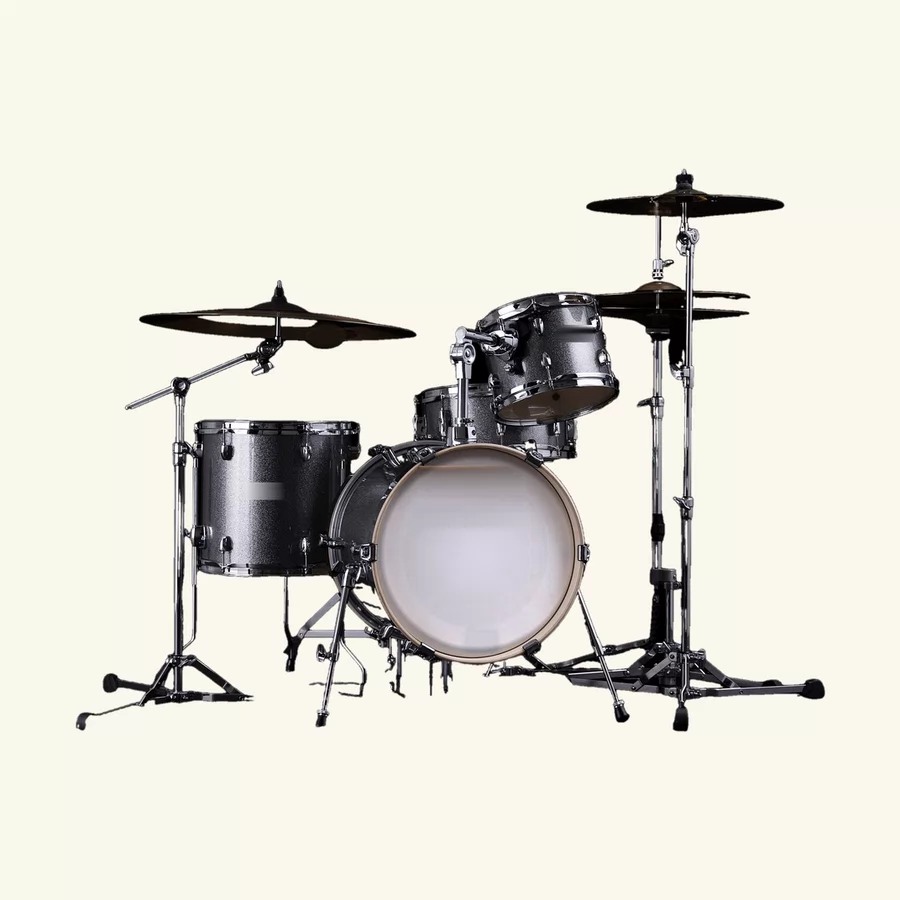
- 1Crash cymbal crash cymbal
Marks loud accents. Zildjian describes it as thin and light, with an explosive, bright sound that fades fast.
- 2Ride cymbal ride cymbal
The largest and heaviest cymbal on the kit. Its sound is darker, and you can hear each stroke clearly.
- 3Hi-hat hi-hat
Two cymbals facing each other. A pedal under the left foot opens and closes them, and you can also hit them with a stick.
- 4Toms tom-toms
Drums mounted on the bass drum or on a stand. The smaller the tom, the higher it sounds.
- 5Snare drum snare drum
The shallowest drum, and the one that shows a drummer's personality most. Its shell can be wood or metal.
- 6Snares and strainer snares / strainer
A row of thin wires under the bottom head. The strainer switch presses them onto the head or lifts them away, and sets how tight they are.
- 7Floor tom floor tom
A tom that stands on the floor on legs or a stand. It gives a low sound.
- 8Bass drum bass drum / kick drum
The biggest and lowest drum. It stands on its side with a head on each end; some front heads have a hole cut in them.
- 9Bass drum pedal and beater pedal / beater
Your foot presses the pedal and the beater hits the bass drum. The pedal can be driven by a metal link, a strap or a chain.
- 10Hoop, lugs and tension rods hoop / lug / tension rod
The hoop holds the head on the shell. Tension rods go through the hoop into lugs fixed on the shell; turning them tighter stretches the head.
How the sound is made
A stick hits the stretched drumhead, and the head moves up and down and pushes the air into sound. It works a bit like a rubber band: the tighter you stretch it, the higher the sound. And the bigger the drum, the lower the sound.
But a drumhead does not vibrate as neatly as a string. It vibrates in many shapes at once, and their frequencies are not whole-number multiples of the lowest one; the second shape of an ideal drumhead is about 1.59 times the first. It is like a crowd where everyone hums a different note: you can tell if the crowd sounds high or low, but you cannot sing back one clear note. So drums have no clear pitch, though they still sound higher or lower.
Most kit drums have two heads with air trapped between them. Hit the top head and it squeezes the air, the air pushes the bottom head, and the push travels back and forth until it fades. Think of two trampolines joined by an air cushion: jump on one and the other moves too. That is why the two heads' motions come in pairs, sometimes moving the same way and sometimes opposite ways.
The snare drum's secret is underneath. When you hit the top head, the bottom head shakes and keeps slapping the snare wires pressed against it, which adds a bright rattle. Lift the snares off and the drum sounds completely different. In a Yamaha experiment, string, rubber bands and cellophane did almost nothing, while fishing line came closest to real snares, because snares need some weight and springiness.
The shell works like a speaker box that rings along with the heads. A big or deep shell sounds thick and full; a small or shallow one sounds bright and light. Shells also have a small air hole. Without it the sound is choked, and on a bass drum it also softens the kick-back your foot feels when the head bulges and springs back.
The bass drum is a powerful instrument: in one experiment an orchestral bass drum put out up to 20 watts of sound power at its peak, more than any other instrument in the orchestra. When it is hit very hard, the head is stretched tighter for a moment, so the sound starts about 10% higher, almost a whole step, and then slides down as the vibration gets smaller.
A cymbal is a thin metal plate, and when it is struck the whole plate vibrates in many ways at once. These vibrations are not whole-number multiples either, so a cymbal has no clear pitch. Scientists shook cymbals with a machine at one single frequency and slowly pushed harder. The vibration went from regular to messier and messier until it became chaotic, and that chaos sounded much like a cymbal struck hard with a mallet. Thin cymbals reach this state easily, and the researchers say this gives the crash its shimmering sound.
Try it: stretch plastic wrap over a bowl and hold it tight with a rubber band. Tap it with a chopstick. Then make the wrap tighter or looser and listen: does the sound go up or down? Put a few grains of rice on top and tap again; the jumping rice shows the skin vibrating.
How to play
Set the stool so your right foot is right in front of the bass drum when you sit. Relax, do not sit too far back, and keep your weight in the middle of the seat. Your right foot goes on the bass drum pedal and your left foot on the hi-hat pedal. Most drummers cross their hands: right hand on the hi-hat, left hand on the snare. Left-handed players can skip the crossing and play hi-hat with the left hand and snare with the right.
Hold the stick between about a quarter and a third of the way up from its end; every stick has a balance point where it bounces most easily. Pinch it between the pad of your thumb and the first joint of your index finger, and let the other three fingers rest lightly. Keep the stick in line with your forearm. Holding both sticks the same way is called matched grip; the traditional grip is harder.
Hitting a drum is like bouncing a basketball: you push it down and let it come back up by itself. This is the rebound stroke, one of the most important ways to play without tension. Yamaha says the right way is not to squeeze all the time but to put in effort only at the moment of impact, which is also why even professionals sometimes lose a stick. Before you start, hold the sticks in an upside-down V with the tips 2–3 cm above the middle of the head, not resting on it, or you will make noise before you begin.
Feet have two main styles. Heel-up means lifting the heel and pressing with your whole leg: easy to stay loud, hard to play quietly. Heel-down means keeping the heel down and using the ankle: easy to play quietly, hard to stay loud.
Play the ride with the tip of the stick and the crash with its shoulder, the part where the stick gets thicker. The snare has many sounds: hitting the hoop and the head together is an open rim shot. For a closed rim shot (cross-stick), used in bossa nova and other styles, you pinch the stick with thumb and index finger and hit the hoop with the grip end. Jazz and ballads often use brushes instead of sticks, which are much quieter.
Drummers practice rudiments, the basic stroke patterns. The Percussive Arts Society (PAS) lists 40 international rudiments in four groups: rolls, paradiddles, flams and drags. It suggests practicing slow, then fast, then slow again.
- Right hand plays eighth notes on the hi-hat, left hand hits the snare on beats 2 and 4, right foot kicks on beats 1 and 3. One of the simplest grooves.
- The hi-hat notes are twice as fine, sixteenth notes, so the groove feels busier.
- With the cymbals pressed together the sound is short and tight; open them and it rings longer and louder.
- The same groove with the right hand on the ride cymbal: each stroke is clear and separate.
- Very soft snare strokes between the normal ones. In drum notation they are shown with brackets around the note head.
- At the end of a section the groove stops and the drummer rolls from snare to high tom to floor tom, then lands on a crash with the bass drum.
How to read drum notation
Most parts of a drum kit have no clear pitch, so there is no written pitch to convert into a sounding pitch. The kit is not a transposing instrument and has no range in the usual sense. Drum music is usually written with a neutral clef, two short vertical lines, which tells you that each line or space stands for an instrument, not a pitch.
Drums use round filled note heads (●) and cymbals use an × head, both with stems. There is no fixed rule for which instrument goes on which line; Yamaha points out that every writer does it a little differently. That is why drum parts usually come with a key. The Percussive Arts Society published Norman Weinberg's Guide to Standardized Drumset Notation to help people write clear drum parts.
Here is one common layout, from a university percussion key. Bass drum in the first space, floor tom in the second space, snare in the third space, middle tom on the fourth line and small tom in the fourth space. With × heads: hi-hat played with a stick on the fifth line, ride in the space above the staff, crash on the first ledger line above, and hi-hat played with the foot in the space below the staff.
A few more marks: + means closed or muted, o means open and ringing, and brackets around a note head mean a very soft ghost note. RH, LH, RF and LF mean right hand, left hand, right foot and left foot. Sometimes the part just says “fill in” so you improvise a fill, or only “Bossa Nova” with a wavy line, so you play your own bossa nova groove.
Listen
- The bigger the drum, the lower the sound: bass drum, floor tom, high tom, then the snare with the rattle of its snares.
- Closed hi-hat is short, open hi-hat rings; the ride is clear stroke by stroke; the crash is a bright splash that fades fast.
- Compare a stroke on the snare head with a dry click on the rim.
- Bass drum and snare make the backbone, the hi-hat cuts the beat into smaller pieces, and a crash marks the start.
History and relatives
Before the drum kit, bass drum, snare and cymbals were often played by different people. Vic Firth's timeline starts in 1865, after the American Civil War, when drummers began trying to do the work of a whole percussion section alone. First came double drumming: both hands playing bass drum and snare, with no feet.
The drum kit appeared in the United States in the late 19th century, along with ragtime and jazz. New Orleans drummer Edward “Dee Dee” Chandler was perhaps one of the first to play the bass drum with a simple foot pedal while playing snare with his hands, and he is often told as the starting point; the Smithsonian notes that others had done it before him. The only known photo of him, from 1896 with John Robichaux's band, shows a pedal on the bass drum in the corner.
In 1909 William F. Ludwig patented a spring bass drum pedal. Reliable and easy to carry, the pedal became a fixed part of the kit, and by the 1920s it was standard. The hi-hat grew out of a pair of hinged boards with small cymbals that sat on the floor; the hi-hat as we know it took shape from the late 1920s to around 1930.
In the early 20th century drummers added Chinese drums to the kit, and around the 1930s these gave way to toms mounted on stands. Gene Krupa worked with Avedis Zildjian on much thinner cymbals, creating the first crash and splash cymbals for the kit. In the 1930s and 1940s more cymbals were added, many sound-effect gadgets were dropped, and the modern kit took shape.
In the 1940s Kenny Clarke moved the main timekeeping onto the ride cymbal and dropped unexpected fills on the bass drum and snare to answer the soloist. Plastic drumheads arrived in the mid-1950s: Evans says Chick Evans invented them in 1956, while Remo says it launched the first successful synthetic head in 1957 and was granted a patent in 1960. Plastic heads do not care about damp or temperature, so they are easier to look after than skin.
The snare drum's ancestor is the medieval European tabor. Larger tabors were played with two sticks and had the snares moved to the bottom head, becoming the side drum, which from the 14th century marched with Swiss infantry alongside fifes. Cymbals reached Europe from Ottoman Turkey in the 18th century. According to Zildjian, in 1618 the Armenian Avedis I found a secret way of treating alloy in Constantinople and used it to make cymbals, and in 1623 the sultan gave him the name Zildjian, meaning cymbal smith. The kit's relatives include timpani, congas, bongos and the Indian tabla.
- 1618 / 1623Avedis I finds his alloy method and receives the name Zildjian, “cymbal smith” (Zildjian’s account)
- 18th c.Cymbals arrive in Europe from Ottoman Turkey
- 1865After the Civil War, drummers start covering a whole percussion section alone (double drumming)
- 1896A band photo shows a pedal on Dee Dee Chandler's bass drum
- 1909Ludwig patents a spring bass drum pedal
- 1927Walberg and Auge launch the Charleston stand, close to today's hi-hat
- 1930sKrupa and Zildjian create the first crash and splash cymbals for the kit
- 1940sKenny Clarke moves the main timekeeping to the ride cymbal
- early 1950sLouie Bellson brings the double bass drum into the spotlight
- 1956–1957Plastic drumheads appear (Evans and Remo each give their own account)
Getting started and care
To choose sticks, Yamaha suggests swinging the thinnest pair, then the thickest, then working back down, and picking the thickest pair that still feels easy. Thicker sticks sound heavier and louder. Most sticks today are hickory; maple is lighter. A round tip touches the head the same way at any angle, so it sounds steady and suits beginners; nylon tips bounce more and sound sharper than wood.
At home you can start on a practice pad. Yamaha recommends the kind on a stand so you can sit and practice your feet at the same time, and says its rubber pad is sturdy; mesh pads can be tightened but slowly loosen with use and need replacing now and then.
Drums are usually not tuned to do-re-mi. You tune each drum until it rings well and sounds the way you like, with the same pitch all around the head. Turn all the rods finger-tight first, then tighten them a little at a time with a drum key in a crisscross order, like the nuts on a car wheel, so the head does not wrinkle.
There is no single right way to tune the two heads; it depends on the sound you want. Yamaha says two heads at the same tension ring long but are not very loud; a bottom head looser than the top gives a shorter ring and a stronger attack, while a tighter bottom head gives a louder, longer sound.
- Wipe the drums after playing, especially the metal parts, which can rust, and the threads, which can stick.
- Drumheads wear out. Loosen the head: if you see dents where the stick lands, it is time to change it. Players who practice a lot change heads about every six months. The first time, ask a music shop or an experienced drummer to show you.
- Snare wires wear out too: about every six months to a year for busy players. Once they start to spread apart, it is already time.
- Newer cymbals have a clear protective coating; a dry, soft cloth is enough. If you use a cymbal polish, follow its instructions, wipe it all off, and do not overdo it: polishing away the grooves on the surface changes the sound.
- A cracked cymbal is best taken to a specialist shop; even after a repair, it will sound a little different.
- If your sticks keep flying out of your hands, try grip tape or grip wax.
- Drum set (Grinnell College Musical Instrument Collection)
- Snare drum (Encyclopaedia Britannica)
- Kenny Clarke (Encyclopaedia Britannica)
- Rossing, Acoustics of Drums (Physics Today, 1992)
- Chaigne, Touzé & Thomas, Nonlinear vibrations and chaos in gongs and cymbals (2005)
- 楽器解体全書 ドラム (Yamaha)
- DTX402 Drum Score / Drumming Fundamentals (Yamaha)
- History of the Drumset (Vic Firth)
- The Birth of the Drum Set (Smithsonian Folkways Magazine)
- Drumset Snare Batter (Evans / D'Addario)
- Cymbals: browse by type (Zildjian)
- Remo company history
- Drumset notation key (Youngstown State University)
- Rudiments (Percussive Arts Society)
- Cymbal (HyperPhysics)
- Cymbal (Encyclopaedia Britannica)
- Zildjian brand history
- Drumsticks FAQ (Vic Firth)
- Guide to Standardized Drumset Notation (Hal Leonard / PAS)
- SABIAN FAQ
Piano sound: Salamander Grand Piano by Alexander Holm (CC BY 3.0).