
Saxophone: Parts, How It Makes Sound, and How to Play
The saxophone is a brass tube that widens from top to bottom, with one thin reed at the mouthpiece. It is made of metal, yet it is a woodwind. This page follows the alto saxophone in E♭, the size most people start on, and also the tenor saxophone in B♭ that you often hear in jazz.
In this lesson
Meet the saxophone
The saxophone is a metal tube with a conical bore: the inside gets wider as it goes down. When you blow, a reed (a thin slice of cane) on the mouthpiece vibrates, and that is where the sound begins.
It is made of brass, so why is it not a brass instrument? Instrument families are sorted by how the sound starts. Brass players buzz their lips; the saxophone uses a reed, so it is a woodwind. Its sound blends well with both brass and woodwinds.
Saxophones come in several sizes. The four most common are soprano, alto, tenor and baritone. The alto is almost always in E♭; the tenor is almost always in B♭.
The alto looks like the letter J, with its neck (the short pipe that holds the mouthpiece) bent by nearly 90 degrees. The tenor is bigger, with a bigger mouthpiece and reed, and its neck has a wavy bend. Most sopranos are straight, and the baritone's neck has a loop at the top.
- Family
- Woodwind (single reed)
- Classification
- Hornbostel–Sachs 422.212: reedpipe with a single reed and a conical bore
- Sounding range
- Alto D♭3 to A♭5 (tenor A♭2 to E♭5)
- Clef
- Treble clef
- Transposition
- Alto in E♭: sounds a major sixth lower than written. Tenor in B♭: sounds a major ninth lower
- Size
- Alto about 70 cm tall; a museum tenor measures about 83 cm
Parts of the saxophone
A saxophone has about 600 parts in four main sections: neck, body, bow and bell. The tube has twenty-some tone holes, but you only have ten fingers. Keys and rods let one finger close holes that are far away.
All the metal is brass, a mix of copper and zinc. Even a gold- or silver-plated saxophone is brass underneath.
Some parts sit inside or behind the instrument where the picture cannot show them; their numbers mark roughly where they are.
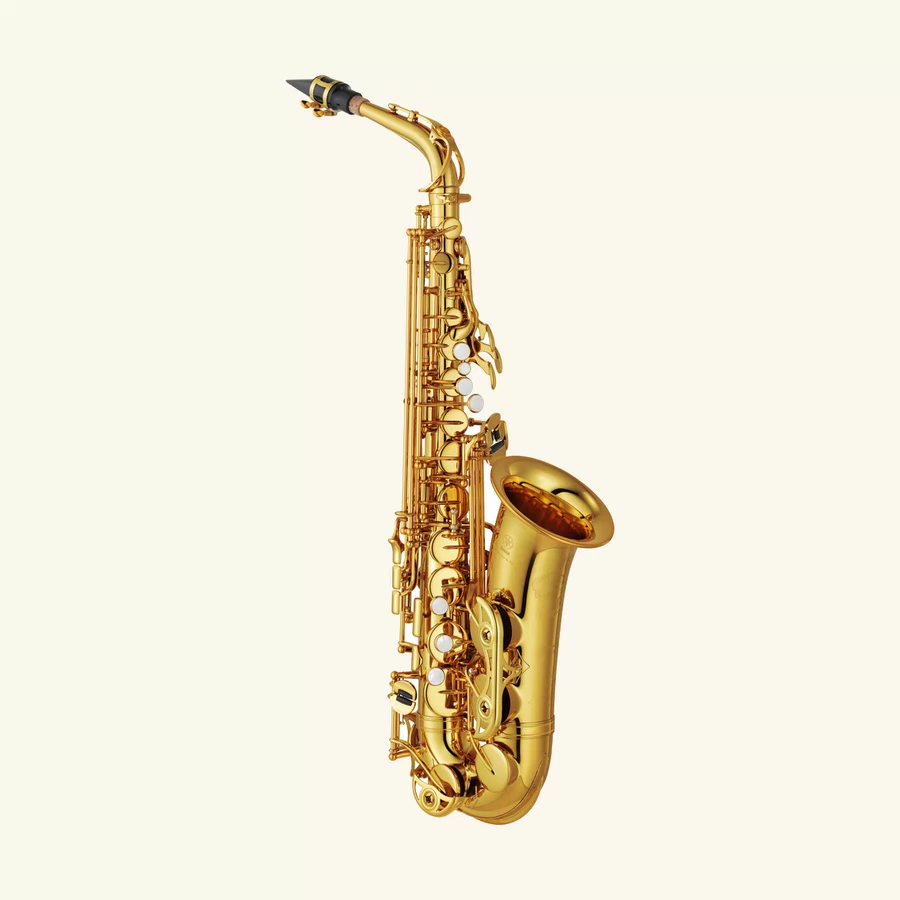
- 1Mouthpiece mouthpiece
Goes in your mouth and holds the reed. It can be plastic, wood or metal, and it slides onto the cork at the end of the neck.
- 2Reed reed
The sound source. Its flat side lies on the mouthpiece, and it opens and closes the air gap like a little valve.
- 3Ligature ligature
A metal band with screws that holds the reed on the mouthpiece. Where you put it changes how the reed vibrates.
- 4Neck neck
Joins the mouthpiece to the body. Its end is wrapped in cork so the mouthpiece seals tightly and the tuning can be adjusted a little.
- 5Octave key octave key
Pressed by the left thumb. It opens a tiny hole so the same fingering jumps up an octave; one key switches between a hole on the neck and one on the body.
- 6Body body
The main cone-shaped tube that carries the tone holes and keys.
- 7Keys and pads keys and pads
Keys cover the holes with round pads made of felt wrapped in leather. On an alto, the biggest pad is 5 cm across.
- 8Thumb rest thumb rest
Your right thumb sits under it to hold the instrument up.
- 9Bow bow
The U-shaped bend that joins body and bell. It folds the long tube into a shape you can hold, and changes the sound only a little.
- 10Bell bell
The flared end of the tube, rolled from one fan-shaped sheet of brass and soldered.
How the sound is made
The reed works like a little door that flaps open and shut. As you blow, the gap between reed and mouthpiece opens and closes again and again, chopping a steady stream of air into puffs. Those puffs set the air inside the tube vibrating. On an alto's lowest note, D♭3, that happens about 139 times a second.
Play softly and the reed swings gently, so the sound is smooth and mellow. Play loudly and it swings so far that it slaps fully shut against the mouthpiece once every cycle. It is like slicing the tops off the waves: many higher overtones appear, and the sound turns bright.
A longer tube gives a lower note. Opening a tone hole is like sawing the tube off at that spot, so the note goes up. Each semitone needs a tube about 6% shorter, so an octave takes 12 holes. Holes for high notes are small; holes for low notes are big, and big ones need keys to cover them.
In a cone-shaped tube, the steps of the overtone ladder are all there: 1, 2, 3 times the lowest frequency, and so on. The second step is about twice the first, so when you jump to the second register you land an octave higher. The clarinet has a straight, cylinder-shaped tube; in its low register mostly the odd steps (1, 3, 5) are there, so it jumps a twelfth (an octave plus a fifth).
The octave key does not make a new note by itself. Like gently holding back the first rung of a ladder, it opens a tiny hole that weakens the lowest resonance, so the second one takes over. That lowest resonance is weak in a cone anyway, which is why the very lowest notes are hard to play quietly but easier to play loud.
The saxophone's sound contains both odd and even overtones, one reason it sounds different from a clarinet. It is also louder than the other woodwinds. Yamaha describes its sound as very close to a human voice, with the widest dynamic range of any woodwind.
Your mouth and throat are a sound space too, a bit like a small room that makes some notes ring. Researchers found that professional players tuned a strong mouth resonance just above the note they wanted in the very high altissimo register. The amateur players in that study did not, and could not play altissimo notes.
Try it: find two cardboard tubes of different lengths, such as a paper-towel tube and a toilet-paper tube. Cover one end of each with your palm and pat it, then listen. The longer tube gives the lower sound, just as a saxophone sounds lower when more holes are closed.
How to play
Three points hold the saxophone: your right thumb under the thumb rest, your top teeth on the mouthpiece, and the neck strap, which takes most of the weight. Adjust the strap so the mouthpiece just reaches your lips without bending over. Sit or stand tall, look ahead and relax, with the instrument upright in front of you and tilted a little to the right.
Embouchure (how you shape your mouth): the lower lip covers your bottom teeth like a cushion, the reed rests on that lip, your top teeth sit on top of the mouthpiece, and the corners of your mouth close around it, as if saying 'oh'. Do not bite. Deep tooth marks on the mouthpiece usually mean you are biting.
Tone, tuning and volume all start with your breath. Support it from your belly so the air keeps a steady speed, instead of squeezing the sound with your mouth. To start a note, touch the reed with your tongue and then let go, like releasing a door you were holding shut.
The left thumb presses the octave key to move into the second register. All saxophones use basically the same fingering: the same written note uses the same fingers on alto and tenor, though each mouthpiece takes some getting used to.
Other techniques: the growl means humming or singing while you blow, for a rough sound. A trill is fast switching between a note and its upper neighbour. Slap tongue means the tongue grabs the reed and pulls it away, then lets it snap back for a percussive pop. Pitch bends and glissandos come mostly from changing the inside of your mouth. Altissimo uses special fingerings and mouth tuning to go above written F♯6.
Learn vibrato after your embouchure, hands, breathing and tone are steady, about one or two years in. Use your jaw like a hinge, moving it a tiny bit so the pitch dips and comes back. At most about sixteenth notes at 72 to 76 beats per minute; faster sounds rushed. Teachers do not recommend using the diaphragm or shaking the instrument.
- A straight long tone with no vibrato on a tenor saxophone: written D5, sounding C4. Long-tone practice aims for this steadiness.
- First a straight note, then the same note with jaw vibrato, on a tenor saxophone (written D5, sounding C4). Listen to the warm wave it adds.
- The tongue lets go of the reed and a short note pops out, on a tenor saxophone: written D5, sounding C4.
Range and notation
All E♭ and B♭ saxophones read treble clef. The written range runs from about B♭3 to F6, and many altos and tenors can also reach F♯6. Above that is the altissimo register, which takes special practice. The standard range is a little under three octaves.
The saxophone is a transposing instrument: the written note and the note you hear are different. The good part is that every size uses the same fingering, so you do not relearn anything when you switch. The alto sounds a major sixth lower than written: written C5 sounds as E♭4. The tenor sounds a major ninth lower (an octave plus a major second): written F4 sounds as E♭3.
So the alto's sounding range is D♭3 to A♭5 (about 139 to 831 Hz), and the tenor's is A♭2 to E♭5 (about 104 to 622 Hz). To play in concert C major with a piano, an alto reads in A major (3 sharps) and a tenor reads in D major (2 sharps).
Listen
- Tenor saxophone, written C4, sounding B♭2, close to its lowest note. Listen to the thick low sound.
- Tenor saxophone, written D5, sounding C4. This note uses the octave key: it is in the second register.
- Tenor saxophone, written E6, sounding D5, near the top of the standard written range (F6).
- The same tenor saxophone climbing through three registers: sounding B♭2, C4, D5 (written C4, D5, E6).
History and family
The saxophone is one of the few widely used instruments known to have been invented by one person, and it is named after him: Adolphe Sax. He was born in Dinant, Belgium, in 1814. His father was also an instrument maker, and Sax studied flute and clarinet at the Brussels Conservatory.
There are several accounts of why he invented it: to improve the sound of the bass clarinet, from experiments putting a reed mouthpiece on a brass instrument, to combine the strengths of woodwinds and brass, or to make a clarinet-like instrument that overblows at the octave. He made it around 1840, showed it in Paris in 1842, and patented it in 1846; the patent covered 8 sizes.
The French army soon adopted the saxophone, and it spread to other countries. Sax fought rivals in court for ten years over his patents and was poor in old age. The Paris Conservatory opened a saxophone class in 1857, taught by Sax himself.
In the orchestra, Bizet's L'Arlésienne is probably one of the first works to use the saxophone, and Ravel's Boléro has tenor and soprano saxophone solos. In the United States it became a popular solo instrument around World War I, then one of the most important solo instruments in swing and jazz. Great jazz saxophonists include Coleman Hawkins, Lester Young, Charlie Parker, Sonny Rollins and John Coltrane.
Relatives: the clarinet also uses one reed, but its tube is a cylinder, so it overblows a twelfth. The oboe and bassoon use two reeds and also have conical tubes. Sax also invented brass instruments such as the saxhorn, which are played by buzzing the lips.
- 1814Adolphe Sax is born in Dinant, Belgium.
- c. 1840Sax creates the saxophone.
- 1842On 12 June, Berlioz devotes a whole article in the Journal des Débats to Sax; the same year Sax settles in Paris and shows the saxophone.
- 1844A B♭ bass saxophone is shown at the French Industrial Exposition.
- 1846Sax patents the saxophone in Paris; the patent covers 8 sizes.
- 1857The Paris Conservatory opens a saxophone class taught by Sax.
- 1894Sax dies in Paris.
- Mid-1920sA standard jazz band has five saxophones.
- 1928Saxophonist Johnny Hodges joins Duke Ellington's orchestra.
Getting started and care
For a first saxophone, the alto is a good choice: it is easier to play than the soprano, the strap carries most of its weight, and it is easier to look after. Start with a standard mouthpiece and a reed around strength 2½, and practise long tones and embouchure. Mouthpiece and reed must suit each other, so ask a music shop if you are not sure.
Reed strengths usually run from 2 to 5; a lower number means a thinner reed. Strengths 2 and 2.5 vibrate easily and sound brighter; 4 and 5 are harder to blow and sound thicker and warmer. Reeds wear out: one usually lasts about one to two weeks, and the sound changes when you switch to a new one; synthetic (resin) reeds last longer. A narrow mouthpiece with a reed that is too soft can make the reed close against the mouthpiece, and the sound may suddenly cut out.
- Before assembling, put a little cork grease on the cork at the end of the neck, where the mouthpiece goes, and do not squeeze the neck or keys while putting it together.
- After playing, take off the reed, clean the mouthpiece with a small swab (careful not to damage its thin tip), then dry the inside of the neck.
- With the neck removed, drop the swab in through the bell and pull it out at the top of the body where the neck fits (soprano, alto and tenor; the baritone is different).
- If a pad is wet, put cleaning paper between the pad and the tone hole and press the key lightly a few times, then move the paper and repeat two or three times; do not pull the paper out while the key is held down.
- Every 2–3 months, put a small drop of key oil at both ends of the key rods and wipe off any extra; a squeaky key means it is time.
- Do not take the keys apart yourself. If low notes become hard to play, a pad may not be sealing; have a music shop check it.
- The mouthpiece tip is thin and can crack or chip if dropped, which changes the tone.
- Saxophone – Britannica
- Antoine-Joseph Sax – Britannica
- Jazz: Orchestral jazz – Britannica
- Saxophone acoustics – UNSW Music Acoustics
- Pipes and harmonics – UNSW Music Acoustics
- Saxophone players and their vocal tracts – UNSW Music Acoustics
- The Saxophone – HyperPhysics
- Alto saxophone – Grinnell College Musical Instrument Collection
- How to slap tongue on the saxophone – D’Addario Woodwinds (DANSR)
- The invention of the saxophone by Adolphe Sax – Selmer
- Musical Instrument Guide: Saxophone – Yamaha
- Saxophone maintenance – Yamaha Musical Instrument Guide
- Beginner's guide to the saxophone – Yamaha Hub
- What's the difference between soprano, alto, tenor and baritone saxophones? – Yamaha Hub
- Teaching Saxophone Vibrato – The Instrumentalist
- Tenor saxophone – Grinnell College Musical Instrument Collection
- Saxophone (M47-1993) – Horniman Museum and Gardens
- Vibrato Production – Woodwind Doubling Resource Project, Bluffton University
- Celebrating Sax – The Metropolitan Museum of Art
- Care and Maintenance (Julius Keilwerth)
- Yamaha Musical Instrument Guide: A beginner saxophone
- Yamaha Musical Instrument Guide: How to choose a reed and mouthpiece
Piano sound: Salamander Grand Piano by Alexander Holm (CC BY 3.0).