
Instrument families: how each one makes sound
A guitar, a flute, a drum and a trumpet look nothing alike, but they all do the same secret thing: they make something vibrate. Once you know that, the whole world of instruments becomes much easier to understand.
In this lesson
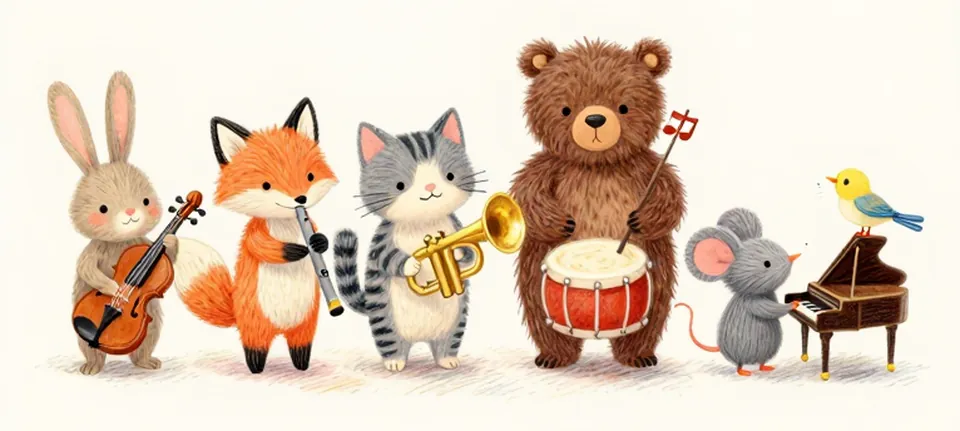
All sound is shaking
Put your fingers lightly on your throat and hum. You can feel a tickle. That tickle is vibration: something moving back and forth very fast. Every sound you hear, from a whisper to a drum, begins with something shaking.
The shaking pushes the air around it, and the air carries the shaking to your ear. How fast the thing shakes decides how high or low the note is. Fast shaking sounds high, like a mouse squeak. Slow shaking sounds low, like a big drum.
Instruments are clever machines for making a vibration on purpose, keeping it going, and making it loud enough to hear.
Try it: stretch a rubber band between two fingers and pluck it. Watch it blur. Now pull it tighter and pluck it again: the note gets higher.
The families
Musicians sort instruments into families by what makes the vibration. Here they are.
- Strings
- A stretched string vibrates when it is plucked, bowed or hit. Violin, cello, guitar, harp.
- Woodwinds
- Air blown across an edge or through a reed vibrates inside a tube. Flute, clarinet, oboe, saxophone.
- Brass
- The player's lips buzz inside a metal mouthpiece, and the tube makes the buzz bigger. Trumpet, horn, trombone, tuba.
- Percussion
- Something is hit, shaken or scraped. Drums, cymbals, xylophone, triangle.
- Keyboards
- A row of keys controls the sound. A piano hits strings with little hammers; an organ sends air through pipes.
- The voice
- Air from your lungs makes two small folds in your throat vibrate. Your mouth shapes the sound into words and notes.
Big is low, small is high
Inside a family, the biggest instruments usually play the lowest notes, and the smallest usually play the highest. A long string, a long tube or a big drum shakes more slowly than a short, small one.
A violin is small and sings high. A double bass is as tall as an adult and rumbles low. A piccolo is a tiny flute with a very high, sparkly sound, and a tuba is a huge brass instrument with a deep, round one.
Which family do you hear?
Next time you listen to a song, try to name the families. Is there a sound made by a string, by someone blowing, or by something being hit? Many songs use three or four families together, and that mixture of sounds is what musicians call the tone colour of the music.
Try it: pick a song you love and write down every instrument you can hear. Then put each one in its family.
Piano sound: Salamander Grand Piano by Alexander Holm (CC BY 3.0).