
The orchestra: a hundred instruments, one sound
A symphony orchestra is the biggest team in music. Sometimes more than eighty players, each with an instrument from the families you now know, make one huge sound together, led by a person with a baton.
In this lesson
Four sections
An orchestra is divided into sections, and each section is one instrument family. The players usually sit in the same place every time, so that everyone can hear and see each other.
- Strings
- The biggest section, at the front and sides: violins, violas, cellos and double basses.
- Woodwinds
- In the middle: flutes, oboes, clarinets and bassoons.
- Brass
- Behind the woodwinds: horns, trumpets, trombones and a tuba.
- Percussion
- At the back: timpani, drums, cymbals and many more. A harp and a piano can join too.
Tuning before the concert
Before the music starts, you can hear a single note repeated by many instruments. This is the orchestra tuning. In most orchestras, the oboe plays an A, and everyone else tunes to it. Many orchestras use an A at 440 vibrations per second, and some tune a little higher.
What does the conductor do?
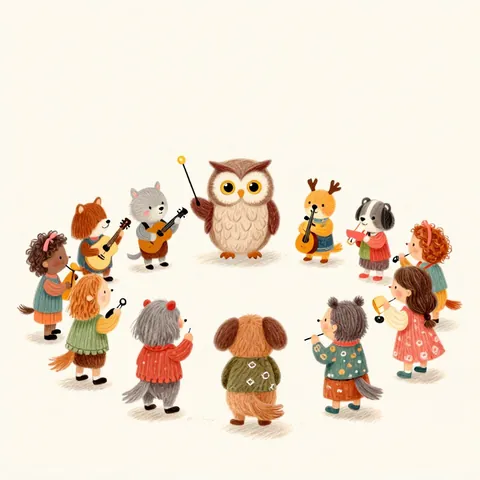
The conductor stands in front of the orchestra and does not play an instrument. With the hands and a small stick called a baton, the conductor shows the speed, tells each section when to come in, and shapes how loud or soft the music is. The conductor is like a coach who helps eighty players move together as one.
Smaller groups
Not all music needs a big orchestra. A string quartet has two violins, a viola and a cello. A wind band has woodwinds, brass and percussion but no violins. A rock band might have a guitar, a bass, a drum kit and a singer. In every group, the players listen to each other first, and that is the real secret of playing together.
Piano sound: Salamander Grand Piano by Alexander Holm (CC BY 3.0).