
Ukulele: Parts, How It Makes Sound and How to Play
The ukulele is a little guitar with four strings. Its strings are tuned in a surprising order, so the whole instrument sounds bright and close together. On this page you will see how it is built, where its sound comes from, and how to play your first chord.
In this lesson
Meet the ukulele
The ukulele is a small, four-string, guitar-like instrument that you pluck. Its ancestor is the machete, a small four-string guitar that Portuguese settlers brought to Hawaii. Its Hawaiian name is often translated as “flea”.
There are four common sizes. From smallest to largest they are soprano, concert, tenor and baritone. The most common small ukuleles are under 60 cm long. Bigger sizes are longer: Kamaka's current baritone, for example, is about 77.5 cm long overall.
Every maker uses slightly different numbers. Taking Kamaka's current models as an example, the soprano's vibrating string is about 34–35 cm long and the baritone's about 50 cm. The soprano has the shortest strings and the most closely spaced frets.
Soprano, concert and tenor ukuleles are tuned G–C–E–A. The baritone is tuned D–G–B–E, the same as the four highest (thinnest) strings of a guitar. This page focuses on the most common setup: a soprano tuned G–C–E–A.
- Family
- String instruments (plucked)
- Classification
- Hornbostel–Sachs 321.322: necked box lute (the neck is attached to a hollow body)
- Standard tuning
- G4–C4–E4–A4 (4th string to 1st string)
- Sounding range
- C4 to about C♯6 (16-fret Kamaka soprano)
- Clef
- Treble clef
- Transposition
- Non-transposing (written at sounding pitch)
- Common sizes
- Soprano, concert, tenor, baritone
Parts of the ukulele
Kamaka calls the soprano's shape a “small, figure eight body”. On Kamaka's current models the top, back and sides are koa, the neck is mahogany, and the fingerboard and bridge are rosewood (ebony on some higher models).
On a Kamaka soprano or concert, the neck meets the body at the 12th fret; on the tenor and baritone it meets at the 14th fret. A 1950s Kamaka in a college museum has nylon strings. A machete that comes with papers from 1843 has gut strings.
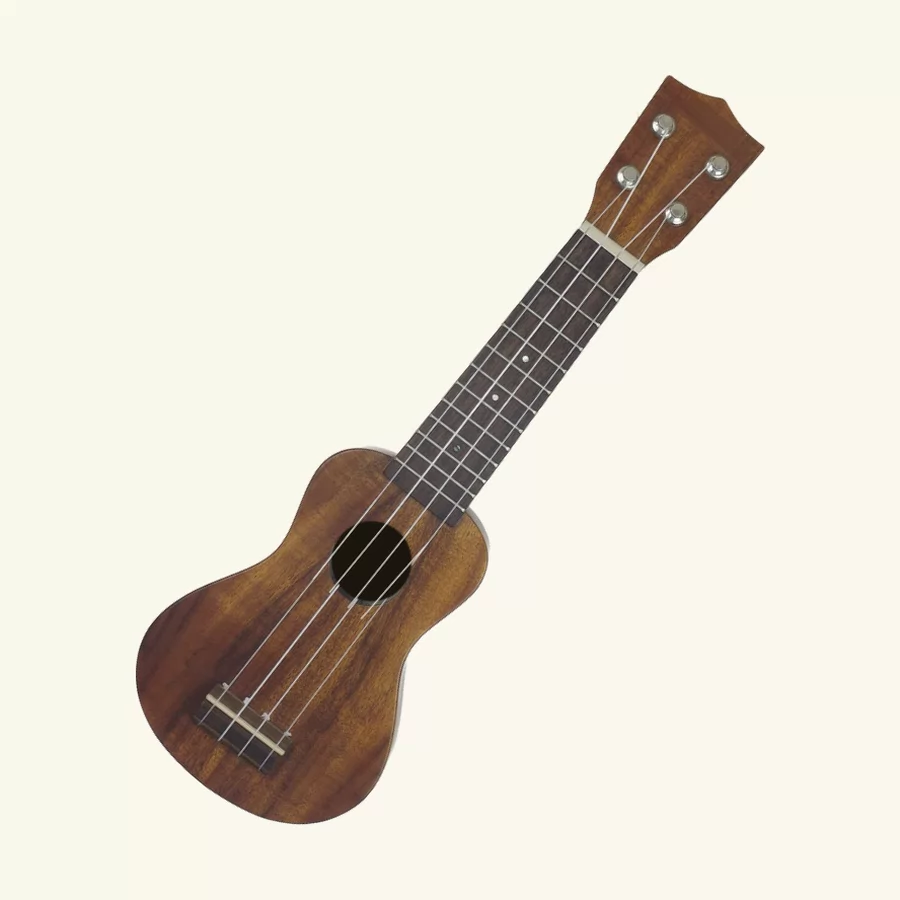
- 1Headstock headstock
The top end of the instrument, where the tuning pegs sit.
- 2Tuning pegs tuning pegs
Turn them to tighten or loosen a string and change its pitch.
- 3Nut nut
One end of the vibrating part of each string.
- 4Neck neck
What your hand holds; it carries the fingerboard.
- 5Fingerboard and frets fretboard & frets
Press a string behind a fret to shorten the vibrating part and raise the note.
- 6Top top / soundboard
The thin wooden face that picks up the string's shaking and pushes the air.
- 7Sound hole soundhole
Air inside the body moves in and out here, helping the low notes.
- 8Bridge bridge
Holds the ends of the strings and passes their vibration into the top.
- 9Back and sides back & sides
Close the hollow body; the traditional shape is a figure eight.
- 10Strings strings
The four strings that vibrate when you pluck or strum them.
Where the sound comes from
A string is so thin that it can barely push the air. On instruments like the guitar and ukulele, the strings themselves make hardly any noise. It is like waving a chopstick: you feel almost no breeze. Wave a fan and you feel a lot more.
So the string passes its shaking through the bridge into the top. The top is a large, thin wooden surface, braced on the inside, and it pushes the air like that fan. Air inside the body also bounces in and out of the sound hole, a bit like the hoot you get when you blow across a bottle. That air helps the low notes most.
The pitch depends on the string. A shorter, tighter or lighter string vibrates faster and sounds higher. When you press a string behind a fret, the part that can vibrate gets shorter, so the note goes up. In equal temperament, each fret raises the note by one semitone.
A plucked string vibrates as a whole and in halves, thirds and quarters at the same time. These are its overtones. If you pluck exactly at a still point (a node) of one of those patterns, that pattern is not started: pluck one third of the way along, and the 3rd, 6th, 9th… of these patterns are missing. The high overtones also fade fastest, so a note sounds rounder a second or two after you pluck it.
A bigger body usually gives a louder, warmer sound with more bass, though the wood and the building matter too. Kala describes the soprano as brighter and softer with less projection, and the baritone as the deepest, close to an acoustic guitar.
Try it: stretch a rubber band between two fingers and pluck it. You hear almost nothing. Now stretch it around an open empty box and pluck again. The box works like the ukulele's body and makes the sound much louder.
How to play
Sit on the front edge of a chair without arms; leaning back makes playing harder. Hold the ukulele close to your body. Without a strap, your right forearm holds it against your chest. You can strum anywhere that feels good, but the sweet spot is near where the neck meets the body.
Your left thumb rests behind the neck. Your fingers arch gently and press with their tips between the frets. Keep these fingernails short and your wrist straight and relaxed. If a finger touches a neighbouring string, it mutes that string and the chord sounds unclear.
From top to bottom as you hold it, the strings are the 4th (G), 3rd (C), 2nd (E) and 1st (A). Start by strumming down with your thumb. The thumb finds strumming up awkward, so strum up with a finger of your right hand. A first lesson often uses the chords C, F, G7 and C7.
Later you can try other techniques. In campanella (Italian for “little bell”), each note of a melody goes on a different string, so the notes ring over each other like bells; baroque guitar used the same kind of tuning for this. A split stroke mixes single notes with full chords and moves the strong strum from beat 2 to the “and” after it, for a ragtime-style rhythm. Method books also teach tremolo.
- Brush across all four strings: down with your thumb, up with a finger. Here is one down-strum of a C chord (1st string pressed at the 3rd fret). The demo is built from the four single strings layered one after another.
- Pluck the strings one at a time with separate fingers, so each note stands apart. Here are the four open strings, 4th to 1st. Kala notes that the tenor's wider fret spacing suits fingerpicking.
Range and notation
Ukulele music is written at the pitch you hear, so it is not a transposing instrument; it is normally written in the treble clef. Compare the guitar, which sounds an octave lower than written; even the baritone ukulele is often written at pitch.
The open strings are G4, C4, E4 and A4. The lowest open string is C4 (middle C), not the G. The G string sits higher than the C. This is called re-entrant tuning, and it is not a mistake. All four open strings fit inside one octave, and strummed together they make a C6 chord.
The highest note is the 1st string (A4) plus one semitone per fret. On a 16-fret Kamaka soprano or concert that is C♯6; on an 18-fret Kamaka tenor it is D♯6. Fret counts vary: a 1950s Kamaka with 12 frets only reaches A5.
With a low-G string, the 4th string drops an octave to G3, and it is written an octave lower too. Kala's Tenor XL traditionally uses low G. The baritone is tuned D3–G3–B3–E4 and reaches about B5 with 19 frets. Britannica also lists a tuning of A4–D4–F♯4–B4.
Many players read tab. Its four lines are the four strings, with the 1st string (A) on top, and each number is a fret. A C chord is a 3 on the top line and 0 on the other three.
Listen
- The 4th string, then the 3rd. The string on top sounds higher, not lower: that is re-entrant tuning.
- G4, C4, E4, A4. All four sit inside one octave, which gives the ukulele its close, bright sound.
- G4, C4, E4 and C5 start a few milliseconds apart, from the 4th string to the 1st, and blend into one chord.
- Middle C on the 3rd string. Listen to the start, then the end: the bright high overtones fade first.
- First a ringing C chord, then a strum with the strings held down. A muted string has almost no pitch, just a short click, which is why fingers must not touch the wrong strings.
History and family
The ukulele grew out of the machete (also called the braguinha), a small four-string guitar from the island of Madeira. One machete made in Madeira between 1840 and 1870 is 50.5 cm long, with a pine top, olive-wood back and sides, and brass frets. The museum says this type was taken up in Hawaii in the 1880s as the ukulele.
On 23 August 1879 the ship Ravenscrag reached Honolulu with 423 people from Madeira who came to work on the sugar plantations. On board were Manuel Nunes, Augusto Dias and José do Espírito Santo. They first worked as plantation hands; by 1889 all three were listed as guitar makers. They are among the first makers of the ukulele.
King Kalākaua brought the ukulele into royal shows and parties at ʻIolani Palace. This royal support helped people see it as Hawaii's own instrument. The name means “jumping flea”. One story says it came from the nickname of Edward Purvis, a small, lively man who helped make it popular. Another says it describes the player's fingers jumping across the strings.
The 1915 Panama–Pacific International Exposition in San Francisco carried the ukulele to mainland America. Martin made its first sopranos that year, concerts from 1925 and its first tenors in 1929. In Hawaii, Samuel Kamaka began building koa ukuleles in 1916 and patented an oval “pineapple” ukulele in 1928.
The family is wide. Madeira's five-string rajão is tuned D–G–C–E–A, so its last four strings match the ukulele's G–C–E–A; the rajão later became the eight-string taropatch. Baroque guitar also used re-entrant tuning. The banjo ukulele swaps the wooden top for a small banjo body with a calfskin head; one example in Edinburgh was made in London around 1940.
- 1840–1870A four-string machete is built in Madeira (now in the V&A)
- 1879The Ravenscrag brings Madeiran workers, including Nunes, Dias and Espírito Santo, to Honolulu
- 1889All three are listed in Honolulu as guitar makers
- 1915Panama–Pacific Exposition in San Francisco; Martin makes its first sopranos
- 1916Samuel Kamaka starts building koa ukuleles in his basement
- 1928Kamaka patents the oval pineapple ukulele
- 1959Kamaka opens its factory on South Street, Honolulu
Getting started and care
Size is a trade-off. The soprano has the shortest strings and the closest frets, and Kamaka calls it the perfect first ukulele and a favorite of players with smaller hands. Bigger sizes sound louder and warmer, with wider fret spacing. Kamaka calls the concert the best blend of size and sound, and says the tenor is the size its artists use most.
The baritone shares its tuning with the guitar's top four strings. Because it sits a fourth lower, the shape that makes C on a soprano makes G on a baritone.
Kamaka notes that solid wood is sensitive to temperature and humidity. Slow changes are usually fine; sudden ones are what to avoid.
- Keep it in a hard case when you are not playing, safe from bumps and sudden changes in temperature or humidity.
- Keep it away from heaters and other direct heat; an instrument humidifier can help keep the humidity at the right level.
- For everyday care, wipe it with a soft, clean, dry cotton cloth; to clean it, use a slightly damp cloth, never a wet one. On a lacquer finish you can use an instrument cleaner, but avoid anything containing wax.
- Keep the nails of your chord hand cut short; it makes pressing the strings much easier.
- If the G string sounds higher than the C string, nothing is wrong: that is the standard re-entrant tuning.
- Ukulele | Britannica
- Hawaiian Dictionaries: ʻukulele (Pukui & Elbert; Parker)
- Machete | V&A Explore the Collections
- Machete de braga M55-1982 | Horniman Museum
- Banjo ukulele | MIMEd, University of Edinburgh
- Ukulele | Grinnell College Musical Instrument Collection
- Manuel Nunes | Ukulele Hall of Fame Museum
- David Kalākaua | Ukulele Hall of Fame Museum
- Our Legacy | Kamaka Hawaii
- Soprano HF-1 | Kamaka Hawaii
- Maintaining Your Ukulele | Kamaka Hawaii
- Understanding Uke Body Sizes | Martin Guitar
- Which Ukulele Size Is Right for You? | Kala
- How a guitar works | UNSW Physics
- Strings, standing waves and harmonics | UNSW Physics
- Your First Ukulele Lesson | Ukulele Magazine
- Ukulele notation | Ukulele Magazine
- Letter from Madeira | Ukulele Magazine
- Daniel Ward Uke Lesson: Standard and Baritone Chord Shapes (Ukulele Magazine)
- How to Tune Your Ukulele, Decoded (Kala)
Piano sound: Salamander Grand Piano by Alexander Holm (CC BY 3.0).