
Violin: How It's Built, How It Sounds, How to Play It
The violin is the smallest and highest member of the violin family. A bow strung with horsehair keeps its strings vibrating for as long as you keep pulling, so a single note can grow, fade or sing. This page shows what is inside a violin, why it makes sound, and how players use their two hands.
In this lesson
Meet the violin
The violin is a string instrument played with a bow. It is the soprano of the violin family, which means it is the member with the highest voice.
It has four strings tuned a perfect fifth apart: G3, D4, A4 and E5. When A4 is tuned to 440 Hz, the open strings vibrate about 196, 293.7, 440 and 659.3 times per second. Many teachers number the strings from the thinnest one, so string 1 is the high E string and string 4 is the low G string.
Violins come in a full size called 4/4 and in smaller fractional sizes for younger players. The fraction is just a size name, not the real length: a 1/2 violin is not half as long as a full-size one.
- Family
- String instrument (violin family, highest member)
- Type
- Bowed string instrument (Hornbostel–Sachs 321.322-71: necked box lute sounded with a bow)
- Open strings
- G3, D4, A4, E5 (in fifths)
- Sounding range
- G3 to A7 (harmonics up to D8)
- Clef
- Treble clef
- Transposition
- Non-transposing (sounds as written)
- Common sizes
- 4/4 full size; 3/4, 1/2, 1/4, 1/8, 1/16, 1/32; also 7/8 and 1/10
Parts of the violin
A violin is a hollow wooden box with a neck. The top (also called the belly) is spruce, while the back, ribs, neck and bridge are maple, so the whole violin is not made of one kind of wood. The body is about 35.5 cm long and the whole instrument about 60 cm.
Two hidden parts sit inside the body. The sound post is a small spruce stick standing between the top and the back near the bridge's treble foot. The bass bar is a strip about 25 cm long glued under the top beneath the bridge's bass foot, and it gives back some of the stiffness lost when the f-holes are cut.
The bow is a stick with a ribbon of about 150 to 250 horsehairs, about 74 cm long. Turning the screw at the frog (the end you hold) tightens or loosens the hair. Counting every small piece, a violin has roughly 70 to 80 parts.
Some parts sit inside or behind the instrument where the picture cannot show them; their numbers mark roughly where they are.
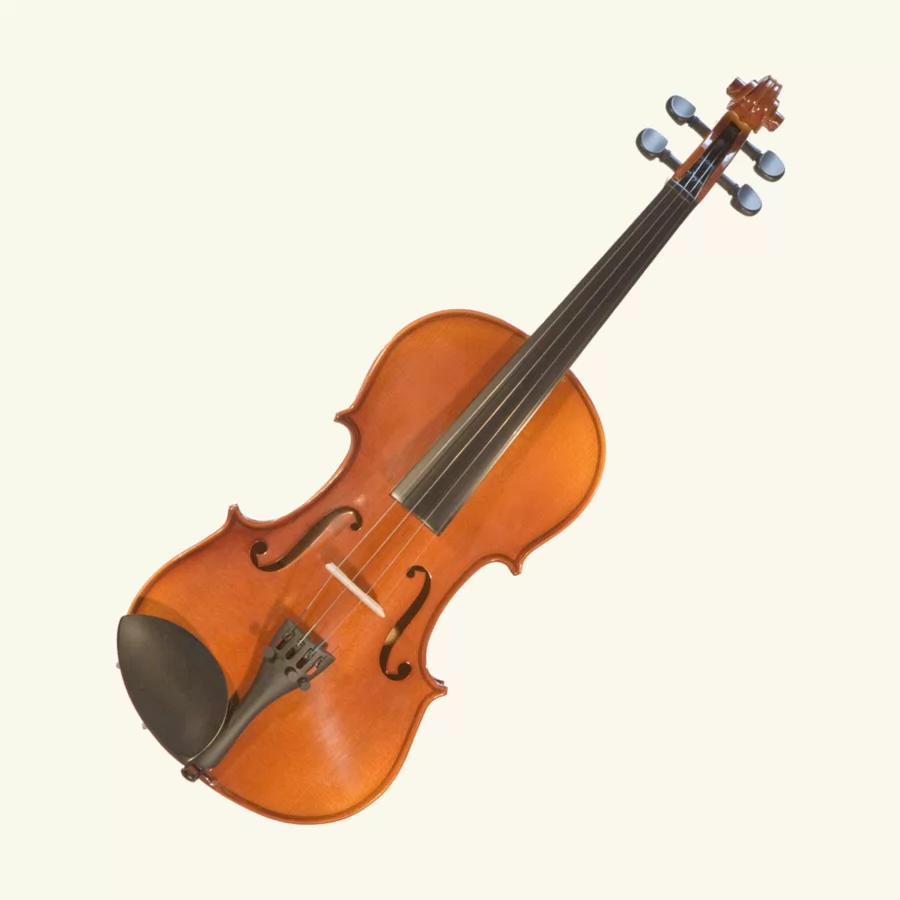
- 1Scroll scroll
The curled carving at the very top of the violin.
- 2Pegbox and pegs pegbox, tuning pegs
Four pegs, two on each side; turning a peg tightens or loosens a string.
- 3Nut nut
One end of the vibrating part of the string; the bridge is the other end, about 32 cm away.
- 4Fingerboard fingerboard
Ebony board with no frets; fingers press the strings onto it to make them shorter.
- 5Top top / belly
Spruce plate that picks up the bridge's shaking and pushes the air.
- 6f-holes
Two f-shaped openings that let the air inside the body resonate with the outside.
- 7Bridge bridge
Maple piece that holds the strings up in four notches and passes their vibration to the top.
- 8Sound post sound post
Spruce stick inside the body that carries force and vibration from the top to the back.
- 9Tailpiece and fine tuners tailpiece, fine tuners
Holds the string ends; fine tuners make tiny tuning changes. Some violins have them on all four strings, some only on E.
- 10Chin rest chin rest
The cup where your jaw rests so you can hold the violin steady.
Where the sound comes from
Rosin on the bow hair makes it grippy when it is still but slippery once it slides. So the bow grabs the string and drags it along, until the string pulls back harder than the grip can hold. Then the string slips back, gets grabbed again, and the cycle repeats. It is the same stick-and-slip that makes a sneaker squeak on a gym floor.
While this happens, the string forms two straight lines with one sharp corner running back and forth along it. Scientists call this Helmholtz motion. Each trip of the corner is one vibration, so the number of trips per second is the note's frequency: on the A string it happens 440 times per second, far too fast to see.
A string alone is very quiet, because it is thin and barely moves any air. The bridge passes the vibration into the top, the sound post carries it on to the back, and these big wooden plates push the air much like a paper fan moves more air than a toothpick. The air inside the body also resonates through the f-holes, a little like the hum when you blow across the mouth of a bottle.
This air resonance sits low in the violin's range. In one set of measurements it was about 242 to 291 Hz, depending on whether the sound post was in and where. Adding the sound post stiffens the body and raised it about 4 semitones; making the f-holes 20% bigger raises it about 1 semitone, and 10% more air inside lowers it about 1 semitone.
Pitch depends on length, tension and weight: tighter and shorter strings sound higher, heavier strings sound lower. Pressing a finger onto the fingerboard shortens the vibrating part, so the note goes up. The sharp corner of Helmholtz motion creates every whole-number overtone, except the few that have a still point (a node) exactly where the bow touches.
Try it: hold a ruler flat on a table edge and twang the part that sticks out. Slide more of it onto the table and twang again. The shorter the free part, the higher the buzz, just like a finger shortening a violin string.
How to play
Rest your jaw on the chin rest and hold the violin level with the floor. Your left hand curves into a relaxed C shape around the neck, with the left elbow under the middle of the violin. Sitting, use the front edge of a firm chair with the left foot slightly forward; standing, keep your feet shoulder-width apart.
For the bow, your right thumb and middle finger meet to make a relaxed oval, with the other fingers gently curved. A down-bow pulls from the frog toward the tip and often goes with strong beats; an up-bow pushes from the tip back to the frog and often goes with weak beats.
Three things shape the tone: bow speed, bow pressure and how close you play to the bridge. Near the bridge the sound is loudest and needs a little more pressure; toward the fingerboard it gets softer. More pressure adds high overtones and makes the sound brighter.
Your left fingers change the pitch on each string, and crossing to another string moves you to another register. Other effects include détaché (one note per bow stroke), slurs (several notes in one stroke), tremolo (very fast strokes at the tip), harmonics (a soft, flute-like sound), sul ponticello (glassy, near the bridge), sul tasto (muted and flute-like, over the fingerboard) and col legno (tapping with the wood of the bow).
- The bow keeps the string vibrating, so the note lasts as long as the stroke.
- Pluck the string with the fleshy part of a finger: a clear start that dies away quickly.
- The bow drops onto the string, travels a little and bounces off, giving short, light notes.
- A left finger rocks a little on the string, so the pitch wavers gently. This bowed A4 is played with vibrato.
Range and notation
Violin music is written in treble clef. The violin is not a transposing instrument, so the written note and the sounding note are the same: a written A4 sounds as A4, 440 Hz.
The lowest note is the open G string, G3. From there the violin reaches about four octaves, and professional players go up to A7; harmonics can reach D8. G3 to G7 is exactly four octaves, so A7 is a whole step more than that.
Each string covers its own stretch. The G string usually plays G3 to C5, the D string D4 to G5, the A string A4 to D6, and the E string E5 to A7, and skilled players can push each of them higher.
Listen
- The open G string: listen for the dark, full color of the violin's lowest note.
- A4 is the open A string, tuned to 440 Hz.
- The open E string: listen for its shiny, slightly metallic edge.
- Two octaves above A4, so it vibrates four times as fast. Compare it with A4 right before it.
- The same note twice: the bowed one keeps going, the plucked one fades away on its own.
History and family
The violin grew out of earlier bowed instruments such as the medieval fiddle, the rebec and the lira da braccio, and it developed from the viola da braccio. It took shape in northern Italy in the mid-1500s, in cities such as Milan, Brescia, Cremona and Venice.
Andrea Amati of Cremona is credited with making the first instruments of the violin family. He set the f-holes, the scroll and the four strings, and he built his instruments on an internal mold. The earliest dated violin is one he made in 1564 for the court of the French king Charles IX; it is kept at the Ashmolean Museum in Oxford.
Later famous makers included Nicolò Amati (1596–1684) and Antonio Stradivari (1644–1737). Stradivari tried a longer model in the 1690s, then from about 1700 used a shorter, wider grand pattern; many writers call the roughly twenty years that followed his golden period. He is said to have made about 1,000 instruments, of which about 600 survive. Giuseppe Guarneri del Gesù (1698–1744) and Jacob Stainer (1621–1683) were also famous makers.
In the 19th century, large concert halls and virtuoso players called for more power. Makers raised the bridge, made the sound post and bass bar thicker, flattened the body and tilted the neck back, giving a stronger, brighter sound. François Tourte (1747–1835) improved the bow: it became longer and stronger, with more tension, so players could use more powerful strokes. In the early 1800s he settled on a stick that curves in toward the hair, which became the standard bow of the violin family.
The violin's family members are the viola (strings C, G, D, A), the cello (C2, G2, D3, A3, an octave below the viola, played upright) and the double bass. The bass is tuned in fourths, E1, A1, D2, G2, and is written an octave higher than it sounds.
- c. 1520–1550The violin takes shape in northern Italy.
- 1564Andrea Amati makes the earliest dated violin that survives.
- c. 1700Stradivari begins his grand pattern; about twenty golden years follow.
- Early 1800sTourte's bow, curving in toward the hair, becomes the standard.
- c. 1820Louis Spohr invents the chin rest.
- 1800sHigher bridges and a tilted neck give a stronger, brighter sound; vibrato becomes common.
- 1900sThe E string changes from gut to steel.
Getting started and care
To check the size, hold the violin under your chin and reach your left hand out to the scroll: your hand should wrap around the scroll comfortably without stretching. Yamaha lists body lengths of about 14 inches for 4/4, 13 for 3/4, 12 for 1/2, 11 for 1/4, 10 for 1/8, 9 for 1/16 and 8 for 1/32.
Before playing, turn the screw at the end of the frog to set the bow hair tension, then rub on rosin evenly along the whole length of the hair; the first time, use more. Tune all four strings first. Common beginner trouble includes squeezing the violin too hard, pressing too much with the jaw, neck or back, and using so much rosin that the sound turns shrill.
Violin wood is held together with glue, so sudden changes in heat or humidity can open a joint or knock the strings out of tune. Keep the violin out of direct sun, away from extreme heat, cold, dryness, damp, dust and strong shaking, and do not leave it in a car for long.
- Always loosen the bow hair before putting the bow back in the case; it helps the bow last longer.
- Wipe the violin with a soft dry cloth; never use benzene, alcohol or thinner, and do not spray anything near it, because these damage the finish.
- In summer and winter, wait until the violin has adjusted to room temperature before playing.
- Replace rosin at least once a year, before it dries out and turns dusty instead of sticky, and change strings every few months.
- Change one string at a time. Removing all four can let the bridge fall and the tailpiece come loose.
- When turning a peg, press it firmly in toward the head at the same time.
- After tuning, check that the side of the bridge facing the tailpiece stands at a right angle to the top. If it leans, set the violin on a steady surface, loosen the strings a little and gently straighten the bridge with both hands, keeping each string in its notch.
- Keep your face away from the violin while tuning or changing strings; a breaking string can hurt your eyes or face.
- Vienna Symphonic Library – Violin
- Vienna Symphonic Library – Cello
- Vienna Symphonic Library – Double Bass
- HyperPhysics – The Violin
- Penn State (D. Russell) – Bowed string motion
- UNSW Music Acoustics – Bows and strings
- UNSW Music Acoustics – Violin articulation
- UNSW Music Acoustics – Strings, standing waves and harmonics
- UNSW – The violin f-holes (paper, PDF)
- Yamaha – Violin owner's manual (PDF)
- Yamaha Hub – What is a fractional size violin?
- Yamaha Hub – Eight great tips for learning violin
- Yamaha Hub – New to teaching strings
- Ashmolean Museum – Musical instruments
- The Met – Andrea Amati violin
- Britannica – Violin
- UNSW – McLennan: the soundpost and A0 resonance
- The Met – Violin makers Nicolò Amati and Antonio Stradivari
- Britannica – Bow (stringed-instrument accessory)
- NIMiT – Violin (Hornbostel–Sachs 321.322-71)
Piano sound: Salamander Grand Piano by Alexander Holm (CC BY 3.0).