
Romantic music: big feelings and big orchestras
In the Romantic era, about 1820 to 1900, composers became more and more independent artists who shared their own feelings, rather than only working for rich families. Music could be stormy, dreamy, funny or heartbroken, and the orchestra grew to match.
In this lesson
Music that tells a story
Romantic composers loved stories, nature and strong feelings. A piece could describe a sunrise, a ghost, a love story or a walk in the forest. This is sometimes called programme music, because the music follows a story or a picture.
To tell big stories, composers added more instruments. The Romantic orchestra has many violins, extra brass and big percussion, so it can whisper and thunder.
The piano becomes a star
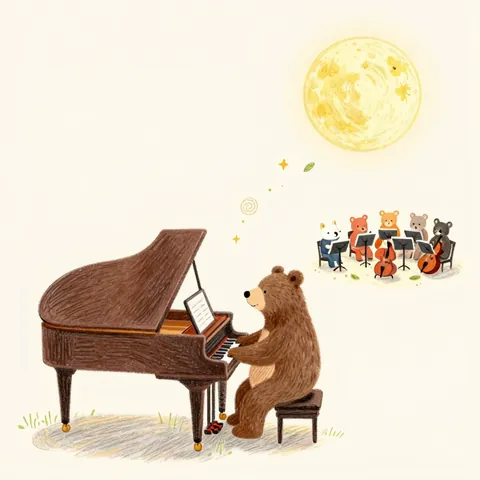
Pianos became louder, stronger and cheaper, and many families could have one at home. Some performers, called virtuosos, amazed audiences with their speed and skill. Frédéric Chopin (1810–1849), a Polish composer who lived mostly in Paris, wrote piano pieces that sound like poems.
Tunes from home
In many countries, composers began to use folk songs and dances of their own people. Antonín Dvořák wrote Czech dances, and Edvard Grieg wrote music inspired by Norway. This is called musical nationalism.
Opera and ballet
Giuseppe Verdi (1813–1901) wrote Italian operas full of famous tunes. Richard Wagner (1813–1883) wrote huge German operas that last for hours. Pyotr Ilyich Tchaikovsky (1840–1893) from Russia wrote the music for the ballets Swan Lake, first shown in 1877, and The Nutcracker, first shown in 1892.
Women composers
Many women wrote wonderful music in this era, even though it was hard for them to work as professionals. Fanny Mendelssohn (1805–1847) wrote hundreds of pieces. Clara Schumann (1819–1896) was one of the most famous pianists of her time and also a composer.
Piano sound: Salamander Grand Piano by Alexander Holm (CC BY 3.0).