
Wolfgang Amadeus Mozart: the child who wrote music
Wolfgang Amadeus Mozart was already playing the keyboard when he was a very small child, around three or four years old, and was making up his own little pieces by the age of five. He lived only 35 years, but wrote an enormous amount of music that people still love.
In this lesson
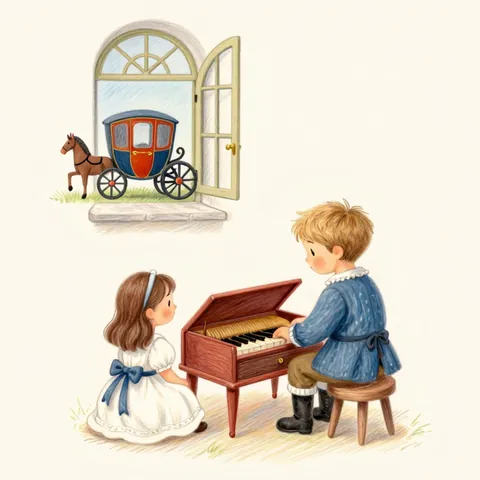
A child on tour
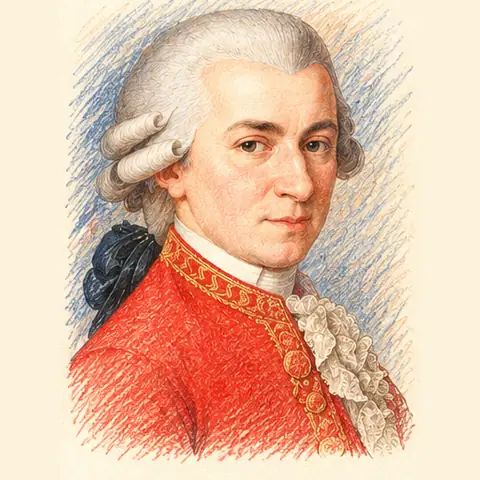
Mozart was born in 1756 in Salzburg, in Austria. His father Leopold was a violinist and a teacher, and he taught both Wolfgang and his older sister Maria Anna, who was nicknamed Nannerl. She was also a very good keyboard player.
When the children were young, their father took them on long trips through Europe to play for kings, queens and other people. They travelled by coach, and the trips were long and tiring.
A turning point
When Wolfgang was about five, he made up little tunes at the keyboard. His father wrote them down, because a small child could not yet do it himself.
In 1762 the family travelled to Munich and then Vienna, so the children could play for the courts there. Wolfgang and his big sister Nannerl played together.
Later, in 1770, a famous story says he heard a long choir piece, Allegri's Miserere, in Rome and wrote it down from memory. His father described it in a letter home, and it shows how sharp his ears were.
Writing in Vienna
When he grew up, Mozart moved to Vienna in 1781. There he played concerts, taught students and wrote music for the theatre and the concert hall. He wrote symphonies, piano concertos, string quartets and operas such as The Marriage of Figaro and The Magic Flute.
Mozart died in 1791 at the age of 35. People still wonder how one person could write so much in such a short life.
Some famous pieces
Mozart's music is known for tunes that are clear, graceful and easy to remember.
- Eine kleine Nachtmusik
- A cheerful piece for string instruments, written in 1787, with a very famous first tune.
- Eine kleine Nachtmusik, first movement · The main tune, a short excerpt played on our piano from a public-domain score.
- The Magic Flute
- An opera with magic, birds and a brave prince, first performed in 1791.
- Symphony No. 40
- A symphony in a minor key, with a restless and singing first tune.
- Piano Sonata No. 11
- A sonata whose last part is known as the "Turkish March" and is one of his best-known tunes.
- Rondo alla Turca ("Turkish March"), Piano Sonata No. 11 · The main tune, a short excerpt played on our piano from a public-domain score.
Try listening for
- Piano Concerto No. 21, slow movement
- Listen for the soft, dreamy tune over gently repeating notes in the strings, written in 1785.
- Twelve Variations on "Ah vous dirai-je, Maman"
- The tune is the same as Twinkle, Twinkle, Little Star, and Mozart dresses it up in many new ways.
- Clarinet Concerto
- Listen to the warm, singing clarinet, in one of his last pieces, from 1791.
- The Queen of the Night's aria
- Listen for the singer leaping up to very high notes, like a bird flying up fast.
- The Queen of the Night's aria ("Der Hölle Rache") · The main tune, a short excerpt played on our piano from a public-domain score.
Hum Twinkle, Twinkle first. Then listen to the variations and see how many times you can still hear the same tune hiding inside.
How to listen
Listen to how a Mozart tune often feels like a question and then an answer, with neat steps up and down. Try to hum it after you hear it once. Many people find it very easy to remember.
Meanwhile, around the world
- 1759Handel dies
The famous composer of Messiah died in London, when Mozart was three.
- 1767Tyagaraja is born
This great composer of South Indian Carnatic songs was born in Tamil Nadu, India, according to tradition.
- 1770Beethoven is baptised
Another great composer was baptised in Bonn in Germany, while Mozart was touring Italy.
- 1781A new planet
William Herschel spotted Uranus from his garden in England, the same year Mozart moved to Vienna.
- 1783First balloon flight
In Paris, two men made the first free flight in a hot-air balloon.
How this page was checked: each fact was looked up again in the sources below — encyclopedias, museums, universities, cultural institutions and makers. Wikipedia was used only as a pointer, never as a source. It has not been reviewed by an outside music expert; if you spot a mistake, please tell us at [email protected].
- Encyclopaedia Britannica — Wolfgang Amadeus Mozart
- Salzburg Mozarteum Foundation — Wolfgang Amadé Mozart
- Mozarteum Köchel Catalogue — Music book for Maria Anna (Nannerl) Mozart, 1759
- Encyclopaedia Britannica — Leopold Mozart
- Encyclopaedia Britannica — The Magic Flute
- Encyclopaedia Britannica — Twelve Variations on “Ah, vous dirai-je, Maman,” K 265
- Classic FM — Mozart's biography: his first concert and European tour (1762–1765)
- Salzburg tourism board — Wolfgang Amadeus Mozart: biography in brief
- Boston Symphony Orchestra — Mozart Piano Concerto No. 21 (program note)
- Classic FM — Mozart: Turkish March (Rondo alla Turca from Sonata No. 11)
- Classic FM — Mozart: Symphony No. 40 in G minor
- English National Opera — An introduction to The Magic Flute
- Hyperion Records — Allegri: Miserere; Palestrina: Missa Papae Marcelli (notes)
- Classic FM — Did a teenage Mozart really transcribe Allegri's Miserere?
- Hyperion Records — Variations on Ah vous dirai-je, maman 'Twinkle, twinkle, little star', K265
- Encyclopaedia Britannica — George Frideric Handel
- Encyclopaedia Britannica — Tyagaraja
- Encyclopaedia Britannica — Ludwig van Beethoven
- Herschel Museum of Astronomy — Explore the museum (garden and telescope)
- Encyclopaedia Britannica — Montgolfier brothers
- Score for the piano excerpt — Eine kleine Nachtmusik, first movement: Mutopia Project, Eine kleine Nachtmusik, 1st movement (KV 525) — typeset by Anonymous (public domain)
- Score for the piano excerpt — Rondo alla Turca ("Turkish March"), Piano Sonata No. 11: Mutopia Project, Sonate Opus KV 331 - Rondo Alla Turca — typeset by Rune Zedeler and Chris Sawer (public domain)
- Score for the piano excerpt — The Queen of the Night's aria ("Der Hölle Rache"): Mutopia Project, Die Zauberflöte - No. 14 Arie (KV 620) — typeset by Deborah Lowrey (public domain)
Piano sound: Salamander Grand Piano by Alexander Holm (CC BY 3.0).