
Baroque: ornaments, opera and the harpsichord
Think of a building full of golden curls, painted ceilings and statues. The music of the Baroque era, about 1600 to 1750, has the same love of decoration and drama.
In this lesson
What does "Baroque" mean?
The word is thought to come from a Portuguese word for a pearl with an uneven shape. It was first used for the very decorated buildings and paintings of the time, and later for the music too.
How Baroque music sounds
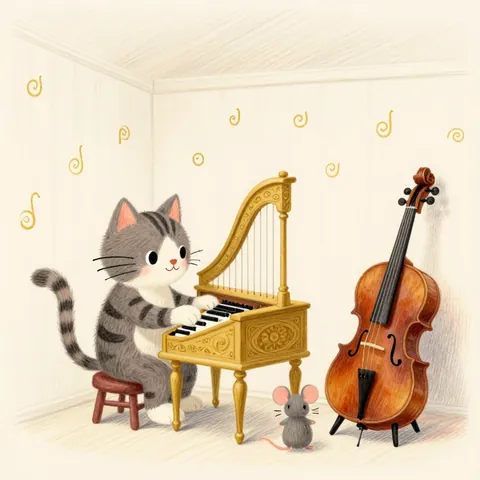
Baroque tunes are often decorated with quick little twirls called ornaments. Underneath, a strong bass line, played by a harpsichord or an organ and a cello, holds everything together. This is called the basso continuo.
Baroque music loves contrast. A group of players may suddenly be soft, then loud, then soft again, like steps going up and down.
The first operas
Opera, a play that is sung from start to finish, began in Italy around the year 1600. One of the first great operas still performed today is L'Orfeo by Claudio Monteverdi, which was first performed in 1607 in the Italian city of Mantua.
Famous Baroque composers
These composers lived in Europe, and many of their pieces are still played today.
- Antonio Vivaldi (1678–1741)
- A violinist and priest from Venice. He wrote hundreds of concertos, including The Four Seasons.
- Johann Sebastian Bach (1685–1750)
- A German organist and composer who wove several melodies together in a clever way.
- George Frideric Handel (1685–1759)
- Born in Germany, he lived in London and wrote operas and the oratorio Messiah, first performed in Dublin in 1742.
- Henry Purcell (1659–1695)
- An English composer who wrote music for the theatre, including an opera called Dido and Aeneas.
Piano sound: Salamander Grand Piano by Alexander Holm (CC BY 3.0).