
Music through time: a timeline
How long have people made music? Much longer than they have been able to write it down. Here is the story in a line, from the first flutes to the phone in your pocket.
In this lesson
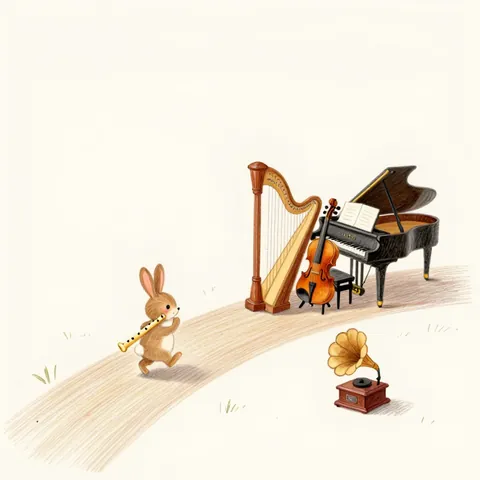
Music is older than writing
People have made music for a very long time. In caves in southern Germany, scientists have found flutes made from the bones of birds and from mammoth ivory. They are about 40,000 years old (give or take a few thousand years), and they are among the oldest instruments ever found. Nobody knows what the first songs sounded like, because there was no way to write them down.
One of the oldest songs that we can read was written about 3,400 years ago on a clay tablet in the ancient city of Ugarit, in what is now Syria. It is called the Hurrian hymn, and it is the oldest nearly complete piece of written music that we have. Experts still argue about exactly how it should sound.
The story in a line
Dates in old history are not exact, so many of these years begin with "about" or "around".
- about 40,000 years agoBone flutes
People carve flutes from bird bone and ivory.
- about 1400 BCEThe oldest written song
A clay tablet from Ugarit holds the oldest nearly complete piece of music that was written down.
- about 500 BCEStrings and numbers
Thinkers in ancient Greece, including followers of Pythagoras, study how the length of a string changes its note.
- about 1025Lines and syllables
A monk called Guido of Arezzo is remembered for teaching with the lines of the staff and the names ut-re-mi, the ancestors of do-re-mi.
- 1501Printed music
Ottaviano Petrucci prints a big book of songs for several voices in Venice with movable type, and music can spread far and fast.
- about 1700The piano
Bartolomeo Cristofori builds the first piano in Italy, an instrument that can play soft and loud.
- about 1600–1750The Baroque era
Opera, the harpsichord and composers such as Vivaldi, Bach and Handel.
- about 1750–1820The Classical era
Clear and balanced music by Haydn, Mozart and the young Beethoven.
- about 1820–1900The Romantic era
Big feelings, big orchestras and piano poems by Chopin.
- 1877Recorded sound
Thomas Edison shows his phonograph, a machine that can record a voice and play it back.
- early 1900sJazz
Jazz grows in New Orleans, in the United States, out of blues, ragtime, marches and African rhythms.
- 1950sRock and roll
Electric guitars and a strong beat bring a new kind of popular music.
- 1982The compact disc
Music goes digital: the first CDs and CD players go on sale.
- 2000sMusic on every phone
Downloads and streaming put millions of songs in your pocket.
A map of the big eras
Music historians cut the story of European concert music into eras. The edges are blurry, and the years below are only rough guides.
- Medieval (about 500–1400)
- Chant sung in unison in churches, and songs of travelling singers.
- Renaissance (about 1400–1600)
- Several voices weaving together, and printed music that spreads far and wide.
- Baroque (about 1600–1750)
- Rich decoration, opera and a strong bass line.
- Classical (about 1750–1820)
- Clear tunes, balance and the symphony.
- Romantic (about 1820–1900)
- Strong feelings, stories and bigger orchestras.
- 20th century and today
- Many styles at once: new classical music, jazz, rock, pop, electronic and more.
One story among many
This map follows the concert music that grew in Europe, so it is only one story. Every part of the world has its own long history of music, such as the classical traditions of India, the music of the royal courts of China and the drumming traditions of West Africa. As you learn more, you can follow those stories too.
Piano sound: Salamander Grand Piano by Alexander Holm (CC BY 3.0).