
Early music: chant, castles and printed pages
Long before pianos and symphonies, music lived in churches, castles and village squares. Here are the voices of the Middle Ages and the Renaissance, and the invention that helped them travel.
In this lesson
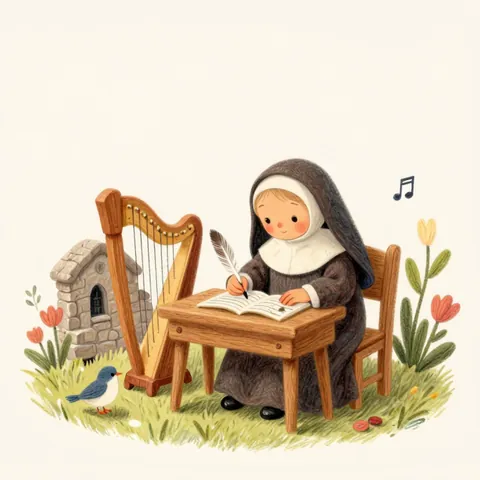
Chant: one tune, many voices
In the early Middle Ages, music in European churches was mostly chant: a single melody sung by everyone together, usually without instruments. It is often called Gregorian chant. The name comes from Pope Gregory I, who, according to legend, collected the melodies, though experts now think they grew over many years, with the style taking shape from about the year 800.
Chant flows like speech. It has no strong beat and no bars, and it is written in an early kind of notation with square notes on four lines.
Hildegard of Bingen
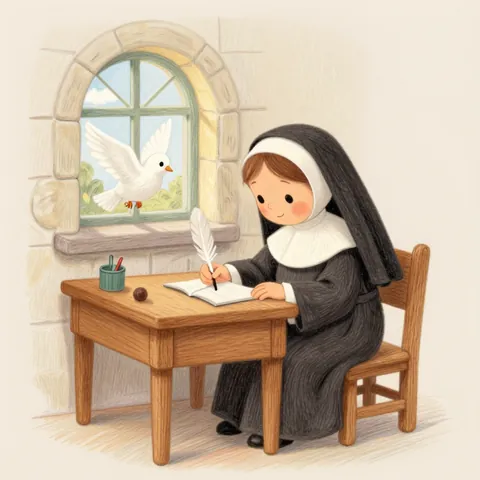
Hildegard of Bingen lived from 1098 to 1179 in what is now Germany. She was the head of a convent, and she was also a writer, a thinker and a composer. She wrote many chants and poems, and a lot of her music is still performed today.
She is one of the earliest composers whose name and many works we know.
Songs in everyday language
Not all music was for church. In southern France from about the year 1100, poet-musicians called troubadours sang songs about love and adventure in the language people spoke every day, not Latin. They sometimes played a lute, a fiddle or a small harp as they sang.
Many melodies at once
Slowly, singers began to sing more than one melody at the same time. This is called polyphony, which means "many sounds". It began in the early Middle Ages, and in Paris, musicians connected with the cathedral of Notre-Dame wrote some of the most famous early polyphony, about the years 1160 to 1250.
In the Renaissance, about 1400 to 1600, composers made the voices blend smoothly, so each singer had a beautiful line. Josquin des Prez (about 1450–1521) and Giovanni Pierluigi da Palestrina (about 1525–1594) were two of the most admired.
Printing changes everything
In 1501, Ottaviano Petrucci in Venice printed a book of songs using movable type. Before that, every piece of music had to be copied by hand. Printed music was cheaper and easier to send, so songs could travel to new towns and countries.
Try it: sing a simple song twice with a friend, starting the second time one line later. You are making your own polyphony.
Piano sound: Salamander Grand Piano by Alexander Holm (CC BY 3.0).