
Concert halls: buildings made for listening
A concert hall is a building made for one job: to make music sound good. The size, the shape and the walls of a room change the sound, which is why musicians care so much about where they play.
In this lesson
How a room changes sound
Sound travels through the air and bounces off walls, floors and ceilings. A room with lots of hard surfaces, like a stone church, makes sounds last a long time, and the sound seems to linger. We call this reverberation, a bit like many tiny echoes blending together. A room full of soft things, like curtains and carpets, makes sounds fade away quickly.
Concert hall builders think carefully about this. If the sound lasts too long, the notes blur together. If it dies too fast, the music can sound dry.
The stage and the audience
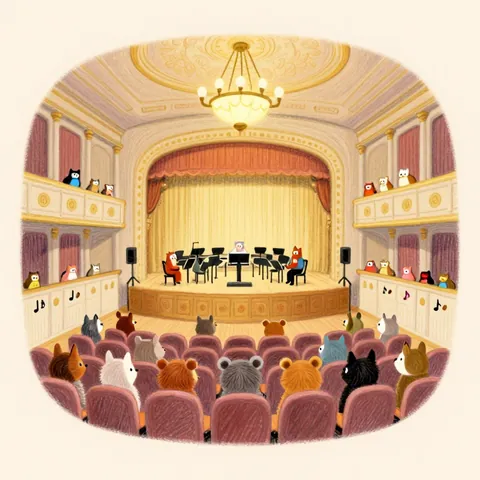
In many halls, the orchestra sits on a stage at one end, and the audience sits in rows, sometimes with balconies. The conductor stands in front of the players. Some halls are shaped like a shoebox, long and narrow. Others, like "vineyard" halls, have the audience around the stage.
A few famous halls
There are hundreds of fine halls around the world. Here are three that many musicians know.
- The Musikverein, Vienna
- Opened in 1870, with a famous golden hall shaped like a shoebox. Its Great Hall is known for its rich, warm sound.
- Carnegie Hall, New York
- Opened in 1891. Many famous musicians have played there, so people use it as a symbol of success.
- Sydney Opera House, Australia
- Opened in 1973, famous for its roof shaped like sails, which stands beside the harbour.
Listening anywhere
You do not need a famous hall to enjoy music. Try singing in a bathroom, a stairwell or a big room, and notice how the same voice sounds different in each place. You have just tested the acoustics, which is the science of how sound behaves in a space.
Piano sound: Salamander Grand Piano by Alexander Holm (CC BY 3.0).