
Clara Schumann: a star pianist and composer
Clara Schumann was one of the most admired pianists of the 1800s. She performed in concert halls across Europe for more than sixty years, and she also wrote music of her own.
In this lesson
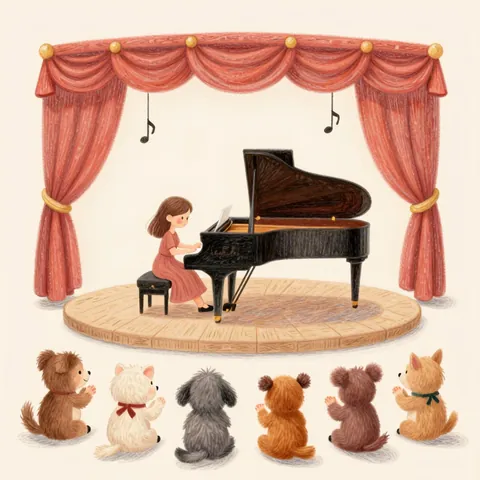
A young star
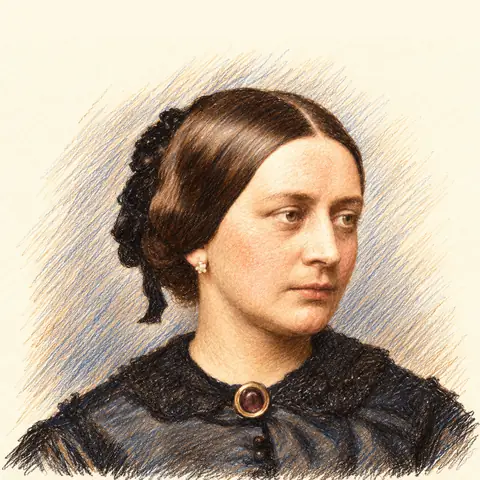
Clara was born in 1819 in Leipzig, Germany. Her father Friedrich Wieck was a famous piano teacher, and he taught her carefully every day. She gave her first public concert when she was nine, and as a teenager she was already becoming known in many parts of Europe.
A turning point
In 1835, when Clara was fifteen, she finished a piano concerto. That is a big piece where a piano plays together with a whole orchestra. On 9 November she played it in Leipzig, and the composer Felix Mendelssohn led the orchestra.
Later, life became much harder. Her husband Robert became very ill in 1854, and he died in 1856. Clara was now the one who earned money for the family, so she travelled to play many concerts.
In 1878 she also began teaching piano at a music school in Frankfurt. She kept performing until 1891. For Clara, music was both her work and her way to care for her family.
Music, family and work
In 1840, Clara married the composer Robert Schumann. They had eight children. Clara kept playing concerts, teaching and composing, and she also played her husband's music for many audiences. After Robert died in 1856, she travelled and worked to take care of her family.
She kept performing until 1891 and died in 1896.
Her music
Clara wrote songs, piano pieces and a piano concerto, which she first played when she was a teenager. After 1856, she wrote very little new music, while concerts, teaching and her large family kept her busy.
Try listening for
- Piano Concerto, slow middle part
- A cello joins the piano and the two seem to sing together, so listen for the cello's warm voice.
- Three Romances for violin and piano
- Clara wrote them in 1853 for the violinist Joseph Joachim, so listen for how the violin sings the tune while the piano supports it.
- Three Romances for Violin and Piano, Op. 22 No. 1 · The main tune, a short excerpt played on our piano from a public-domain score.
- Variations on a theme by Robert Schumann
- A theme by her husband is changed again and again, so listen for the tune hiding in each new version.
- Piano Trio in G minor
- She wrote it in 1846 for piano, violin and cello, so listen for the three players taking turns with the melody.
- Piano Trio in G minor, Op. 17 — first movement, opening theme · The main tune, a short excerpt played on our piano from a public-domain score.
Pick one piece and listen to the first minute twice. The second time, try to hum the main tune, or tap a finger every time a new instrument joins in.
Why she matters
Clara built a career as a pianist that lasted more than sixty years. She was also one of the first pianists to play from memory in concerts, as many pianists do today.
Meanwhile, around the world
- 1846The saxophone is patented
The Belgian instrument maker Adolphe Sax received a patent for his new saxophone in Paris.
- 1871Aida opens in Cairo
Verdi's opera about ancient Egypt had its first performance at the opera house in Cairo, Egypt.
- 1877Edison shows the phonograph
Thomas Edison announced a machine that could record sound and play it back.
- 1879The ukulele reaches Hawaii
Workers from Madeira, an island of Portugal, brought small guitar-like instruments that led to the ukulele.
- 1893A symphony from the New World
Dvořák's Ninth Symphony had its first performance at Carnegie Hall in New York City.
How this page was checked: each fact was looked up again in the sources below — encyclopedias, museums, universities, cultural institutions and makers. Wikipedia was used only as a pointer, never as a source. It has not been reviewed by an outside music expert; if you spot a mistake, please tell us at [email protected].
- Encyclopaedia Britannica: Clara Schumann
- Schumann-Portal: Chronological short vita – Clara Schumann
- Schumann-Haus Leipzig: Clara Schumann biography (audio guide)
- Kultur Frankfurt (City of Frankfurt): Schumann, Clara (1819–1896)
- Encyclopaedia Britannica: Robert Schumann
- Schumann-Portal: Clara Schumann (marriage, Op. 7 premiere)
- National Arts Centre (Canada): programme notes – Clara Schumann, Piano Concerto in A minor, Op. 7
- National Arts Centre (Canada): programme notes – Clara Schumann, Piano Trio in G minor, Op. 17
- Breitkopf & Härtel: Clara Schumann – 3 Romances Op. 22
- PTNA Piano Encyclopedia: Clara Schumann, Variations on a Theme by Robert Schumann Op. 20
- Classic FM: Clara Schumann facts – pianist and composer
- Indiana University of Pennsylvania: Recital celebrates Clara Schumann, pianist, teacher, composer
- Smithsonian Magazine: The First Saxophone Was Made of Wood
- Encyclopaedia Britannica: Aida (opera by Verdi)
- Encyclopaedia Britannica: Phonograph
- Ukulele Hall of Fame Museum: Manuel Nunes
- Encyclopaedia Britannica: New World Symphony
- Score for the piano excerpt — Three Romances for Violin and Piano, Op. 22 No. 1: IMSLP #441723: Drei Romanzen für Violine und Klavier, Op. 22 — complete score (engraved edition, plate no. 9201; publisher/year not stated in the file) (public domain)
- Score for the piano excerpt — Piano Trio in G minor, Op. 17 — first movement, opening theme: IMSLP #15825: Trio für Pianoforte, Violine und Violoncello, Op. 17 — full score (19th-century edition, plate no. 7562) (public domain)
Piano sound: Salamander Grand Piano by Alexander Holm (CC BY 3.0).