
Frédéric Chopin: poems for the piano
Frédéric Chopin wrote almost all of his music for one instrument, the piano. His pieces can sound like quiet poems, night songs or proud dances, and many pianists love to play them.
In this lesson
From Poland to Paris
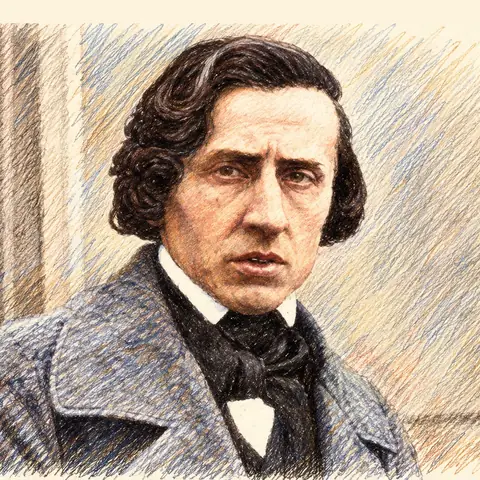
Chopin was born in 1810 near Warsaw, in Poland. He played the piano very well as a child and gave his first public concert when he was about eight years old. As a young man, he left Poland in 1830, and the next year he settled in Paris, where he lived for most of the rest of his life.
Chopin was often unwell, and he died in Paris in 1849, at the age of 39.
A turning point
As a teenager, Chopin studied composition in Warsaw with a teacher named Józef Elsner, from 1826 for about three years. In a school report, Elsner wrote that Chopin had amazing talent.
In Paris, Chopin gave his first concert on 26 February 1832, in a hall owned by the piano makers Pleyel. He was one of several performers that evening.
Yet he gave only about 30 public concerts in his whole life. His soft, delicate playing sounded best in small rooms, so he often played for friends in salons.
Music that sings
Chopin's melodies are like songs for the piano. The right hand often sings a beautiful tune, while the left hand plays a gentle background. He also used the rhythms of Polish dances in his music, which shows how much he loved his home country.
Try listening for
These four pieces show different ways Chopin made the piano sing.
- Nocturne in E-flat, Op. 9 No. 2
- Listen for the gentle tune with graceful leaps over a rocking left hand; it feels like a lullaby.
- Nocturne in E-flat, Op. 9 No. 2 · The main tune, a short excerpt played on our piano from a public-domain score.
- Prelude Op. 28 No. 15 ("Raindrop")
- Listen for one note that keeps repeating, like drops falling, while the mood changes around it.
- Prelude Op. 28 No. 15 ("Raindrop") · The main tune, a short excerpt played on our piano from a public-domain score.
- Étude Op. 25 No. 1
- Listen for very fast, soft broken chords in both hands that ripple like a harp in the wind.
- Fantaisie-Impromptu
- Listen for the right hand playing fast notes against the left hand's triplets, which makes the music swirl.
Play the Op. 9 No. 2 nocturne and rock slowly from side to side, feeling its gentle rocking pulse. Then hum the main tune.
Some pieces to know
Chopin gave many of his pieces the names of dances or night songs.
- Nocturnes
- Quiet, dreamy night songs for piano.
- Waltzes
- Dances in three beats, some slow and some very fast, like the "Minute Waltz".
- Waltz Op. 64 No. 1 ("Minute Waltz") · The main tune, a short excerpt played on our piano from a public-domain score.
- Polonaises
- Proud Polish dances with a strong rhythm.
- Études
- Pieces that are also exercises, usually each practising one skill, yet beautiful to listen to.
Meanwhile, around the world
- 1824A choir joins a symphony
In Vienna, Beethoven's Ninth Symphony was first played, with singers in the last part.
- 1829Bach is heard again
In Berlin, Mendelssohn, aged 20, conducted Bach's St Matthew Passion and helped bring Bach's music back.
- 1830A story in sound
In Paris, Berlioz's Symphonie fantastique was first performed, telling a story through music.
- 1840A pianist's wedding
Pianist Clara Wieck married composer Robert Schumann; she knew Chopin and played his music.
- 1846The saxophone is patented
Adolphe Sax, a Belgian inventor working in Paris, patented the saxophone.
How this page was checked: each fact was looked up again in the sources below — encyclopedias, museums, universities, cultural institutions and makers. Wikipedia was used only as a pointer, never as a source. It has not been reviewed by an outside music expert; if you spot a mistake, please tell us at [email protected].
- Encyclopaedia Britannica: Frédéric Chopin
- Fryderyk Chopin Institute (chopin.pl): Chronicle of Chopin's life and work, Metamorphoses
- Culture.pl (Adam Mickiewicz Institute): Chopin in Concert – The Avid Dislike of Public Performance
- Hyperion Records: Frédéric Chopin (composer biography)
- PTNA Piano Encyclopedia: Chopin, Nocturne No. 2 in E-flat major Op. 9-2
- PTNA Piano Encyclopedia: Chopin, 12 Études Op. 25
- PTNA Piano Encyclopedia: Chopin, Fantaisie-Impromptu in C-sharp minor Op. 66
- PTNA Piano Encyclopedia: Chopin, Waltz No. 6 in D-flat major Op. 64-1 ("Minute")
- WNYC: The Fishko Files – Chopin's 'Raindrop' Prelude
- G. Henle Verlag: Chopin Nocturnes (HN 185)
- Encyclopaedia Britannica: Symphony No. 9 in D Minor, Op. 125 (Beethoven)
- Encyclopaedia Britannica: Felix Mendelssohn
- Encyclopaedia Britannica: Hector Berlioz
- Schumann-Portal: Frédéric Chopin – Clara Schumann's friends, colleagues and contemporaries
- Schumann-Portal: Chronological short vita – Clara Schumann
- Smithsonian Magazine: The First Saxophone Was Made of Wood
- Score for the piano excerpt — Nocturne in E-flat, Op. 9 No. 2: Mutopia Project, Nocturne Op. 9 No. 2 — typeset by Renato Biolcati Rinaldi, from G. Schirmer 1881 (CC BY-SA 3.0)
- Score for the piano excerpt — Prelude Op. 28 No. 15 ("Raindrop"): Mutopia Project, Prelude Op. 28 No. 15 — typeset by Magnus Lewis-Smith, from Edition Peters (public domain)
- Score for the piano excerpt — Waltz Op. 64 No. 1 ("Minute Waltz"): Mutopia Project, Valse Op. 64 No. 1 ("Minute Waltz") — typeset by Magnus Lewis-Smith, from Edition Peters (public domain)
Piano sound: Salamander Grand Piano by Alexander Holm (CC BY 3.0).