 Sowlea
Italian music terms, explained simply
Most music printed around the world uses Italian words to tell you how to play: how fast, how loud and with what feeling. You do not need to speak Italian. Learn them in groups, and picture each one, and they will stick.
In this lesson
How to read these words
The words are written above or below the music. A speed word such as Allegro at the start tells you how fast. Loudness marks tell you how loud: p is short for piano (soft) and f for forte (loud). (The instrument's full name, pianoforte, means "soft-loud", because it could play both.) Small helper words such as molto (very) or poco (a little) change the word next to them, just like "very" and "a little" do in your own language.
Many pieces also print a number such as ♩ = 120. That means 120 beats per minute (BPM): set your metronome to it. The BPM numbers in this list are only rough guides. Books and metronomes give slightly different numbers, and the right speed also depends on the piece.
All terms by group
116 terms
No term matches that. Try a shorter word.
Speed
- Grave 25–45 BPM
- Very slow and serious.A heavy bell tolling slowly.
- Largo 40–60 BPM
- Very slow and broad.An elephant walking calmly.
- Lento 45–60 BPM
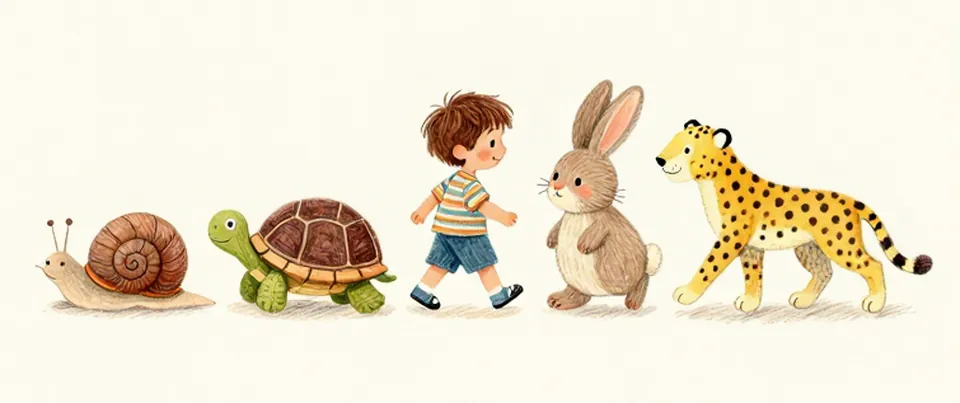
- Slow.A snail crossing a leaf.
- Larghetto 60–66 BPM
- Slow, but a little less slow than largo.A small elephant: still slow, a bit lighter.
- Adagio 66–76 BPM
- Slow and at ease.Floating on your back in calm water.
- Andante 76–108 BPM
- At a walking pace.Strolling to school with time to spare.
- Andantino 84–112 BPM
- A little faster than andante (most musicians today read it this way).A brisk little walk.
- Moderato 108–120 BPM
- At a moderate, medium speed.Riding a bicycle along a flat road.
- Allegretto 112–128 BPM
- Fairly quick and light, a bit slower than allegro.Skipping happily down a path.
- Allegro 120–156 BPM
- Quick and lively. The word also means cheerful.Running in the playground.
- Vivace 140–176 BPM
- Lively and fast.A puppy that cannot sit still.
- Presto 168–200 BPM
- Very fast.A rabbit racing away.
- Prestissimo 200+ BPM
- As fast as possible.A cheetah at full speed.
Changing speed
- accelerando
- Gradually get faster. Short form: accel.A train leaving the station.
- ritardando
- Gradually get slower. Short form: rit. or ritard.A bicycle rolling to a stop.
- rallentando
- Gradually slow down (almost the same as ritardando). Short form: rall.A merry-go-round winding down.
- ritenuto
- Held back: slower right away, not gradually. Short form: riten.Pressing the brake, not just letting go of the pedals.
- allargando
- Slowing down and getting broader, often louder too.A grand finale with arms spreading wide.
- stringendo
- Pressing forward, getting faster with excitement.Hurrying as the bus arrives.
- a tempo
- Go back to the earlier speed.Back to your normal walk after a detour.
- tempo primo
- Return to the speed at the very start. Also written Tempo I.Back to the starting line.
- rubato
- Freely stretching and hurrying the time for expression.Telling a story, pausing for effect, then going on.
- fermata
- The sign 𝄐: hold this note or rest longer than written.Pausing a video on your favourite moment.
- l'istesso tempo
- Keep the same beat speed even though the time signature (the numbers like 3/4 at the start) changes.Same heartbeat, different dance.
Loudness
- pianississimo ppp
- As soft as possible. Written ppp.A feather landing.
- pianissimo pp
- Very soft. Written pp.Whispering in a library.
- piano p
- Soft. Written p.Talking quietly so the baby sleeps.
- mezzo piano mp
- Moderately soft. Written mp.Chatting at the dinner table.
- mezzo forte mf
- Moderately loud. Written mf.Your normal speaking voice in class.
- forte f
- Loud. Written f.Calling a friend across the playground.
- fortissimo ff
- Very loud. Written ff.Cheering at a football match.
- fortississimo fff
- As loud as possible. Written fff.Thunder right overhead.
Changing loudness
- crescendo
- Gradually get louder. Short form: cresc., or a long wedge under the notes that opens up (like a stretched <).A wave building up.
- decrescendo
- Gradually get softer. Short form: decresc., or a long wedge that closes (like a stretched >). Do not mix it up with the small accent > over a single note.A wave fading on the sand.
- diminuendo
- Gradually get softer (same as decrescendo). Short form: dim.A car driving away into the distance.
- sforzando
- A sudden strong accent on one note. Written sfz or sf.A sudden clap of hands.
- forte-piano
- Loud, then immediately soft. Written fp.A door slamming, then silence.
- subito
- Suddenly. Subito piano means suddenly soft.Turning the lights off in one click.
- morendo
- Dying away, softer and usually slower.A candle slowly going out.
Mood and character
- dolce
- Sweetly, gently.Singing a lullaby.
- cantabile
- In a singing way, smooth and expressive.Playing as if your instrument were singing.
- espressivo
- With expression and feeling. Short form: espress.Telling a story that matters to you.
- con brio
- With spirit and energy.Jumping out of bed on the first morning of the holidays.
- con fuoco
- With fire, passionately.A dragon breathing flames.
- maestoso
- Majestically, grand and dignified.A king entering the hall.
- grazioso
- Gracefully.A ballet dancer turning.
- giocoso
- Playfully, joyfully.Kittens playing with a ball of yarn.
- scherzando
- Jokingly, in a light and teasing way.Playing hide-and-seek.
- leggiero
- Lightly, with a light touch.Tiptoeing on stones across a stream.
- pesante
- Heavily, with weight.A giant stomping.
- tranquillo
- Calmly, peacefully.A quiet lake at sunrise.
- agitato
- Restless and excited.Waiting for your exam results.
- animato
- Animated, with life (often a little faster).A cartoon coming to life.
- sostenuto
- Sustained: hold the notes full, often a little slower.Holding a long breath while singing.
- misterioso
- Mysteriously.Walking into a dark cave with a torch.
- appassionato
- Passionately.Speaking about what you love most.
- semplice
- Simply, without extra decoration.A plain glass of water.
- tenero
- Tenderly.Holding a small bird in your hands.
How to play each note
- legato
- Smoothly connected, no gaps between notes.Drawing a line without lifting the pencil.
- staccato
- Short and detached. Shown by a dot above or below the note.Popping bubbles one by one.
- staccatissimo
- Very short and sharp. Shown by a small wedge.Raindrops tapping a tin roof.
- tenuto
- Hold the note for its full length, maybe a touch longer. Shown by a short line.Pressing a doorbell and holding it.
- marcato
- Marked: each note strong and clear. Shown by a ^ sign.Marching soldiers' boots.
- accent
- Play this note stronger than its neighbours. Shown by a small > above or below the note. (The word is English; in Italian it is accento.)Saying one word louder in a sentence.
- portato
- Between legato and staccato: slightly separated, gently pressed notes. Shown by dots (or short lines) under a slur.Footsteps on soft snow.
- glissando
- A slide from one note to another through the notes in between. Short form: gliss.Sliding down a slide in the park.
- tremolo
- Very fast repetition of one note, or very fast back-and-forth between two notes. Short form: trem.A hummingbird's wings.
- trill
- Quickly alternating a note with the note above. Shown by tr. (English; Italian trillo.)A bird's chirping song.
- arpeggio
- Play the notes of a chord one after another, like a harp.Climbing stepping stones one at a time.
Repeats and road signs
- 𝄆 … 𝄇
- Repeat signs 𝄆 … 𝄇: play the music between them twice. If there is only the end sign 𝄇, go back to the very beginning.Pressing replay on a song.
- da capo
- From the beginning. Short form: D.C.Going back to the start of a board game.
- dal segno
- Go back to the sign 𝄋. Short form: D.S.Returning to the bookmark.
- al fine
- And play until the word Fine. D.C. al Fine: go back to the beginning and stop at Fine.Ride until the stop marked "end".
- al coda
- After D.C. or D.S., when you reach the "To Coda" sign 𝄌, jump to the Coda: the ending section, which starts with the same sign.Taking the shortcut to the finish.
- fine
- The end (used with D.C. or D.S.).The last page of a book.
- coda
- A closing section at the end. Its sign is 𝄌.The tail of the piece.
- segno
- The sign 𝄋 that D.S. sends you back to.A flag marking the spot.
- volta
- 1st and 2nd ending brackets (1. and 2.). The first time, play the 1st ending, then go back to the repeat sign. The second time, skip the 1st ending and play the 2nd.Two different doors out of the same room.
- bis
- Twice: repeat this short passage.Saying "again!" once.
- simile
- Keep going in the same way.Knitting the next row in the same pattern.
- attacca
- Go straight on to the next part without a break.Two train carriages linked together.
Little helper words
- molto
- Very, much. Molto allegro: very quick.Extra spicy.
- poco
- A little. Poco più mosso: a little faster.Just a pinch of salt.
- poco a poco
- Little by little.Climbing a hill one step at a time.
- più
- More. Più forte: louder.One more spoonful.
- meno
- Less. Meno mosso: less moving, slower.One spoonful fewer.
- assai
- Very, quite. Allegro assai: very quick.Really, truly.
- non troppo
- Not too much. Allegro non troppo: quick, but not too quick.Fast, but don't run in the corridor.
- sempre
- Always, still. Sempre piano: stay soft.Keep your seatbelt on the whole ride.
- mosso
- Moving, with motion.A boat drifting forward.
- con moto
- With motion, keep it moving.Walking with purpose.
- con
- With.Bread with butter.
- senza
- Without.Tea without sugar.
- ma
- But.Fast, but careful.
- quasi
- Almost, as if.Almost like a song.
Playing together
- tutti
- Everyone plays.The whole class singing together.
- solo
- One player alone.One voice in the spotlight.
- soli
- A small group plays the special part.A few friends on stage.
- divisi
- Players of one section split into parts. Short form: div.Two teams from one class.
- unisono
- Everyone on the same notes again (after divisi). Short form: unis.Everyone back on one team.
- a due
- Both players play the same part. Written a 2.Twins saying the same thing.
- ad libitum
- Freely, as you like. Short form: ad lib.Choose your own toppings.
- tacet
- This instrument is silent for this section.Waiting quietly for your turn.
- colla voce
- Follow the singer's timing.Dancing along with your partner's lead.
Instrument techniques
- pizzicato
- Pluck the strings with a finger instead of using the bow. Short form: pizz.Plucking a rubber band.
- arco
- Use the bow again (after pizzicato).Painting with a long brush stroke.
- con sordino
- With a mute, for a softer, veiled sound. Short form: con sord.Talking through a scarf.
- senza sordino
- Without the mute.Taking the scarf off.
- sul ponticello
- Bow near the bridge for a glassy, whispery sound.A ghostly whisper.
- col legno
- Play with the wooden side of the bow.Tapping a stick on a fence.
- una corda
- Piano: press the soft (left) pedal.Putting a blanket over the sound.
- tre corde
- Piano: release the soft pedal.Taking the blanket off.
- ottava
- 8va: play an octave higher than written. 8vb: an octave lower.Taking the lift up (or down) one floor.
- loco
- Back to the written pitch after an ottava.Back on your own floor.
- mano destra
- Right hand. Short form: m.d. (English books may use R.H.)The hand you wave with (for most people).
- mano sinistra
- Left hand. Short form: m.s. (English books may use L.H.)The other hand.
Piano sound: Salamander Grand Piano by Alexander Holm (CC BY 3.0).