
Music of South Korea: from silk-string zithers to K-pop
Korean music has quiet palace songs, loud village drums and stage shows that people watch all over the world. Many of the oldest tunes belong to the shared tradition of the Korean Peninsula, and this page follows the sounds from long ago to today.
In this lesson
What does Korean music sound like?
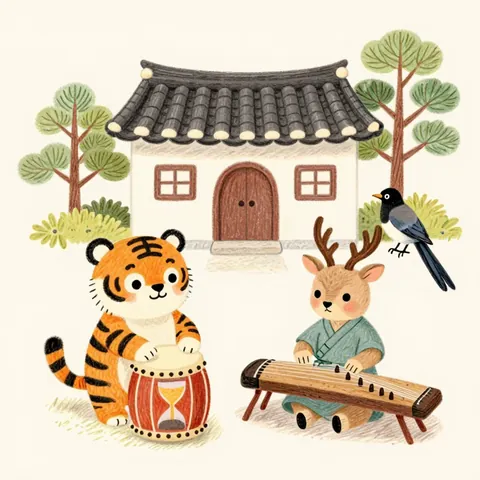
Imagine a long wooden zither lying across a player's lap. Silk strings are plucked and bent, so each note can slide and wobble like a voice. That is the gayageum, and its gentle, singing sound is a good first taste of Korean tradition.
Old Korean music had many homes. At the royal court, slow and calm pieces were played at big ceremonies. One famous example is the music for the Jongmyo ritual, held once a year to honour the ancestors of the Joseon kings. Out in the villages, farmers marched with gongs and drums in a lively band music called nongak.
There are also stories told with songs. In pansori, one singer tells a long tale with singing, speaking and acting, while one drummer keeps the beat and shouts cheers. A folk song called Arirang is loved so much that people sing it in many versions, and UNESCO lists it as living heritage.
In the 1900s, new sounds arrived. Church hymns and Western songs came in, and Koreans wrote their own songs in that style. Later, a pop style called trot became popular, with singers such as Lee Mi-ja. After 1992 a new wave began, with rap and dance beats, which grew into K-pop. By the 2010s and 2020s, K-pop groups and songs were known around the world.
The story of one song: Arirang
Many Koreans know a refrain that goes "Arirang, arirang, arariyo." It is the heart of a folk song that people have sung for a very long time.
After the refrain come two short lines, and each region sings its own. Experts count about 3,600 versions, grouped into around 60 main ones. Songs of longing, parting and hope are common.
Because the tune is simple, anyone can join in and make up new words. UNESCO added Arirang to its heritage list in 2012.
Traditional instruments
Here are some instruments you can look up and listen to.
- Gayageum
- A zither with 12 silk strings; the player sits on the floor, plucks with the right hand and presses and bends the strings with the left.
- Geomungo
- A six-string zither with raised frets, played with a short stick; old records credit a minister of the Goguryeo kingdom with making it.
- Haegeum
- A fiddle with two strings held upright on the knee; the bow slides between the strings, and the player has no fingerboard to press on.
- Daegeum
- A big bamboo flute played sideways, with a special hole covered by a thin reed membrane that adds a soft buzzing sound.
- Ajaeng
- A wide zither with silk strings that is played by rubbing a stick of forsythia wood across them like a bow; it sounds a bit like a rough cello.
- Janggu
- An hourglass-shaped drum with two heads: one is struck with a bamboo stick, the other with the bare hand, and the two sides sound different.
- Kkwaenggwari
- A small gong held in the hand; its player leads a nongak band.
- Jing
- A large gong that gives a deep, long ring, played in nongak and samulnori.
How to listen
Close your eyes and follow one sound at a time. Ask yourself: is it getting faster? Is the note sliding? Is the drum repeating a pattern?
- Listen for bending notes
- On the gayageum, the left hand pushes a string to raise the note and add a wobble, so a note can sing like a voice.
- Listen for a slow start and a fast finish
- A sanjo solo begins with a very slow rhythm and speeds up to a fast one, and the janggu drummer shouts cheers along the way.
- Listen for repeating drum patterns
- Korean music uses rhythm patterns called jangdan, repeated on the janggu, whose two heads give a low sound and a higher sound.
Set a metronome to a slow 50 BPM and clap along. After every 8 claps, raise the speed a little, like a sanjo growing faster. How fast can you stay in time?
Big moments in the story of Korean music
- About 500sZithers of the old kingdoms
Old records say the geomungo was made in Goguryeo and the gayageum in the Gaya kingdom, around the 500s.
- 1400sA way to write music down
In King Sejong's time, a notation called jeongganbo was made, which used a grid to show both pitch and length of notes.
- Late 1600sPansori appears
Singers began telling long stories with voice and drum; the form later became famous across the peninsula.
- About 1890Sanjo is born
Kim Chang-jo is said to have shaped sanjo around 1890: a long solo piece for the gayageum that starts slow and speeds up.
- About 1920A song in Western style
The composer Hong Nan-pa wrote Bongseonhwa around 1919–1920, often called the first Korean song written in Western style.
- 1992Rap and dance arrive
Seo Taiji and Boys sang Nan Arayo, mixing rap and dance beats, and it became a huge hit.
- 1996–2012K-pop goes wide
H.O.T. debuted in 1996 and is often called the first K-pop idol group; in 2012 Psy's Gangnam Style became the first YouTube video to reach a billion views.
- 2020Dynamite tops the US chart
BTS sang Dynamite fully in English, and it debuted at number one on the US Billboard Hot 100 in August.
Names to look up
These are only examples, not a ranking; ask a grown-up or search for them to listen.
- Hwang Byungki
- Ahn Sook-sun
- Kim Duk-soo
- Lee Mi-ja
- Cho Yong-pil
- Unsuk Chin
- Seo Taiji and Boys
- IU
- BTS
- BLACKPINK
Meanwhile, around the world
While Korean music grew, here is what was happening in other places.
- 537Hagia Sophia is finished
In what is now Istanbul, a giant domed church was completed, around the time the old zithers of the Korean kingdoms were being made.
- About 1455The Gutenberg Bible
In Germany, books printed with movable type began to appear, in the same century as Korea's music notation.
- 1685Bach is born
The German composer Johann Sebastian Bach was born, around the time pansori storytelling was taking shape.
- 1964The Beatles on American TV
The band played on The Ed Sullivan Show in February 1964, and tens of millions watched.
- 1969First Moon landing
Apollo 11 landed on the Moon on July 20.
- 2005YouTube begins
The first video was uploaded in April, and the site later helped songs like Gangnam Style travel the world.
Piano sound: Salamander Grand Piano by Alexander Holm (CC BY 3.0).