
Music of India: ragas, drums and songs from the movies
Music in India is very old, and it is still part of weddings, festivals, temples and movies today. Let's explore the big ideas, the instruments and the songs.
In this lesson
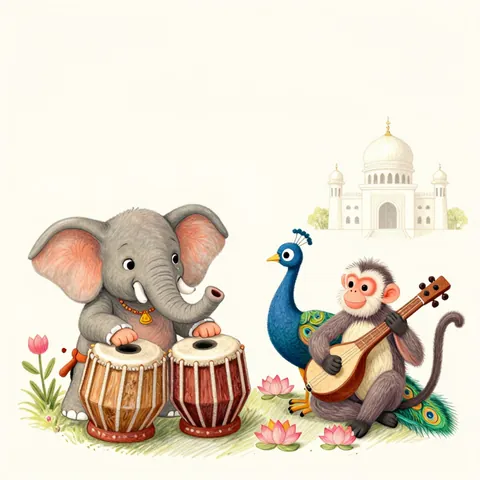
What does Indian music sound like?
Imagine a singer or a sitar starting very slowly, with a steady humming sound underneath. Then the tune stretches, bends and slowly wakes up, and the drums join in.
Two ideas hold much of this music together: a raga, which is like a set of notes with its own mood, and a tala, which is a repeating rhythm pattern. A musician can make up lots of new ideas inside these two frames.
The story of a singer and the rain
Long ago, a singer named Tansen worked in the court of Emperor Akbar. He lived in the 1500s and is one of the best-known names in North Indian music.
Many stories say Tansen could change the world with a raga. One tells how Raga Megh Malhar made rain fall. Another says Raga Deepak lit lamps by itself.
Careful readers think these tales are probably legends. Still, they show how people feel about ragas: each one has a mood, and some are linked to rain, evening or morning.
Raga and tala, made simple
A raga is like a box of colors for a tune. It tells the musician which notes to use and gives the music a feeling, such as calm, joyful or sleepy. The word comes from an old word that means "to color", as in coloring the mind. Long ago, ragas were matched with times of day and seasons, and some musicians still do this.
A tala is a rhythm cycle, like a clock that keeps going around. One famous tala, called teental, has 16 beats split into four groups of four. Listeners clap on some beats and wave a hand on one "empty" beat. The first beat, called sam, is like home base, and the music loves to land there.
Two big classical traditions
North India is home to Hindustani music. South India is home to Carnatic music. They share ideas like raga and tala, but they feel a little different.
Hindustani music is known for lots of making-up on the spot, and its main drum is the tabla. Carnatic music leans more on set songs called kritis, and its main drum is the mridangam. Neither one is better. They are like two cousins who speak related languages.
Instruments you can look for
Here are some instruments you may hear in Indian music.
- Sitar
- A long-necked plucked instrument with movable curved frets, a few main strings to play, and a set of extra strings underneath that hum along by themselves.
- Tabla
- A pair of small hand drums, played sitting down, with a black paste in the middle of each skin that helps give it its special sound.
- Tanpura
- A long instrument with no frets and about four strings, strummed one after another to make a steady drone that the singer or player can lean on.
- Sarangi
- A short-necked fiddle played with a bow, with extra strings that echo, and notes made by pressing the strings with the fingernails and skin of the left hand.
- Saraswati veena
- A large plucked lute with 24 frets, used mostly in Carnatic music, and named after a goddess of music and learning.
- Bansuri
- A simple side-blown bamboo flute that sounds airy and soft, and is loved in North Indian music.
- Mridangam
- A barrel-shaped drum with two heads, played sitting cross-legged, and the main drum in Carnatic music. Its name comes from old words for "clay" and "limb", because early ones were made of hardened clay.
- Harmonium
- A small keyboard with a hand-pumped bellows, brought to India from Europe in the 1800s and reshaped by Indian makers into a small one played on the floor and now often used for singing and devotional songs.
How to listen
Indian classical music often unfolds like a flower opening. Try listening without waiting for a big tune. Notice the steady hum, the slow start and the spoken drum sounds.
- Listen for the drone
- A tanpura plays the same notes again and again underneath, so the singer or player always has a steady home note to return to.
- Listen for the slow start
- Many North Indian pieces begin with an alap, a slow opening with no steady beat, and the pulse and speed build up later.
- Listen for the drum words
- Tabla players learn each stroke as a spoken syllable, such as dha, dhin and na, and can say a rhythm out loud before playing it.
Say "dha dhin dhin dha" four times, slowly, to make 16 beats. Clap on beat 1, 5 and 13, and wave your hand on beat 9. Then try it with the metronome.
Folk songs and songs of devotion
Away from the concert halls, music lives in villages, festivals and prayer. The dhol is a big double-headed drum played with two sticks, and its booming beat makes people dance at weddings and celebrations, including bhangra dancing in Punjab.
In Bengal, wandering Baul singers sing about finding what is precious inside yourself, often with a one-stringed ektara. In the Rajasthan desert, the Manganiyar are families of hereditary musicians who pass songs down from parent to child.
Qawwali is joyful devotional singing in groups, with clapping, harmonium and drums. It grew from Sufi traditions known across South Asia, and the poet-musician Amir Khusrau, who lived about 700 years ago, is traditionally credited with helping shape it.
Songs from the movies
Movie songs are among the most popular music in India. Alam Ara, widely seen as India's first sound film, came out in 1931 and had songs in it, and songs have been a part of Hindi films ever since.
Many film songs are sung by playback singers, who record the voice while the actor on screen moves their lips. Film music mixes classical ideas, folk tunes and pop, and in recent times also electronic sounds.
Big moments in the story of India's music
- About 1200–1000 BCE (estimated)Chants with melodies
The Samaveda, a book of sung chants, holds some of the oldest written-down melodies in the world.
- About 200 BCE–200 CE (estimates vary)A big book on the arts
The Natya Shastra, a Sanskrit book about drama, dance and music, was put together around this time.
- 1200sAmir Khusrau
A poet and musician from Delhi who many stories say changed the music of his time, though the tales about what exactly he invented are mostly legend.
- About 1562Tansen at the royal court
The singer Tansen joined Emperor Akbar's court, and many tales are told about him, though most are not proven.
- Lived about 1760–1847Three Carnatic masters
Tyagaraja, Muthuswami Dikshitar and Syama Sastri, called the Trinity of Carnatic music, wrote songs still sung today.
- 1931Songs on the big screen
Alam Ara, widely seen as India's first sound film, put songs into the movies.
- 1966Sitar meets pop
George Harrison of the Beatles went to India to learn sitar from Ravi Shankar, and Indian sounds reached rock and pop fans.
- 2009A film composer wins two Oscars
A. R. Rahman won two Academy Awards for the music of Slumdog Millionaire.
Names to look up
These are only examples, not a ranking. Ask a grown-up or search for them to listen to their music.
- Ravi Shankar
- M. S. Subbulakshmi
- Lata Mangeshkar
- Zakir Hussain
- Hariprasad Chaurasia
- Kishori Amonkar
- Bhimsen Joshi
- Tyagaraja
- Anoushka Shankar
- A. R. Rahman
Meanwhile, around the world
Here is what was happening elsewhere around the same times.
- 1454–1455Printing with movable metal type
In Europe, the Gutenberg Bible was printed, in the century before Tansen's time at court in India.
- 1508–1512Michelangelo paints a famous ceiling
In Rome, he painted the ceiling of the Sistine Chapel, about 50 years before Tansen joined Akbar's court.
- 1632Work on the Taj Mahal begins
In Agra, builders began a famous white marble tomb, in the century after Tansen's time at court.
- 1876The first telephone call
Alexander Graham Bell made the first successful phone call, in the same century that the harmonium arrived in India.
- 1927The Jazz Singer
A US film with synchronized singing and some speech helped sound films take off, four years before India's Alam Ara.
- 1969The first people walk on the Moon
Apollo 11 landed in July, the same year Ravi Shankar played at the Woodstock festival.
Piano sound: Salamander Grand Piano by Alexander Holm (CC BY 3.0).