
Music of China: from ancient bells to opera and rock
China has some of the oldest instruments and music-making in the world, and many of them are still played today. Quiet strings, loud horns, big bells and opera all live side by side with modern songs.
In this lesson
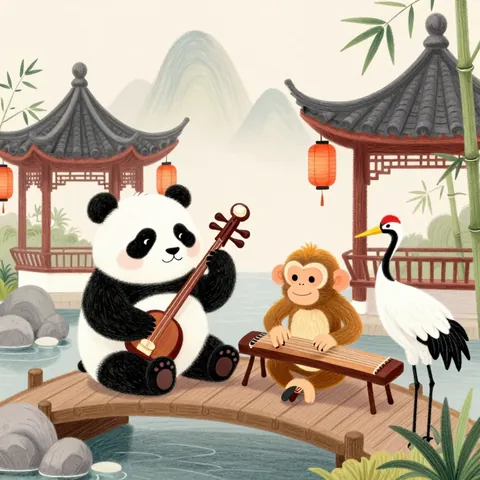
How Chinese music sounds and where you hear it
A lot of traditional Chinese music is built on a five-note scale, called a pentatonic scale. It puts the focus on a singing melody and on the special color of each instrument, more than on big chords.
Long ago, people sorted instruments by what they are made of, such as silk strings, bamboo, bronze and stone. Songs were sung with bells, drums and stone chimes, and old song collections were written down as poems.
Today you can hear this music at opera theatres, at weddings and festivals, in orchestras that use traditional instruments, in film songs and in pop and rock.
The story of one song: Jasmine Flower
"Mo Li Hua" means Jasmine Flower. It is a folk song from the Jiangnan area, near the lower Yangtze River, around cities like Suzhou and Hangzhou. The words praise the sweet white flower.
Nobody knows who first sang it. Some words were written down about 400 years ago, and many people say the song is around 300 years old. Folk songs change as people pass them along.
The tune uses five notes, and it traveled far. The opera composer Puccini used it in Turandot (1926), and an adapted version opened the medal ceremonies at the 2008 Olympics.
Traditional instruments
Here are some instruments from Chinese music, old and still in use.
- Guqin
- A quiet seven-string instrument that lies flat; the right hand plucks the strings while the left hand presses and slides along them.
- Guzheng
- A long plucked zither with movable bridges under each of its many strings, played with picks on the fingers; many modern ones have about 21 strings.
- Pipa
- A pear-shaped lute with four strings, held almost upright and played by plucking with the fingers and fingernails.
- Erhu
- A two-string fiddle whose bow hair passes between the strings, with a snakeskin-covered body, played sitting down with the body on the knee.
- Dizi
- A bamboo flute held sideways, with a special hole covered by a thin membrane that gives it a bright, buzzy sound.
- Sheng
- A mouth organ made of a bunch of bamboo pipes with reeds inside, which makes sound whether you breathe out or in.
- Suona
- A loud, high horn with a double reed and a metal bell, often played at weddings and festivals.
- Bianzhong
- A set of bronze bells hung in a frame and struck with mallets; each bell can give two different notes, depending on where it is hit.
How to listen
Close your eyes and follow one tune at a time. Chinese music often puts the melody first, and each instrument has its own special color.
- Listen for one singing tune
- Much traditional Chinese music is about a single melody line, more than thick chords.
- Listen for slides and bends
- On the guqin, a player can slide a finger along a string, so the note glides instead of jumping.
- Listen for drums, gongs and cymbals
- At Lunar New Year, a lion dance is led by loud drum beats with gongs and cymbals.
Set the Sowlea metronome to a slow beat and clap along. Then hum one note and slowly slide it up, like a guqin or erhu would, and land on the next click.
Big moments in the story of China's music
- About 433 BCBells in a royal tomb
A ruler named Marquis Yi of Zeng was buried with a huge set of bronze bells, over sixty of them, plus flutes and string instruments; the bells can still be played.
- About 112 BCA music office for folk songs
During the Han dynasty, the court had a Music Bureau that gathered songs and ballads from ordinary people.
- About 714The Pear Garden
In the Tang dynasty, Emperor Xuanzong set up a school for musicians and dancers; opera performers are still sometimes called children of the Pear Garden.
- 1271 to 1368Plays full of songs
In the Yuan dynasty, a theatre form called zaju mixed singing, speaking, dance and comedy in four acts.
- 1500sKunqu becomes the favorite
A gentle, elegant opera style from the Kunshan area spread widely; its most famous play, The Peony Pavilion, was written in 1598.
- 1790Opera troupes come to Beijing
Opera troupes from Anhui came to Beijing for an emperor's birthday, and this is seen as the beginning of Peking opera.
- 1937Songs in the movies
In the film Street Angel, the singer Zhou Xuan sang songs that people loved, such as The Wandering Songstress.
- 1986Chinese rock is heard
Cui Jian performed Nothing to My Name on a TV music show, with a suona solo in place of a guitar solo, and many call this the start of Chinese rock.
Names to look up
These are just some examples, not a ranking. Ask a grown-up to help you search for them and listen.
- Hua Yanjun (Abing)
- Liu Tianhua
- Mei Lanfang
- Nie Er
- Xian Xinghai
- Zhou Xuan
- Cui Jian
- Wu Man
- Tan Dun
- Lang Lang
Meanwhile, around the world
While these things were happening in China's music, the rest of the world was busy too.
- 432 BCThe Parthenon is finished
In Athens, work on the decorations of the Parthenon temple ended, at about the time the bells of Marquis Yi were buried.
- 800Charlemagne is crowned
In Rome, Charlemagne was crowned emperor on Christmas Day, while the Tang dynasty was still going in China.
- 1271Marco Polo sets out
A young Venetian named Marco Polo began his long trip to Asia, the year the Yuan dynasty was named.
- 1599The Globe Theatre opens
Shakespeare's company built the Globe in London, just one year after The Peony Pavilion was written.
- 1791Mozart's Magic Flute
The Magic Flute opera was first performed in Vienna, the same year Mozart died, just after Peking opera began to take shape.
- 1937Snow White on the screen
Disney's first full-length cartoon, with songs like Heigh-Ho, premiered, the same year Street Angel came out.
Piano sound: Salamander Grand Piano by Alexander Holm (CC BY 3.0).