
Music of Russia: from church choirs to ballet and rock
Russian music has folk songs played on triangle-shaped balalaikas, church choirs with no instruments at all, and ballets and symphonies that fill concert halls around the world. This page follows those sounds from old village tunes to modern bands.
In this lesson
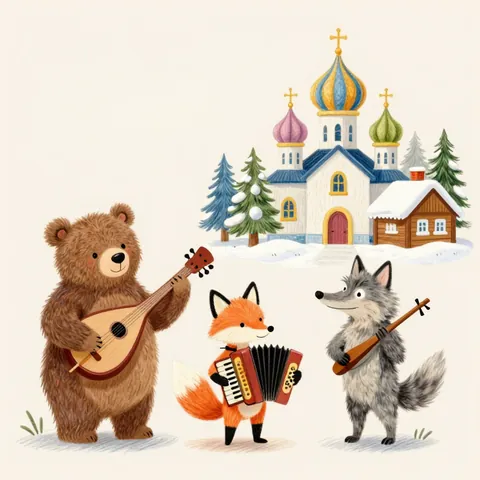
What does Russian music sound like?
Imagine a small triangle-shaped guitar with three strings, strummed fast until the notes shimmer like a tiny storm. That is the balalaika, and it is one of the best-known sounds of Russian folk music. Villagers also sang many songs, and short funny rhyming songs called chastushki were often sung with an accordion or a balalaika.
Church music has a very different feel. In the Russian Orthodox Church, voices sing without any instruments. An old style called znamenny chant has a single melody line, written with special hook-like signs instead of ordinary notes. Russian choirs are also famous for very deep bass singers, called oktavists, who sing some of the lowest notes a human voice can reach.
In the 1800s, composers began to build a Russian style of concert music. Mikhail Glinka wrote operas that used Russian tunes. Later, a group of five composers was nicknamed the Mighty Handful, and Pyotr Ilyich Tchaikovsky wrote ballets such as Swan Lake and The Nutcracker, which are still danced everywhere. Mussorgsky wrote a piano suite called Pictures at an Exhibition, and Rimsky-Korsakov wrote Scheherazade and was famous for the colours he got from an orchestra.
In the 1900s, Rachmaninoff wrote piano music full of long, singing tunes, Stravinsky's ballet scores such as The Firebird and The Rite of Spring changed how rhythm was used, and Shostakovich wrote fifteen symphonies. Sofia Gubaidulina became a famous woman composer who even used the bayan accordion in some of her pieces. Rock bands like Kino arrived in the 1980s, and today Russian pianists and singers perform on stages all over the world.
The story of one tale: Peter and the Wolf
In 1936, a children's theatre in Moscow asked a composer for a new piece. He wrote a musical tale with a narrator and an orchestra. It was made to help children learn the sounds of the instruments.
Every character has its own instrument. The bird is a flute, the duck is an oboe, and the cat is a clarinet playing short, springy notes. Grandfather is a bassoon, the wolf is three horns, and Peter is the string players.
The hunters' shots are drums. Listen once and you can point to each instrument by ear, like a game of musical hide-and-seek.
Traditional instruments
Here are some instruments you can look up and listen to.
- Balalaika
- A plucked instrument with a triangle-shaped body and three strings; it comes in many sizes, from a small prima to a huge bass that stands on the floor.
- Bayan
- A big button accordion with every note available on its buttons; it is named after an old singer-storyteller called Boyan and is loved by concert players.
- Gusli
- A flat, many-stringed instrument, one of the oldest of Russia; the player rests it on the knees and strums or plucks it, and folk versions have from about 11 to 36 strings.
- Domra
- A round-bodied, long-necked plucked instrument with three or four metal strings, played in Russian folk orchestras.
- Garmon
- A small button accordion that plays one set of notes (a scale), often called a garmoshka and used to accompany songs and dances.
- Zhaleika
- A little wooden pipe with a single reed and a bell at the end, made from horn or birch bark; it has a bright, slightly nasal sound.
- Wooden spoons
- Real spoons clacked together in the hand to make a rhythm, played in folk bands and dances.
How to listen
Russian music can be very different from piece to piece. Try these three clues when you listen.
- Listen for a shimmering strum
- The balalaika has a short sound that fades fast, so players strum or pluck very quickly to keep the music flowing.
- Listen for voices alone
- Znamenny chant is sung by many voices together on one melody, with no instruments at all.
- Listen for very low voices
- Some Russian church choirs have octavists, singers who can reach notes far below most other voices.
Set the metronome to a fast pace and clap along. Then say a silly four-line rhyme in time with the clicks, like a chastushka, which is a short, quick, funny song.
Big moments in the story of Russian music
- From the 1200sChurch chant flourishes
Znamenny chant, sung by voices alone with its special hook-shaped signs, spread widely in the Russian Orthodox Church in towns like Novgorod and Moscow.
- About 1170Gusli in the records
The first written records of the gusli come from the city of Novgorod.
- 1836Glinka's opera
Mikhail Glinka's opera A Life for the Tsar was a big success; he is often called the starting point of Russian classical music.
- 1877Swan Lake at the Bolshoi
Tchaikovsky's ballet Swan Lake was first shown at the Bolshoi Theatre in Moscow in March.
- 1880sThe balalaika joins an orchestra
The violinist Vasily Andreyev improved the balalaika and arranged folk tunes for balalaika orchestras.
- 1913The Rite of Spring
Stravinsky's ballet had its first show in Paris in May, with rhythms so wild that the audience made a big commotion.
- 1958The Tchaikovsky Competition begins
A music contest for young pianists and violinists began in Moscow; singers and other instruments were added later.
- 1981Kino forms
The rock band Kino, led by Viktor Tsoi, started in the city of Leningrad, now called Saint Petersburg.
Names to look up
These are only examples, not a ranking; ask a grown-up or search for them to listen.
- Pyotr Ilyich Tchaikovsky
- Modest Mussorgsky
- Nikolai Rimsky-Korsakov
- Sergei Rachmaninoff
- Igor Stravinsky
- Dmitri Shostakovich
- Sofia Gubaidulina
- Kino
- Daniil Trifonov
Meanwhile, around the world
While Russian music grew, here is what was happening in other places.
- 1163Notre-Dame begins
In Paris, builders began the great cathedral of Notre-Dame, around the time the gusli was first written about in Novgorod.
- 1839Photography goes public
In France, the daguerreotype was announced in August, a few years after Glinka's first big opera.
- 1877The phonograph
Thomas Edison announced his sound-recording machine in November, the same year Swan Lake was first shown.
- 1889The Eiffel Tower is finished
In Paris, a 300-metre iron tower was completed for a World's Fair, in the years when balalaika orchestras were forming.
- 1981The IBM PC
IBM released its first personal computer in August, the same year the band Kino began.
Piano sound: Salamander Grand Piano by Alexander Holm (CC BY 3.0).