
Music of Japan: from temple bells to anime songs
Japan has very old music that is still played today, and brand-new music that people around the world listen to. Songs from fishing boats, stages, cartoons and video games all live side by side.
In this lesson
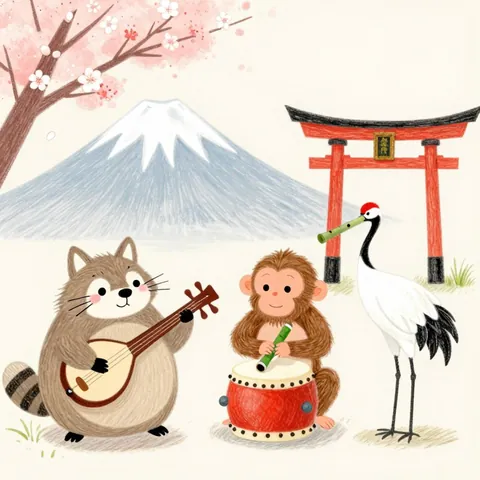
How Japanese music sounds and where you hear it
Some music in Japan is more than a thousand years old. Court musicians still play gagaku, a kind of orchestra music that came to Japan long ago and has changed very little since.
Music is also part of stories and festivals. Fishermen sang work songs while they pulled in their nets, actors sing and play on the stage in Noh and kabuki, and big drums boom at summer festivals.
Today you can also hear Japanese pop songs, cartoon themes and video-game music all over the world.
The story of one song
Sōran Bushi is a song from Hokkaido, in northern Japan. It is said to have been sung first by fishermen. Calls like “Dokkoisho!” and “Sōran!” helped cheer them on while they worked.
Summer has its own dance music. At Obon, people dance in a circle around a tall wooden tower called a yagura. Local folk songs play, and taiko drums often join in. This dance, bon odori, is nearly 600 years old.
One more tune: “Sakura Sakura,” a spring song about cherry blossoms. Its melody was printed in a koto textbook in 1888, and people still sing it today.
Traditional instruments
Here are some instruments that are used in Japan's old music.
- Koto
- A long wooden instrument with 13 strings, played by plucking the strings with picks on the fingers while the player kneels beside it.
- Shamisen
- A banjo-like instrument with three strings, played with a large pick called a bachi, which sometimes also taps the body of the instrument.
- Shakuhachi
- A bamboo flute that you blow across the open end, with four holes on the front and one on the back.
- Biwa
- A short-necked lute with four strings, played with a wooden pick, once used by traveling storytellers to sing long tales.
- Taiko
- The Japanese word for drum; big taiko are struck with thick wooden sticks and can be played by a whole group together.
- Sho
- A small mouth organ made of 17 bamboo pipes, which gives a soft, shimmering sound in gagaku court music.
- Hichiriki
- A short bamboo pipe with a double reed, a bit like a tiny oboe, which plays the melody in gagaku.
How to listen
Close your eyes and listen to a koto or a shakuhachi. Notice how a single note can wiggle and slide, and how the music leaves quiet gaps between sounds.
- Listen for a five-note tune
- Many Japanese melodies, like “Sakura Sakura,” use a scale with just five notes, which makes them simple and easy to hum.
- Listen for the shouts (kakegoe)
- In folk songs, festivals and taiko music, players and dancers call out short shouts to cheer, give a signal or keep everyone together.
- Listen for bending notes
- A koto player presses a string to raise its pitch, and a shakuhachi player tilts the angle of the breath to bend a note up or down.
Set the metronome to 60. Count 1-2-3-4 out loud, and on every fourth beat shout a short “Hey!” like a festival kakegoe. Can you keep it steady for one minute?
Big moments in the story of Japan's music
- About 700sCourt music arrives
Gagaku, along with instruments like the koto, biwa and sho, came to Japan from the Asian mainland around the Nara period.
- Late 1300sNoh takes shape
Kan'ami and his son Zeami helped create Noh, a stage art that mixes singing, dance, a flute and drums.
- 1500sThe shamisen arrives
A three-stringed instrument came to the main islands from Okinawa and became a favorite for theatre and songs.
- 1603Kabuki begins
A performer named Izumo no Okuni put on dancing shows in Kyoto that are said to be the first kabuki.
- 1879Western music in school
The government set up a group to plan music lessons, and Western-style songs soon started to be taught to schoolchildren.
- 1951The taiko group is born
Daihachi Oguchi is credited with inventing the modern taiko ensemble, where many drummers play together.
- 1985Game music goes worldwide
Koji Kondo wrote the tunes for Super Mario Bros., which are known by millions of people around the world.
- 2007A singing computer star
Hatsune Miku, a voice program that can sing songs written by fans, went on sale in Japan.
Names to look up
These are just some examples, not a ranking. Ask a grown-up to help you search for them and listen.
- Yatsuhashi Kengyo
- Toru Takemitsu
- Seiji Ozawa
- Hibari Misora
- Kyu Sakamoto
- Yellow Magic Orchestra
- Mariya Takeuchi
- Joe Hisaishi
- Koji Kondo
- Hikaru Utada
Meanwhile, around the world
While these things were happening in Japan's music, the rest of the world was busy too.
- 762Baghdad is founded
The city of Baghdad was founded around the time that gagaku was already being played at the Japanese court.
- 1368The Ming dynasty begins
A new dynasty began in China at about the time Kan'ami and Zeami were making Noh.
- About 1600Shakespeare writes Hamlet
In England, a famous play was written just a few years before kabuki began in Kyoto.
- 1685Bach is born
The German composer Johann Sebastian Bach was born. The same year, Yatsuhashi Kengyo, a famous koto player and composer in Japan, died.
- 1879The electric light bulb
Thomas Edison showed a long-lasting electric light bulb, the same year Japan began planning school music lessons.
- 1969People walk on the Moon
Astronauts landed on the Moon, in the years when Toru Takemitsu and Seiji Ozawa were becoming known around the world.
Piano sound: Salamander Grand Piano by Alexander Holm (CC BY 3.0).