
Music of Spain: from castle songs to flamenco guitars
Spain is famous for guitars, but its music is much bigger than that. There are old songs from royal courts, village bagpipes, dance rhythms and pop stars loved around the world.
In this lesson
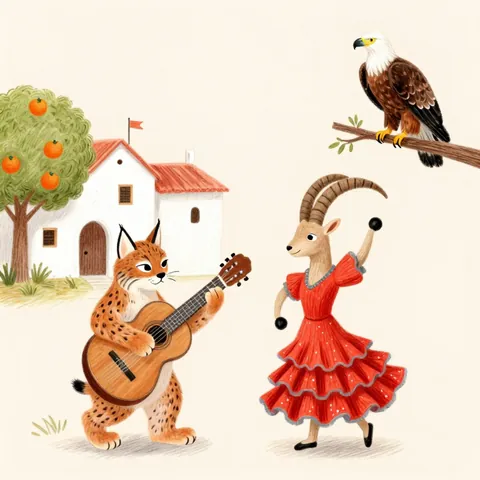
What does Spanish music sound like?
Picture someone strumming a guitar fast while another person claps a strong beat and a dancer stamps the floor. That is flamenco, a music and dance art from Andalusia in the south. It has three parts: cante (singing), toque (guitar playing) and baile (dancing). Clapping, called palmas, and castanets add more rhythm.
Spain has many local sounds. In Galicia in the northwest, the gaita (a kind of bagpipe) plays with drums. In Catalonia in the northeast, a band called a cobla plays for a circle dance named the sardana.
Long ago, King Alfonso X of Castile had a big book of more than 400 songs about the Virgin Mary written down in the 1200s, called the Cantigas de Santa María. In the 1500s, the composer Tomás Luis de Victoria wrote calm church music for singers. Later, a Spanish style of play with songs and talking, called zarzuela, became popular.
In the 1800s and 1900s, composers such as Albéniz, Granados and Falla used Spanish dance tunes in piano and orchestra pieces. Today, Spanish pop mixes flamenco, Latin rhythms and electronic beats.
The story of one song
In 1940, in Barcelona, a guitar concerto was played in public for the first time. Joaquín Rodrigo wrote it in 1939 and named it after the palace and gardens of Aranjuez. Its slow middle part is the most loved: an English horn sings a quiet tune while the guitar plays softly underneath.
In 1960, the jazz trumpeter Miles Davis and the arranger Gil Evans made their own version of that slow tune for the album Sketches of Spain. It helped more people hear the tune.
Now picture Catalonia. On weekends and festivals, people join hands in a circle in a square and dance the sardana. A band of 11 players, called a cobla, plays for them. One player plays a small flute with one hand and a little drum with the other.
Instruments you may hear
Here are some instruments you can look up and listen to.
- Classical guitar
- A guitar with six nylon strings that is plucked with the fingers; its modern shape was shaped a lot by the guitar maker Antonio de Torres in the 1800s.
- Flamenco guitar
- A guitar a bit lighter and brighter than the classical one, with a plastic plate so the player can tap its wood like a drum.
- Vihuela
- A plucked, guitar-shaped instrument with six pairs of strings that was popular in Spain in the 1500s.
- Castanets
- Two small shells joined by a string, held in the hand and clicked together; the name comes from the Spanish word for chestnut.
- Cajón
- A wooden box that the player sits on and slaps; it comes from Peru and was brought into flamenco in the late 1900s, and Paco de Lucía is often credited with this.
- Gaita
- A bagpipe from Galicia: the player fills a bag with air and presses it, so the pipes keep sounding, including a low drone.
- Tenora
- A loud, reedy woodwind from Catalonia that plays the tune in a cobla band for the sardana dance.
How to listen
In Spanish music, rhythm is often easy to hear: a clap, a click, a stamp or a drum keeps everyone together. Try to find who is keeping the beat.
- Listen for a 12-beat cycle
- Many flamenco styles repeat a rhythm pattern of 12 beats called a compás, and the clapping and guitar keep it going round and round.
- Listen for the drone
- A Galician gaita plays the tune on one pipe while a low drone pipe keeps sounding underneath.
- Listen for the three-beat swing
- The jota is usually counted in three, and castanets often click along with it.
Set the Sowlea metronome to a slow tempo and count 1-2-3, 1-2-3. Clap loudly on 1 and softly on 2 and 3. Can you keep it going for one whole minute?
Big moments in the story of Spanish music
- 1200sSongs for Mary
At the court of King Alfonso X, musicians made the Cantigas de Santa María, 420 songs written in Galician-Portuguese.
- 1536A book for the vihuela
Luis de Milán printed the first known collection of music for the vihuela, called El maestro.
- 1657Zarzuela is born
A show with spoken scenes, songs and dances, El laurel de Apolo, is usually named as the start of zarzuela.
- Late 1700sFlamenco takes shape
In Andalusia, singing, guitar and dance came together into the art we call flamenco.
- 1850sA new guitar shape
Antonio de Torres built guitars with a bigger body and a new way of bracing inside, close to the classical guitar we know today.
- 1905–1908Iberia for piano
Isaac Albéniz wrote Iberia, twelve piano pieces full of Spanish rhythms.
- 1940Concierto de Aranjuez
Joaquín Rodrigo's guitar concerto was first played in Barcelona on 9 November.
- 2018Flamenco meets pop
Rosalía released El mal querer, which mixes flamenco with pop and electronic sounds.
Names to look up
These are only examples, not a ranking; ask a grown-up or search for them to listen.
- Tomás Luis de Victoria
- Isaac Albéniz
- Manuel de Falla
- Andrés Segovia
- Paco de Lucía
- Camarón de la Isla
- Carmen Linares
- Montserrat Caballé
- Alejandro Sanz
- Rosalía
Meanwhile, around the world
While Spanish music grew, here is what was happening in other places.
- 1271Marco Polo sets out
The young Venetian began his long trip to Asia, around the time the Cantigas were being collected.
- 1564Shakespeare is born
The English writer was born in Stratford-upon-Avon, while the composer Tomás Luis de Victoria was still alive.
- 1756Mozart is born
The composer was born in Salzburg on 27 January, around the time flamenco was taking shape in Andalusia.
- 1851The Great Exhibition
A huge fair of inventions opened in London in the Crystal Palace, in the decade of Torres's new guitars.
- 1905Einstein's big year
Albert Einstein published four famous science papers, the same year Albéniz began Iberia.
- 1969First Moon landing
Apollo 11 landed on the Moon on July 20.
Piano sound: Salamander Grand Piano by Alexander Holm (CC BY 3.0).