
Music of Egypt: from tomb harps to Cairo radio stars
Egypt has music clues that are thousands of years old, painted on tomb walls and kept in museums. Its singers and songwriters also became famous across the Arabic-speaking world through records, radio and films.
In this lesson
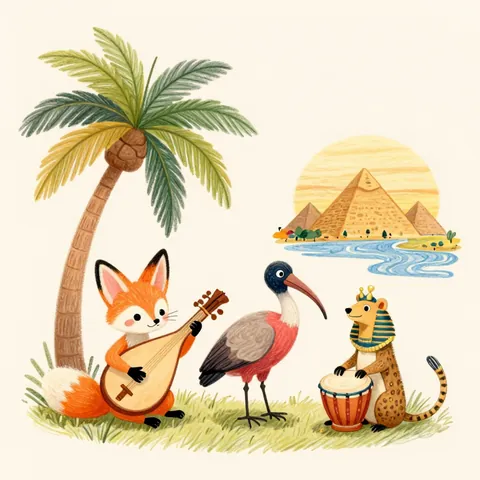
How Egyptian music sounds and where you hear it
In tombs, artists painted musicians playing harps and other instruments, so we know music was already part of life in ancient times. We cannot hear how it sounded, but we can look at the pictures and the instruments that were found.
Today, Egyptian music is often built on long, flowing tunes with small slides between notes, and on rhythms played on hand drums. Singers might stretch a single line of a song for a long time, and the listeners cheer when it moves them. People use the word tarab for that deep feeling of enjoying music.
You can hear it at weddings, in street celebrations, on the radio and in films, and in modern pop and dance music.
The story of two trumpets from a tomb
In 1922, Howard Carter's team opened the tomb of the young king Tutankhamun. Inside were two trumpets, one silver and one made of bronze or copper. They had been sleeping there for about 3,300 years.
On 16 April 1939, a British army bandsman named James Tappern played them for a radio show. He had to add a modern mouthpiece first. Around 150 million people may have tuned in, according to one account.
The trumpets could make only about three notes. They were probably used for signals, not tunes. Now they are very fragile, so they rest safely in a museum.
undefined
Here are some instruments you can find in Egypt's music, old and new.
- Harp
- Paintings in ancient Egyptian tombs show harps shaped like a bow, with strings plucked by the player; some are from about 4,500 years ago.
- Sistrum
- A rattle with a handle and a metal frame holding loose rings or bars, which jingle when you shake it; ancient Egyptians used it in ceremonies.
- Ney
- An end-blown flute made of a hollow reed, played by blowing across the top; some say it has been played for around 4,500 years.
- Oud
- A pear-shaped lute with no frets, usually with 11 strings, played with a pick called a risha; it is used across Arabic-speaking regions.
- Qanun
- A flat, wide, many-stringed instrument that lies on the player's lap, and is plucked with picks on the fingers of both hands.
- Tabla (darbuka)
- A goblet-shaped hand drum that gives a deep "doom" sound in the middle and a sharp "tak" at the edge; the Egyptian style has rounded edges for fast rolls.
- Mizmar
- A loud, piercing double-reed pipe, a bit like a small oboe, played outdoors at weddings and celebrations in Egypt and nearby regions.
How to listen to Egyptian music
Close your eyes and follow one sound at a time: first the drum, then the tune, then the singer. Each one has a clue to find.
- Listen for the drum's "doom" and "tak"
- The hand drum makes a deep "doom" when hit in the middle and a bright "tak" near the edge, and together they make the rhythm.
- Listen for notes in between
- Arabic tunes use tiny steps smaller than the piano's keys, and a ney player can bend a note by changing the blowing angle.
- Listen for a line that comes back
- In the tarab style, a singer may repeat one line again and again, changing it a little each time, until the listeners are swept away.
Set the Sowlea metronome to a slow beat. Say "doom" on each click and "tak" halfway between clicks, with a clap for tak. Then try to keep it going for one minute.
Big moments in the story of Egypt's music
- About 2500 BCHarps on tomb walls
Tomb paintings from around this time are the oldest known pictures of harps without a front pillar, showing that music was already important in ancient Egypt.
- About 1300s BCTrumpets in a tomb
Two trumpets found in the tomb of Tutankhamun in 1922 are about 3,300 years old and were played again on the radio in 1939.
- 1869–1871A grand opera house
The Khedivial Opera House opened in Cairo in 1869, and Verdi's opera Aida had its world premiere there in 1871.
- 1932Cairo Congress of Arab Music
Musicians and scholars from many places met in Cairo to talk about Arabic music, and 360 performances were recorded.
- 1934Radio concerts begin
Umm Kulthum began monthly radio concerts, said to be held on the first Thursday of the month for about forty years.
- 1944Early tape music
Halim El-Dabh recorded a ceremony in Cairo and changed the sounds with electronic equipment, creating one of the earliest known tape-music works.
- 1996A pop breakthrough
Amr Diab's album Nour El Ain became a big breakthrough, helping spread his pop sound beyond Egypt.
- Early 2000sMahraganat starts
Young musicians in Cairo mixed street wedding music, electronic beats and hip-hop into mahraganat, sharing it by phone and later on the internet.
Names to look up
These are just some examples, not a ranking. Ask a grown-up to help you search for them and listen.
- Sayed Darwish
- Umm Kulthum
- Mohamed Abdel Wahab
- Abdel Halim Hafez
- Layla Murad
- Halim El-Dabh
- Hamza El Din
- Mohamed Mounir
- Amr Diab
- Fatma Said
Meanwhile, around the world
While these things were happening in Egypt's music, the rest of the world was busy too.
- 2600–2400 BCStonehenge's big stones
In what is now England, people raised the giant stones of Stonehenge around the time harps were being painted on Egyptian tombs.
- 1877The phonograph
Thomas Edison invented the phonograph, a machine that could record sound and play it back, which later made records possible.
- 1903The first airplane flights
The Wright brothers made the first powered flights in the United States, when Sayed Darwish was a boy in Alexandria.
- 1969People walk on the Moon
Apollo 11 astronauts landed on the Moon, the same year Ahmed Adaweyah began performing in Cairo.
- 2005YouTube begins
YouTube was founded, and later became a place where songs from many countries, including mahraganat, were shared.
Piano sound: Salamander Grand Piano by Alexander Holm (CC BY 3.0).