
Music of Mexico: from Aztec drums to mariachi trumpets
Mexican music grew from many roads: the drums and whistles of the Aztec age, the guitars and violins that came from Spain, and the brass bands and accordions of later years. Each region of the country has its own sound, and you can hear the mix in every song.
In this lesson
What Mexican music sounds like
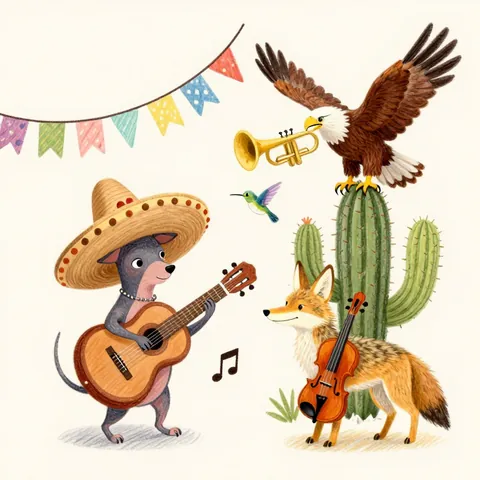
Imagine a party in the town square. Trumpets sing high, guitars strum a bouncy beat, and people clap and dance. That is the sound many people picture when they think of Mexico.
But there is much more. In Veracruz, players trade verses over harps and small guitars. In the north, an accordion plays a dance tune. In the old Aztec lands, drums were played for ceremonies long before any guitar arrived.
The story of one song: La Bamba
La Bamba is a very old folk song from Veracruz, on Mexico's eastern coast. It belongs to son jarocho, a style that mixes Spanish, Indigenous and African music.
Long ago it was sung at weddings. Dancers stamped quick steps together, and guests could add new verses just for the happy couple. Players on harp, jarana and requinto kept the song bouncing along.
Nobody is sure what the word "bamba" means. Some think it comes from a word for swaying. In 1958, a young American singer, Ritchie Valens, made a rock and roll version that many people still know today.
Traditional instruments
Here are some instruments you can look up and listen to.
- Huehuetl
- An upright wooden drum with a skin on top, played with the hands or sticks, used by the Aztecs and neighbouring peoples.
- Teponaztli
- A hollow log drum with an H-shaped cut on top; you hit the two wooden tongues with padded sticks to get two different notes.
- Clay whistles, ocarinas and conch shells
- Old Mexican peoples made whistles and ocarinas from clay and blew conch shells like trumpets to start ceremonies.
- Jarana jarocha
- A small, strummed guitar-like instrument from Veracruz that keeps the beat in son jarocho.
- Huapanguera
- A big, deep-voiced guitar with eight strings, played in the Huasteca region together with a violin and a jarana.
- Vihuela and guitarrón
- In a mariachi band, the round-backed vihuela strums the rhythm and the big guitarrón plays the low bass notes.
- Trumpet and violin
- These two are the bright voices of a mariachi, playing the tunes that singers follow.
- Button accordion and bajo sexto
- In norteño music, the small accordion plays the tune while the bajo sexto, a big twelve-string guitar, plays the beat and bass.
How to listen
Mexican music has many styles, so listen for how the beat moves. Some songs sway, some bounce, and some stop for a happy shout. Pick one song and notice what the instruments do.
- Listen for the shout
- In rancheras, the singers or the audience often let out a big yell, called a grito, between the verses.
- Listen for 3 and 6 mixing
- Mariachi songs in the son style swing between a count of three and a count of six, so the beat feels like it is rocking.
- Listen for the bounce
- Norteño music from the north often has a polka-like bounce, with the accordion on the tune and the bajo sexto on the beat.
Set the Sowlea metronome to a medium speed and clap on every click. First count 1-2-3, 1-2-3 for a swaying feel, then count 1-2, 1-2 for a bouncing feel. Then listen to one ranchera and one norteño song and guess which count each one is closer to.
Big moments in the story of Mexican music
- 1325 (traditional date)Tenochtitlan begins
According to tradition, the Aztec capital was founded on an island in a lake in 1325, and drums like the huehuetl and teponaztli were played there.
- 1521Old and new meet
After the Spanish took Tenochtitlan, Spanish instruments like guitars and violins began to mix with local ones, starting new kinds of music.
- 1700sSon jarocho takes shape
In Veracruz, Spanish, African and local music blended over time into a lively style of songs and dances.
- 1800sBrass bands arrive
From the middle of the century, valved brass instruments reached Mexico and town bands began to play; in Sinaloa this grew into the banda with its tuba and tambora drum.
- Early 1900sRanchera and corrido
Ranchera songs about love, home and the countryside grew popular around the time of the Mexican Revolution, and corridos told stories in song.
- 1930sTrumpets join the mariachi
Around the 1930s, as mariachi became a stage and radio act, the trumpet gained fame and became a bright voice of the group.
- 1936–1956The film golden age
Mexican movies were made in great numbers, and singing stars like Jorge Negrete and Pedro Infante helped spread Mexican songs.
- 2011Mariachi honoured
UNESCO added mariachi to its list of the world's intangible cultural heritage.
Names to look up
These are examples, not a ranking; ask a grown-up to help you search for them and listen.
- Carlos Chávez
- Pedro Infante
- José Alfredo Jiménez
- Vicente Fernández
- Chavela Vargas
- Juan Gabriel
- Los Tigres del Norte
- Café Tacvba
- Natalia Lafourcade
- Lila Downs
Meanwhile, around the world
Here is what else was going on while Mexican music was growing.
- 1539First printing press in the Americas
A printing press was set up in Mexico City, and printed books began to spread there years after the Spanish arrived.
- 1685Bach is born
In Germany, the composer Johann Sebastian Bach was born; his music is still played everywhere today.
- 1810A church bell rings
On 16 September, a priest named Miguel Hidalgo rang the church bell in the town of Dolores and called for independence, a day Mexico still celebrates.
- 1829The accordion is patented
In Vienna, Cyrill Demian patented an instrument called the accordion; it later became a favourite in places like northern Mexico.
- 1879Danzón is born in Cuba
The danzón, a slow elegant dance, took shape in Cuba, and Miguel Faílde's Las alturas de Simpson was played that year; it later became loved in Mexico, especially in Veracruz and Mexico City.
- 1936A Mexican symphony in Boston
Carlos Chávez conducted his Sinfonía india, built on tunes of native peoples of Mexico, with the Boston Symphony Orchestra.
Piano sound: Salamander Grand Piano by Alexander Holm (CC BY 3.0).