
Music of Germany: from church choirs to robot pop
Germany is home to centuries of choirs, church organs and famous composers. It is also where a band called Kraftwerk built pop songs out of electronic machines.
In this lesson
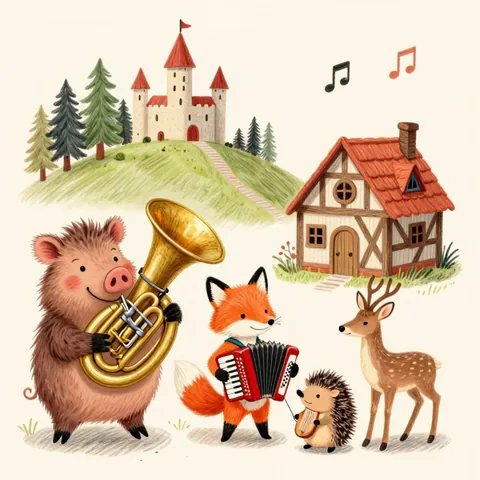
What does German music sound like?
There is no single German sound. Long ago, people sang love songs in the castles and hymns in the churches. Later, great composers wrote symphonies, piano pieces and songs for one singer with a piano.
Folk music has its own flavor too. In the Alps, people danced the Ländler, a dance in three beats per bar with lots of hopping and stamping. Many people think it helped shape the waltz, which also counts in three: ONE-two-three, ONE-two-three.
In recent times, Germany became famous for electronic music. In the 1970s, a band named Kraftwerk used synthesizers and drum machines to make songs that sounded like the future.
The story of one song
In 1974, the band Kraftwerk made a record about a drive on a German motorway. The song is called Autobahn, and the word means motorway.
The band worked in its own studio in Düsseldorf, called Kling Klang. There they used synthesizers, drum machines and electronic drums they built themselves. You can hear car sounds and horns in the music.
A short version of the song, about three and a half minutes long, became a hit in early 1975. Many people heard electronic pop for the first time.
Instruments and sounds of Germany
Here are some instruments with a German story. Many of them travelled far beyond Germany.
- Pipe organ
- A giant keyboard instrument that pushes air through pipes, and Germany has a long tradition of building them, with makers such as Arp Schnitger and Gottfried Silbermann.
- Zither
- A flat instrument with about 30 to 38 strings, played in the Alps: the left hand presses the melody strings and the right thumb plucks them with a small pick.
- Harmonica
- A little mouth organ where each breath makes thin metal reeds buzz, and the German clockmaker Matthias Hohner began making them in Trossingen in 1857.
- German concertina
- A small squeezebox with buttons on both ends, introduced by Carl Friedrich Uhlig in 1834, which makes sound as you push and pull the bellows.
- Bandoneon
- A squeezebox named by the German instrument dealer Heinrich Band in the mid-1800s, first meant for church music, but later a star of Argentine tango.
- Synthesizer
- An electronic keyboard that makes sounds with electricity, and the band Kraftwerk used synthesizers, drum machines and a vocoder to make its music.
How to listen
German music often has a clear plan. Listen for the beat first, then for how the melody and the accompaniment share the work.
- Listen for the three-beat swing
- The Ländler and the waltz both count in three, with a strong first beat: ONE-two-three.
- Listen for a galloping horse
- In Schubert's song Erlkönig, which he wrote at age 18, the piano plays fast repeating notes that sound like a horse running.
- Listen for robot patterns
- Kraftwerk built its songs from short, repeating rhythms, and used a vocoder to make voices sound like robots.
Set the metronome to three beats per bar. Clap hard on beat one and softly on two and three. Now try to stamp on beat one like a Ländler dancer.
Big moments in the story of German music
- About 1100sHildegard of Bingen
A nun and abbess named Hildegard, who lived from about 1098 to 1179, wrote songs with soaring melodies, and 69 of her pieces still survive.
- 1100s to 1300sMinnesang
Poet-singers wrote love songs in German, and Walther von der Vogelweide, who lived from about 1170 to about 1230, is the best known of them.
- 1212A boys' choir begins
The Thomanerchor of Leipzig was founded in 1212, and boys still sing in it today.
- About 1529A hymn for everyone
Martin Luther wrote the words and the tune of the hymn Ein feste Burg around 1527 to 1529, so people could sing together in German.
- 1723Bach in Leipzig
Johann Sebastian Bach became the music director of the churches in Leipzig, where he wrote and led music for almost 27 years.
- 1824Beethoven's Ninth
On 7 May 1824, Beethoven's Ninth Symphony was first played in Vienna, and it was one of the first big symphonies by a famous composer to include singers.
- 1876A theatre for one composer
Richard Wagner's festival theatre in Bayreuth opened, and the four operas of The Ring of the Nibelung were performed there together for the first time.
- 1974Kraftwerk's Autobahn
Kraftwerk, a band formed in Düsseldorf in 1970, released Autobahn, a record about driving whose title song lasts nearly 23 minutes.
Names to look up
These are only some examples, not a ranking, so ask a grown-up or search for them to listen.
- Hildegard of Bingen
- Johann Sebastian Bach
- Ludwig van Beethoven
- Clara Schumann
- Fanny Hensel
- Johannes Brahms
- Anne-Sophie Mutter
- Kraftwerk
- Nena
- Hans Zimmer
Meanwhile, around the world
While these things happened in German music, here is what else was going on in other places.
- 1215Magna Carta in England
In the time of the Minnesang poets, King John of England put his seal on the Magna Carta, an important agreement, at Runnymede.
- 1543The Sun at the center
A few years after Luther's hymn, Copernicus published his idea that the planets travel around the Sun.
- 1725Vivaldi's Four Seasons
Two years after Bach arrived in Leipzig, the Italian composer Vivaldi's four violin concertos about the seasons were published in Amsterdam.
- 1825A steam railway opens
A year after Beethoven's Ninth, the first public railway pulled by steam locomotives opened in England.
- 1876The first telephone call
In the year the Bayreuth theatre opened, Alexander Graham Bell made the first successful telephone call.
- 1977Music flies into space
A few years after Autobahn, the Voyager spacecraft left Earth carrying a golden record with music by Bach and Beethoven.
Piano sound: Salamander Grand Piano by Alexander Holm (CC BY 3.0).