
Music of Italy: from chanting monks to opera and pop
Many music words you may know, like piano, allegro and soprano, come from Italian. Italy is also where do-re-mi, opera and the piano began or took shape.
In this lesson
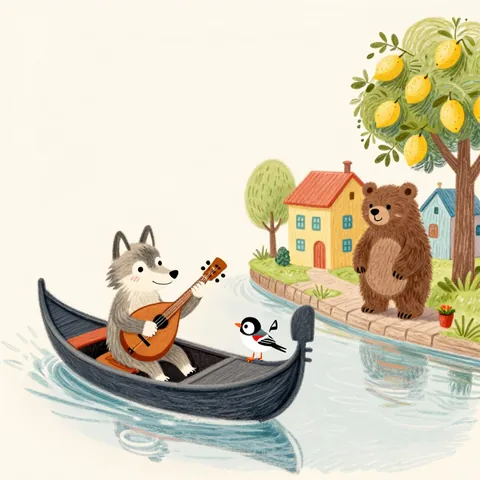
What does Italian music sound like?
Long ago, monks in churches sang slow, calm songs called chants. One kind is called Gregorian chant. It is named after Pope Gregory I, but experts think it grew over many years, and the story that he wrote it all is mostly a legend.
Around the year 1025, a monk named Guido of Arezzo helped singers learn songs faster. He used the first sounds of a Latin hymn, ut-re-mi-fa-sol-la, to name notes. That is where do-re-mi comes from. (Ut was later changed to do.)
Italy also loves to sing out loud. Opera tells a whole story with singing instead of speaking. Songs from Naples, like 'O sole mio, are sung by big voices with lots of feeling. And the tarantella is a quick folk dance from the south, usually in a bouncy 6/8 beat with tambourines.
Italian words are everywhere in music. Allegro means fast and lively, adagio means slow and relaxed, piano means soft and forte means loud. When you see these on sheet music, you are reading Italian.
The story of one song
In 1898, a poet named Giovanni Capurro wrote words about a sunny day after a storm. Eduardo di Capua wrote the tune. They called it 'O sole mio, which means "my sunshine" in the Neapolitan language of Naples.
The song was shown at Piedigrotta, a yearly song contest in Naples. It came second that year. But people loved it so much that it soon beat the winner in popularity.
Today singers all over the world sing it, in many languages. Try humming it: the tune rises and falls like a happy wave.
Instruments of Italy
Some of the world's best-loved instruments were built, or first shaped, in Italy.
- Violin
- A small string instrument played with a bow; famous makers in the town of Cremona, such as Amati and Stradivari, made violins that people still treasure.
- Piano
- An instrument with keys that make hammers hit strings, so you can play soft or loud; it was invented in Florence by Bartolomeo Cristofori.
- Mandolin
- A small, plucked instrument with eight strings in four pairs, played with a pick; the Neapolitan style became the most widespread kind.
- Organetto
- A small button accordion used in Italian folk music, often to play lively dances.
- Zampogna
- An Italian bagpipe with several pipes and a bag made of animal skin; it is especially linked to Christmas music.
- Tambourine
- A frame drum with jingles, shaken and tapped to drive the beat of the tarantella dance.
How to listen
Italian music often puts the voice and the dance in front. When you listen, ask: who is telling the story, and what is making me want to move?
- Listen for … talking that turns into singing
- In an opera, some parts sound like speech (recitative) and others are full songs (arias).
- Listen for … a trembling, shimmering note
- A mandolin player strikes a pair of strings again and again very fast, so one note keeps ringing.
- Listen for … a bouncy 6/8 dance beat
- The tarantella is fast and usually in 6/8, often with tambourines keeping the beat.
Set the Sowlea metronome to a slow tempo and count 1-2-3-4-5-6, clapping hard on 1 and 4. That is the rocking feel of 6/8. Can you keep it going as you slowly speed up?
Big moments in the story of Italy's music
- About 1025Guido and the music teacher's trick
Guido of Arezzo wrote about a way to teach singers notes using ut-re-mi-fa-sol-la.
- 1500sPalestrina in Rome
Palestrina wrote beautiful church music for many voices singing together, and is a star of Renaissance music.
- 1600An early opera
Jacopo Peri's Euridice was performed in Florence; it is the oldest opera whose music still survives.
- 1607Monteverdi's Orfeo
Claudio Monteverdi's opera L'Orfeo was performed in Mantua, and it is still staged today.
- About 1700The piano appears
Bartolomeo Cristofori in Florence built an early piano, and by 1711 it was described in print as a harpsichord with soft and loud.
- 1725The Four Seasons
Antonio Vivaldi's four violin concertos about the seasons were published.
- 1853Verdi's La traviata
Giuseppe Verdi's opera had its first night in Venice, and it became one of the most performed operas.
- 1898'O sole mio
The song from Naples was presented at a song festival and became famous around the world.
Names to look up
These are only examples, not a ranking; ask a grown-up or search for them to hear their music.
- Guido of Arezzo
- Francesca Caccini
- Claudio Monteverdi
- Antonio Vivaldi
- Giuseppe Verdi
- Giacomo Puccini
- Mina
- Ennio Morricone
- Laura Pausini
- Måneskin
Meanwhile, around the world
While Italy's music grew, big things were happening elsewhere too.
- 1450sThe Gutenberg Bible
Johannes Gutenberg's printed Bible appeared in Germany around the mid-1450s, a big step toward printing books, and later music, in large numbers.
- 1610Jupiter's moons
Galileo, an Italian scientist, looked at Jupiter through a telescope and saw four moons, just a few years after Monteverdi's Orfeo.
- 1685Bach is born
The German composer Johann Sebastian Bach was born, around the time the first pianos were being built in Italy.
- 1824Beethoven's Ninth
Beethoven's Ninth Symphony, with singers in the last part, was first performed in Vienna.
- 1969Walking on the Moon
Apollo 11 landed on the Moon; by then Italian songs and film music were heard around the world.
Piano sound: Salamander Grand Piano by Alexander Holm (CC BY 3.0).