
Music of Nigeria: from talking drums to Afrobeats
Nigeria is a big country in West Africa with more than 250 groups of people, and each one has its own songs, drums and dances. Its music grew from old village traditions into styles that make people dance around the world.
In this lesson
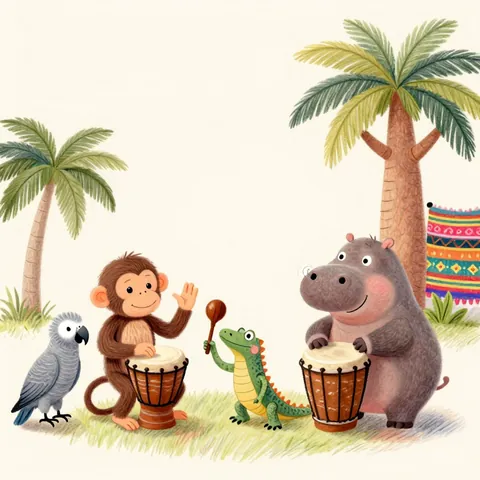
What does Nigerian music sound like?
Imagine lots of drums talking to each other at once, with shakers rattling and people singing back and forth. Many Nigerian songs have a leader who sings a line and a group who answers, like a game of call and reply.
Three big groups of people are the Yoruba, the Igbo and the Hausa. In the Yoruba lands, drum bands are famous. The Igbo are known for the udu clay pot drum and iron bells. In the north, the Hausa play long trumpets, talking drums and one-string fiddles.
The drum that talks
In Yoruba, the pitch of a voice can change what a word means. The dùndún drum copies that. Its player squeezes the cords under one arm to make the sound higher, and taps with a curved stick.
Drummers can copy the ups and downs, the timing and the feeling of speech. They have used this to share news, jokes, proverbs and praise. The drum does not copy vowels or consonants, only the tune of the words.
Another Nigerian drum had a different job. The Igbo ikoro is a huge slit drum kept in one place, usually the village square. When its sound rang out, people came together to hear important news.
Traditional instruments
Here are some instruments you might hear in Nigeria, from village drums to royal trumpets.
- Dùndún (talking drum)
- A drum shaped like an hourglass that is tucked under the arm; squeezing its cords changes the pitch so it can copy the tones of the Yoruba language.
- Shekere
- A dried gourd covered by a net of beads that is shaken and also tapped, so one instrument sounds like a rattle and a drum.
- Udu
- A clay pot with two holes, played by slapping the big hole and the pot with the hands; it comes from the Igbo people.
- Bàtá
- A two-headed drum shaped like an hourglass that is played in sets; Yoruba people use it for ceremonies, including those for Shango, a thunder spirit.
- Ikoro
- A huge wooden slit drum of the Igbo people that is hit with sticks; when it sounds, people gather in the village square because something important has happened.
- Ogene
- An iron bell made by blacksmiths and struck with a wooden stick; Igbo musicians use it to keep a ringing beat.
- Kakaki
- A very long trumpet from northern Nigeria that is played with drums at the courts of Hausa emirs, who are local leaders.
- Goje
- A fiddle with a single string, played with a bow, from the Hausa people.
How to listen
Pick one sound and follow it for a while. It might be the singer, the drum or the bell. Then try to hear how the other sounds fit around it, like friends talking at the same time.
- Listen for … a question and an answer
- A leader sings a line and a group answers; this call and response is the most common way to arrange music in Nigeria.
- Listen for … a drum going up and down
- A talking drum changes its pitch as the player squeezes it, so it can sound like a voice asking or saying something.
- Listen for … many rhythms at once
- Afrobeat layers interlocking rhythms from drums and percussion, so a groove can feel full and keep moving for a long time.
Clap a steady beat with the Sowlea metronome. Then make up a short clap or hum as a question, and let a friend answer it with a different one.
Big moments in the story of Nigeria's music
- 1920sJuju begins in Lagos
Musicians such as Tunde King mixed Yoruba songs with a guitar-banjo, rattles and drums to make a new style called juju.
- 1950sHighlife dance bands
Bands led by people like Victor Olaiya played highlife, a happy dance music that came to Nigeria from Ghana and got its own Nigerian flavor.
- 1957I. K. Dairo's band
I. K. Dairo started his band and added the accordion and talking drums to juju, and many people came to love it.
- 1960A new country
Nigeria became independent on 1 October 1960, with a week of parties, music and dance in Lagos.
- Late 1960s and 1970sAfrobeat and fuji
Fela Kuti and his band created Afrobeat, a long groove of horns, funk and jazz, while Sikiru Ayinde Barrister helped shape fuji.
- 1982–1983Juju goes worldwide
King Sunny Adé's albums Juju Music and Synchro System won new listeners abroad, and Synchro System earned a Grammy nomination.
- 1992Nollywood begins
The film Living in Bondage helped start Nollywood, Nigeria's huge movie industry, and films soon needed songs and music of their own.
- 2000s and 2010sAfrobeats
Afrobeats, with an s, is a name for the pop music of West Africa, and singers like Burna Boy, Tems and Wizkid made Nigerian pop popular around the world.
Names to look up
These are only examples, not a ranking; ask a grown-up or search for them to listen. Fela Kuti and Fela Sowande are two different musicians.
- Fela Kuti
- Tony Allen
- I. K. Dairo
- King Sunny Adé
- Onyeka Onwenu
- Fela Sowande
- Sade
- Burna Boy
- Tems
- Wizkid
Meanwhile, around the world
Here is what was happening elsewhere while Nigeria's music kept changing.
- 1920sRadio reaches homes
In the early 1920s, regular radio broadcasts began in several countries, around the time juju was starting in Lagos.
- 1969People walk on the Moon
The Apollo 11 astronauts landed on the Moon on 20 July, in the same years Fela Kuti was building Afrobeat.
- 1981Music on TV
The channel MTV began in the United States, a year before King Sunny Adé's Juju Music album.
- 1991The web opens up
The World Wide Web became open to everyone on the Internet, and a year later Nollywood started in Nigeria.
- 2007The first iPhone
The first iPhone went on sale, and smartphones soon spread, so today people can stream Afrobeats on them.
Piano sound: Salamander Grand Piano by Alexander Holm (CC BY 3.0).