
Music of Brazil: three roots, one big carnival
Brazilian music grew from three kinds of music that met in one place: Indigenous, African and Portuguese. Out of that mix came samba, bossa nova, forró and many more sounds.
In this lesson
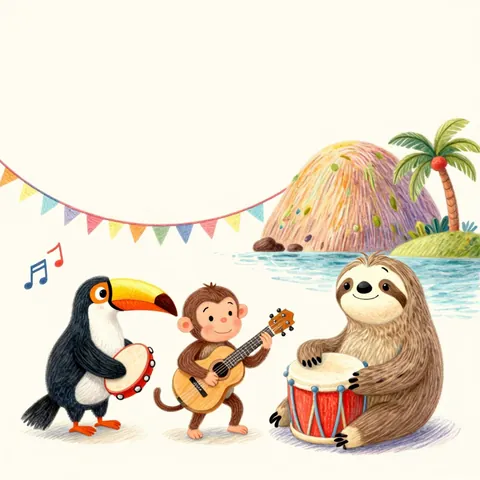
How Brazil sounds
Long ago, the people who already lived in the land had their own songs, rattles and flutes. Then people came from Portugal, bringing songs, guitar-like instruments and European melodies. Many people also came from Africa, and they brought drums, rhythms and call-and-answer singing. Mixed together over hundreds of years, these three roots made Brazilian music.
Samba is the sound many people think of first. A famous early song, "Pelo Telefone", was recorded around 1916 and came out in early 1917, and it was a hit at carnival. In 1928 the first "samba school" was founded in Rio de Janeiro. A samba school is really a big neighborhood group that sings, dances and plays together for the yearly carnival parade.
In the late 1950s a calm, quiet style called bossa nova appeared. Its name means something like "new way". Singers use soft voices and gentle guitar. Later, in the late 1960s, Tropicália artists mixed Brazilian music with new sounds from around the world. After them, a wide style called MPB (Música Popular Brasileira, "Brazilian popular music") grew, with thoughtful songs and many singer-songwriters.
Brazil has lively regional styles too. Forró comes from the Northeast and is played with an accordion, a big drum and a triangle. Axé began in the 1980s in Salvador, in the state of Bahia, and is a cheerful dance music for street parties. Funk carioca began in Rio de Janeiro in the 1980s as dance music with strong beats.
The story of one circle and one parade
In a capoeira circle, called a roda, two people play a game of movement while everyone else claps and sings. A berimbau, a bow with a gourd, tells the players how fast and how low to move.
Each samba school picks a theme for its yearly parade. Composers then write songs about that theme and compete, and the school's winning song is sung by thousands of people as they march.
Behind that song, a bateria of hundreds of drummers sets the pace. The deep surdo drums keep the beat steady, so the whole parade can move together.
Traditional instruments
Many Brazilian instruments are for rhythm, and most of them are small enough to carry in a parade.
- Cavaquinho
- A small guitar-like instrument with four strings that came from Portugal; players strum it quickly with a pick to keep the rhythm in samba.
- Berimbau
- A long wooden bow with a wire and a hollow gourd; it is tapped with a small stick and is the main sound of capoeira, a Brazilian martial art with music.
- Pandeiro
- A round hand drum with little metal jingles, like a tambourine, played with the thumb, fingers and palm.
- Surdo
- A big, deep bass drum; in a samba band, the surdos keep the steady heartbeat that everyone else follows.
- Cuíca
- A small drum with a stick inside it; the player rubs the stick with a damp cloth to make a squeaky sound that some people compare to a laugh.
- Agogô
- Two metal bells joined together, each with a different pitch, struck with a stick; its name comes from the Yoruba language of West Africa.
- Tamborim
- A very small, light drum held in one hand and hit quickly with a thin stick to make bright, snappy patterns.
- Reco-reco
- A scraper with notches; when you drag a stick across it, it goes "reco-reco", which is where its name comes from.
How to listen
Brazilian music is full of rhythm layers. Try listening to one instrument at a time, then to all of them together.
- Listen for the off-beat push
- Samba is mostly counted in twos, and its rhythms often land between the main beats, which is called syncopation.
- Listen for call and response
- In samba and capoeira, a soloist sings a line and a group answers it.
- Listen for the quiet guitar
- In bossa nova, the guitarist plays a gentle, syncopated pattern that copies samba drums, and the singer stays soft.
Set the Sowlea metronome to a slow speed and clap on every click. Then clap just between the clicks. That in-between clapping is the feeling of syncopation.
Big moments in the story of Brazil's music
- From about 1500Three kinds of music meet
Portuguese people arrive, and over time Indigenous, Portuguese and African music begin to blend.
- 1899A carnival march
Chiquinha Gonzaga writes "Ô Abre Alas", often called the first carnival march.
- 1916–1917A famous early samba
"Pelo Telefone" is recorded and becomes a carnival hit; many people call it the first recorded samba.
- 1928The first samba school
Deixa Falar is founded in Rio de Janeiro, and Pixinguinha writes "Carinhoso", a beloved song of the choro style.
- 1930–1945Bachianas Brasileiras
Composer Heitor Villa-Lobos writes nine pieces that mix the style of Bach with Brazilian tunes.
- 1958Bossa nova arrives
João Gilberto records "Chega de Saudade", a song by Antônio Carlos Jobim and Vinicius de Moraes, and the quiet new style spreads.
- 1968Tropicália
A group of young artists releases the album "Tropicália: ou Panis et Circencis", mixing Brazilian music with new ideas.
- 1984The Sambadrome
A special street-stadium for samba school parades opens in Rio de Janeiro.
Names to look up
These are only examples, not a ranking; ask a grown-up or search for these names to hear their music.
- Pixinguinha
- Chiquinha Gonzaga
- Cartola
- Heitor Villa-Lobos
- Luiz Gonzaga
- João Gilberto
- Gal Costa
- Elis Regina
- Daniela Mercury
- Anitta
Meanwhile, around the world
Here is what was happening elsewhere around the same times.
- 1685Bach is born in Germany
While Portuguese and African music were mixing in Brazil, a future great European composer was born.
- 1895The first movie shows
The Lumière brothers in France show films to a paying crowd, just a few years before the first carnival march in Brazil.
- 1917The first jazz records
In the United States, a band makes some of the first jazz records, the same year samba's first hit came out.
- 1928Mickey Mouse cartoon with sound
"Steamboat Willie" shows in cinemas the same year the first samba school was founded.
- 1958A satellite for the United States
The United States launches its first satellite, Explorer 1, in the year bossa nova began.
- 1969People walk on the Moon
Apollo 11 lands on the Moon, a year after Tropicália's famous album.
Piano sound: Salamander Grand Piano by Alexander Holm (CC BY 3.0).