
Music of France: from cathedral singers to French touch
French music has been played in castles, in cathedrals, on busy Paris streets and in dance clubs. Let's follow its story from singing poets to electronic beats.
In this lesson
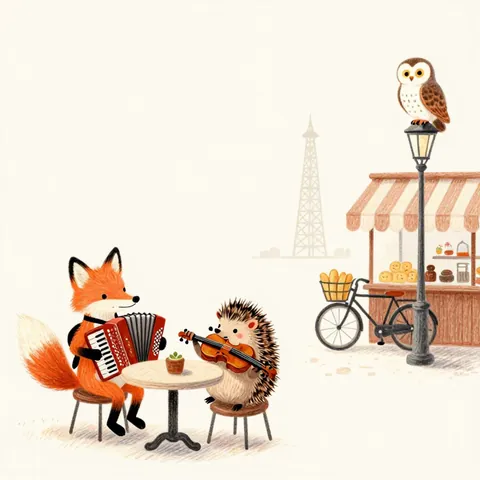
What French music sounds like
France does not have just one sound. Some French music is grand and stately, some is dreamy and soft, and some is made for dancing and singing along in a café.
A good way to start listening is to try three things: a dreamy flute piece by Debussy, a Paris street song sung by Édith Piaf, and a dance track by Daft Punk. Same country, very different worlds.
Two stories: a song and a party
In April 1792, an army officer named Rouget de Lisle wrote a marching song in the city of Strasbourg. Its first name was War Song for the Army of the Rhine.
Later that year, volunteers from Marseille sang it as they came to Paris. People began calling it La Marseillaise, and it became the national anthem in 1795.
France also has a music party. Fête de la Musique began in Paris in 1982. Every June, people play outdoors and many concerts are free.
Traditional instruments
Here are some instruments you will meet in the story of French music.
- Accordion (accordéon)
- A box with bellows and buttons or keys: you squeeze and stretch it to push air past little metal reeds; Cyrill Demian patented it in Vienna in 1829, and it later became the sound of Paris dance cafés.
- Cornemuse du Centre
- A bagpipe from central France, with one melody pipe and two drone pipes that hum steady low notes.
- Vielle à roue (hurdy-gurdy)
- A string instrument where you turn a crank, so a rosined wheel rubs the strings like a bow, while keys change the notes of the melody string.
- Saxophone
- A metal instrument played with a single reed, invented by Adolphe Sax, a Belgian who moved to Paris in 1842 and patented it in 1846.
- Harpsichord (clavecin)
- A keyboard whose strings are plucked, not hit; French composers such as Couperin and Rameau wrote lovely pieces for it.
- Flute
- Debussy's famous piece about a faun's afternoon begins with a dreamy flute solo.
- Musette
- The old name for a kind of French bagpipe, which gave its name to the dance halls called bals musette.
How to listen
French music often paints a mood, so listen for the feeling and the dance, not only the tune.
- Listen for a steady hum
- The hurdy-gurdy has drone strings that sing one unchanging note under the tune, a sound a lot like a bagpipe.
- Listen for the waltz swing
- Paris bal-musette bands, led by the accordion, played waltzes: count three beats, with the first one a little stronger.
- Listen for a floating mood
- Debussy's Prelude to the Afternoon of a Faun is slow and soft, and it opens with one lonely flute.
Set the Sowlea metronome to 3/4 and clap a waltz: loud on 1, soft on 2 and 3. Then hum a tune over it.
Big moments in the story of French music
- 1100s–1200sTroubadours
Poet-singers in the south of France sang about love in the Occitan language, and some of them were women, called trobairitz.
- About 1160–1250Notre-Dame singers
Composers connected with Notre-Dame in Paris, such as Léonin and Pérotin, wrote church music with several voices singing together.
- 1672Opera at the king's court
Jean-Baptiste Lully, born in Florence, became head of the royal opera, the Royal Academy of Music, in the time of King Louis XIV.
- 1722Rameau explains harmony
Jean-Philippe Rameau published a famous book on harmony, while François Couperin and Rameau wrote harpsichord music.
- 1792La Marseillaise
Rouget de Lisle wrote this song in one night, and it was adopted as the national anthem in 1795.
- 1894Debussy's dreamy sound
Claude Debussy's Prelude to the Afternoon of a Faun was first heard, a piece often linked to musical Impressionism.
- 1947Piaf and chanson
Édith Piaf recorded La Vie en rose, a song she had first sung in concert in 1946, and it became one of her best-known songs.
- 1997French touch
The Paris duo Daft Punk released the album Homework, which brought French house music to the whole world.
Names to look up
These are examples, not a ranking; ask a grown-up or search for them to listen.
- Beatriz de Dia
- Pérotin
- François Couperin
- Jean-Philippe Rameau
- Claude Debussy
- Lili Boulanger
- Édith Piaf
- Françoise Hardy
- Daft Punk
- Aya Nakamura
Meanwhile, around the world
While French music was changing, here is what was happening in other places.
- 1215Magna Carta in England
King John sealed the Magna Carta at Runnymede, near Windsor, a few years after Pérotin wrote church music in Paris.
- About 1455Printing in Germany
The first finished copies of the Gutenberg Bible appeared, one of the first big books printed with movable metal type in Europe.
- 1685Bach is born
Johann Sebastian Bach was born in Eisenach, in what is now Germany, in the same years Lully led French opera.
- 1805Beethoven's Eroica
Beethoven's Third Symphony was first performed in the years after the French Revolution.
- 1877The phonograph
Thomas Edison announced a machine that could record and play back sound, a few years before bal musette became popular in Paris in the 1880s.
- 1969First Moon landing
Apollo 11 landed on the Moon, a year after French singer Françoise Hardy released her album Comment te dire adieu.
Piano sound: Salamander Grand Piano by Alexander Holm (CC BY 3.0).