
Music of the United Kingdom: from bagpipes and harps to The Beatles
The United Kingdom is made up of England, Scotland, Wales and Northern Ireland, and each place has its own musical traditions. Together they gave us bagpipes, harps, brass bands, grand operas and pop music that people sing all over the world.
In this lesson
What does the music sound like?
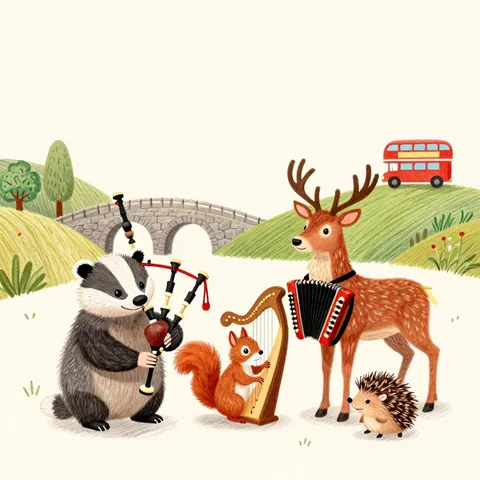
It sounds like many different things! In Scotland you might hear bagpipes and fast fiddle dances. In Wales there are harps and big choirs. In England there are folk songs, church music and brass bands, and across the UK people love to sing together.
Composers such as Purcell, Handel and Elgar wrote music for kings, churches and concert halls. In 1878 the comic opera H.M.S. Pinafore, by Gilbert and Sullivan, opened in London. Later, bands like The Beatles filled the radio, and in 1967 they released the album Sgt. Pepper's Lonely Hearts Club Band.
The story of one song
In January 1856, a Welsh father and son made a song together. Evan James wrote the words, and his son James James wrote the tune. At first it was called Glan Rhondda, which means Banks of the Rhondda.
The song was first sung in a chapel hall in Maesteg. Later it was printed in a book of Welsh tunes and got the name Hen Wlad Fy Nhadau, meaning Old Land of My Fathers.
In 1899, a singer named Madge Breese made the first Welsh-language record with it. In 1905, fans at a rugby match in Wales sang it out loud, and people have kept doing it ever since. Today crowds still sing it together.
Traditional instruments
Here are some instruments you can hear in the music of the four lands.
- Great Highland bagpipe
- A Scottish instrument: the player blows air into a bag and squeezes it, so the long drone pipes keep one steady sound going while the melody pipe plays the tune.
- Northumbrian smallpipes
- A much quieter kind of bagpipe from north-east England that is filled with air by a small bellows, so it works well indoors.
- Welsh triple harp
- A harp with three rows of strings, closely linked with Welsh folk music, which is plucked with the fingers.
- Irish harp
- An old harp tradition from Ireland; a famous harp gathering was held in Belfast in 1792 so that the tunes could be written down.
- Concertina
- A small, hand-held instrument with bellows and buttons, patented in England by Charles Wheatstone in 1829.
- Fiddle
- The violin played in folk style; Scottish fiddlers play lively reels and strathspeys for dancing.
- Brass band
- A group of cornets, trombones, tubas and drums; brass bands are often tied to local towns and workplaces, and bands still compete in contests every year.
How to listen
You do not need to know any music words to listen well. Close your eyes, pick one sound, and follow it from start to end. Then ask yourself: is it steady, bouncy, loud or soft?
- Listen for the drone
- A Highland bagpipe has three drone pipes that hum long, steady notes underneath, while the chanter plays the tune on top.
- Listen for the bounce
- A Scottish strathspey is a dance tune in 4/4 with dotted, jerky rhythms, and it is often followed by a smoother, faster reel.
- Listen for the warm glow
- A British brass band has cornets, horns, trombones, euphoniums, tubas and percussion but no woodwinds, and its cone-shaped brass tubes give a warm sound.
Set the Sowlea metronome to 108 BPM, which is about the speed Highland dancers use for a strathspey. Clap on every click, then try humming a bouncy tune over it.
Big moments in the story of the country's music
- 1575Music printing for Tallis and Byrd
Queen Elizabeth I gave the composers Thomas Tallis and William Byrd the sole right to print music in England.
- By 1689Purcell's opera Dido and Aeneas
Henry Purcell wrote an opera that is sung from beginning to end; it had been performed at a girls' school in London by the end of 1689.
- 1717Handel's Water Music
George Frideric Handel, who had settled in London, wrote music for a royal boat trip on the River Thames.
- 1856A Welsh song is born
Evan James wrote the words and his son James James wrote the tune of Hen Wlad Fy Nhadau, a song loved all over Wales.
- 1895The first Proms
The Promenade Concerts began in London with low ticket prices, so lots of people could come and hear an orchestra.
- 1962The Beatles' first single
Love Me Do came out in October and began the band's long chart career.
- 1994Britpop
Blur's Parklife and Oasis's Definitely Maybe were two big albums of Britpop, a bright, catchy style of guitar music.
- 2003Grime
Dizzee Rascal's album Boy in da Corner won the Mercury Prize and showed the world a new sound called grime.
Names to look up
These are just examples, not a ranking; ask a grown-up or search for them to listen.
- Thomas Tallis
- Henry Purcell
- Edward Elgar
- Ethel Smyth
- Benjamin Britten
- The Beatles
- Queen
- Kate Bush
- Adele
- Dizzee Rascal
Meanwhile, around the world
While music grew in the four lands, big things were happening elsewhere too.
- Mid-1450sGutenberg's printed Bible
In Mainz, Johannes Gutenberg printed a famous Bible using movable metal type, a new way to make many copies of a book.
- 1685Bach is born
Johann Sebastian Bach was born in Eisenach, Germany, only a few years before Purcell's opera was performed in London.
- 1903First airplane flights
The Wright brothers flew their powered airplane in North Carolina, in the same decade as Elgar's famous marches.
- 1969People on the Moon
Apollo 11 landed on the Moon on 20 July, two years after Sgt. Pepper.
- 1993The web is free for all
CERN announced that anyone could use the World Wide Web for free, the year before Britpop's big albums.
Piano sound: Salamander Grand Piano by Alexander Holm (CC BY 3.0).