
Music of the United States: from blues to hip-hop
American music is a mix of many sources, so it sounds like many things: church choirs, brass bands, guitars, drum machines and huge stage shows. This page follows some of the big styles from long ago to today.
In this lesson
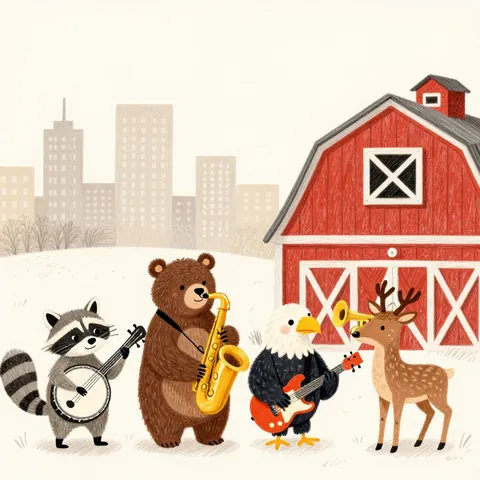
What does American music sound like?
American music has several roots: songs and drumming of Native American peoples, folk songs and hymns brought from Europe, and rhythms and ways of singing brought from Africa. Many songs and sounds made by African American communities are an important source of American music. These sounds met and mixed, and new styles grew from them.
The blues began among African Americans in the South, between about the 1860s and 1890s, with "blue notes" and call-and-response singing. Gospel made church singing even stronger and grew up in the 1930s, especially in Chicago. Jazz took shape in New Orleans around 1900, with improvising and swinging rhythms, and instruments like trumpet, saxophone, clarinet and piano.
Country music rose in the Southern states in the 1920s, mixing folk songs, blues and hymns, played on guitar, fiddle and banjo. In the 1950s, rock and roll blended blues, gospel and country, and the electric guitar became a star. In the 1970s, hip-hop began at parties in the Bronx, in New York City: DJs stretched the beats with two turntables while others rapped along.
The country also has music for stages and screens. Broadway musicals combine songs, speaking, acting and dance, and Hollywood film scores use orchestras to make a movie feel bigger. The composer George Gershwin put a jazz flavour into concert music, and Aaron Copland and Leonard Bernstein wrote pieces that sound very American too.
The story of one song: Jingle Bells
Jingle Bells was printed in Boston in 1857 by James Lord Pierpont, but under another name: "The One Horse Open Sleigh." Sleigh-ride songs were popular then. The title we know came with a new edition in 1859.
Nobody is sure where or when he first wrote it. Boston, Medford and Savannah have all been named in different stories, so historians are still checking.
On 16 December 1965, two astronauts on Gemini 6 played it in space with a small harmonica and some bells, as a surprise for Mission Control. Those instruments are now in a museum.
Traditional and special instruments
Here are some instruments you can look up and listen to.
- Banjo
- A plucked instrument with a round, drum-like body; the usual American kind has five strings, with a short fifth string, and it was shaped from African instruments by African Americans.
- Steel-string guitar
- An acoustic guitar with steel strings, which sound brighter and louder than nylon ones; it is heard in folk, blues, country and bluegrass.
- Electric guitar
- A guitar whose pickups turn string vibrations into electric signals for an amplifier; the first ones appeared in the 1930s, when big bands needed louder guitars.
- Saxophone
- Designed by Adolphe Sax of Belgium around 1840; it has a metal body but a single reed like a clarinet, and it became a star of jazz.
- Trumpet
- A brass instrument with three valves, played by buzzing the lips into the mouthpiece; jazz players like Louis Armstrong made it famous.
- Harmonica
- A small mouth instrument with metal reeds; you blow and draw air through its holes, and the 10-hole kind is often called a blues harp.
- Native American flute
- A wooden flute with two air chambers and a soft, breathy sound; it is one of the best-known wind instruments of Native American music.
- Turntables
- Record players that hip-hop DJs use; DJ Kool Herc played the same short beat on two of them, back and forth, to make a longer dance break.
How to listen
American styles often share a few simple patterns. Play one song three times and follow just one thing each time: the drums, the singer, then the part that makes you want to move.
- Listen for the backbeat
- In much rock and roll and R&B, the snare drum hits hardest on beats 2 and 4 of each bar, which makes you want to clap or nod along.
- Listen for swing
- In jazz, pairs of quick notes are often played long-short instead of evenly, which gives the music a bouncy, rolling feel.
- Listen for blue notes
- In blues and jazz, singers and players bend some notes slightly lower than usual, which makes the music sound expressive and a little sad.
Put on a rock or pop song and set the Sowlea metronome to its speed. Clap only on beats 2 and 4. Then try a swing drum rhythm and see how it feels different.
Big moments in the story of American music
- Around 1900Jazz takes shape in New Orleans
Brass bands, blues and ragtime mixed in New Orleans; the first jazz records were made in 1917.
- 1920Crazy Blues
Mamie Smith recorded it in August; she was the first African American singer to record vocal blues, and it sold about a million copies in under a year.
- 1924Rhapsody in Blue
George Gershwin's piece, mixing concert music and jazz, was first played in New York on 12 February, and begins with a famous clarinet slide.
- 1925–1927Country music on the radio and on record
The Grand Ole Opry began broadcasting from Nashville in 1925, and the Bristol sessions of 1927 recorded the Carter Family.
- 1943Oklahoma! changes Broadway
Richard Rodgers and Oscar Hammerstein II made a musical where the songs and dances helped tell the story.
- 1954Elvis records for Sun
Elvis Presley made his first big recording in Memphis in July, blending country, blues and gospel; rock and roll was soon booming.
- 1973Hip-hop begins in the Bronx
A party on 11 August, where DJ Kool Herc stretched the beats, is often called the birthday of hip-hop; "Rapper's Delight" became the first big rap hit in 1979.
- 2018A rapper wins the Pulitzer Prize
Kendrick Lamar's album DAMN. won the Pulitzer Prize for Music, the first time it went to someone outside classical and jazz.
Names to look up
These are only examples, not a ranking; ask a grown-up or search for them to listen.
- Louis Armstrong
- Ella Fitzgerald
- Aaron Copland
- Elvis Presley
- Aretha Franklin
- Dolly Parton
- Michael Jackson
- Beyoncé
- Kendrick Lamar
- Taylor Swift
Meanwhile, around the world
While American music grew, here is what was happening in other places.
- 1824Beethoven's Ninth Symphony
In Vienna, a choir joined a symphony orchestra at the first performance on 7 May, long before blues and jazz took shape.
- 1889The Eiffel Tower opens
In Paris, the tower opened to visitors in May, around the time the blues was growing in the American South.
- 1913The Rite of Spring
Stravinsky's ballet had its first performance in Paris on 29 May, with rhythms that shocked some of the audience, a few years before the first jazz records.
- 1962The Beatles' first single
"Love Me Do" came out in the UK on 5 October, as rock and roll music from the US was inspiring young bands there.
- 1982The first compact discs
The first commercial CD was made in August, and CDs went on sale in Japan in October, the same year Michael Jackson's Thriller came out.
- 2012Gangnam Style
The South Korean song became the first YouTube video to reach a billion views, showing how music could now travel around the world in days.
Piano sound: Salamander Grand Piano by Alexander Holm (CC BY 3.0).