
Music of Austria: Vienna, waltzes and Alpine sounds
For hundreds of years, musicians from all over Europe travelled to Vienna, the capital of Austria, to find work and listeners. Around the city, the Alps kept their own music too: zithers, button accordions and village dances.
In this lesson
Why is Vienna called a city of music?
First, Vienna had people who needed music. The emperor's court kept singers and players from 1498, and rich families, churches and theatres also paid for new music. So composers could find jobs, students and audiences there. Haydn, Mozart, Beethoven and Schubert all lived and worked in Vienna, and Beethoven and Brahms moved there from Germany.
Second, the city built homes for music and kept them busy. The Vienna Philharmonic gave its first concert in 1842, the Court Opera opened in 1869 with Mozart's Don Giovanni, and the Musikverein, with its famous Golden Hall, opened in 1870. Vienna also loved to dance: the waltz grew up here, and each winter the city still holds hundreds of balls.
Haydn, Mozart, Beethoven and the Viennese Classical style
Haydn, Mozart and Beethoven knew one another. Haydn and Mozart became friends in Vienna in the 1780s, and the young Beethoven studied with Haydn there from 1792. Because all three did their great work in Vienna, people often call their music the Viennese Classical style.
Their favourite big form was the symphony: a long piece for orchestra in several movements. A typical plan has four: a fast first movement, a slow one, a dance in three beats called a minuet, and a lively finale. Haydn wrote more than 100 symphonies and helped make this plan popular.
Inside a first movement, they often used sonata form. Imagine a story with three parts: we meet the main tunes, then the tunes go on an adventure and change, and finally they come home again. Listening for the moment the first tune returns is a great way to follow the music.
How the waltz took over Vienna
Long ago, in the villages of Austria and southern Germany, couples danced turning dances in three beats per bar, such as the Ländler. The waltz grew up alongside them. In the early 1800s, the people of Vienna went wild for it, and big dance halls filled with spinning couples.
Two bandleaders, Joseph Lanner and Johann Strauss I, wrote new waltzes for these halls, and they were rivals. Later, Strauss's son, Johann Strauss II, wrote The Blue Danube. It was first sung by a men's choir in 1867 and was only a small success. As a piece for orchestra, it became a hit around the world.
The dancing never stopped. Today, Vienna holds more than 400 balls each season, mostly in January and February. When the opening dance is done, someone calls out "Alles Walzer!", which means everybody waltz, and the floor is open to all.
Instruments and sounds of Austria
Some of these instruments belong to the concert halls of Vienna, and some belong to the villages and inns of the Alps.
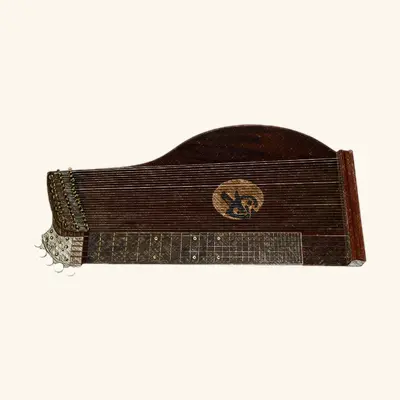 Zither
A flat box of strings played on a table, popular in Austria and Bavaria, and the Viennese player Anton Karas made it world famous with his music for the 1949 film The Third Man.
How it is built: A flat wooden box lies on a table. A few melody strings run over a fretted fingerboard and are plucked with a ring on the thumb, while many open strings beside them play bass and chords.
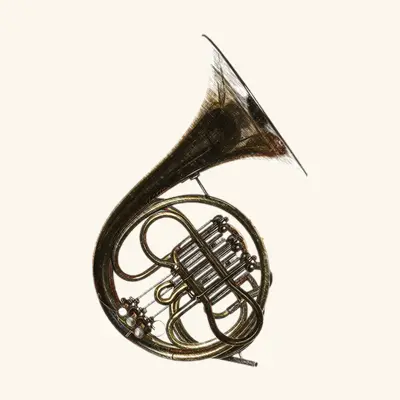 Vienna horn
A special kind of French horn with its own valve design from 1800s Vienna, still played today by the horn players of the Vienna Philharmonic.
How it is built: A long brass tube is coiled into a circle and opens into a wide bell. The player buzzes the lips into a mouthpiece, and valves send the air through longer or shorter tubes to change the note.
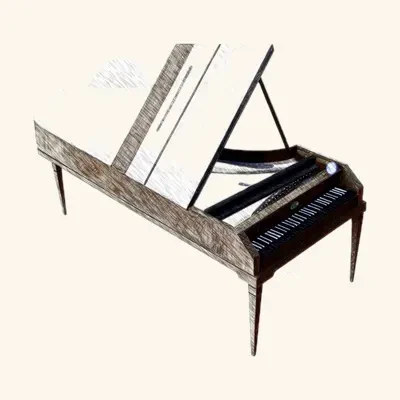 Viennese fortepiano
An early piano with a light touch, and Mozart bought one from the Vienna maker Anton Walter in 1782 and kept it until he died.
How it is built: It looks like a slim wooden piano. Pressing a key flips a small, light hammer up against the strings, so the sound is clear and a little softer than a modern piano.
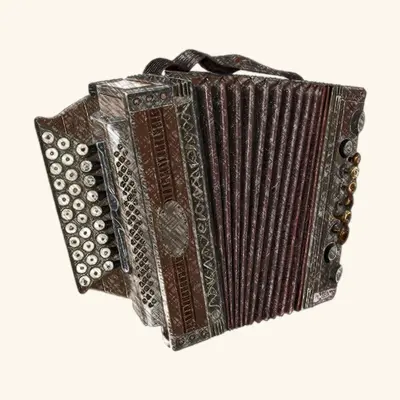 Steirische Harmonika
A button accordion from the Alpine folk tradition, named after the Austrian region of Styria, with deep, strong bass notes.
How it is built: Two wooden ends are covered in buttons and joined by a folded bellows. Pushing or pulling the bellows sends air over metal reeds, and one button often gives two different notes for push and pull.
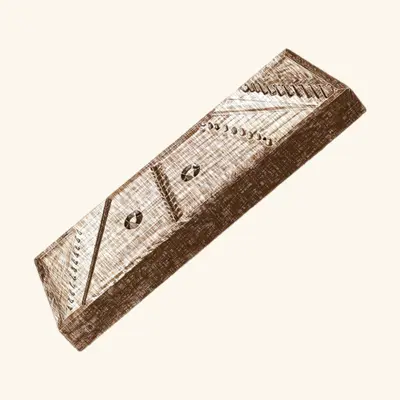 Hackbrett
A hammered dulcimer, and in the 1930s Tobi Reiser and others in Salzburg built a version that can play every note of the scale.
How it is built: A wooden box shaped like a trapezoid holds many strings in groups. The player strikes the strings with two small wooden hammers, one in each hand.
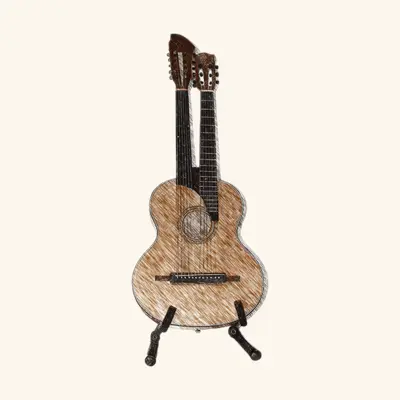 Contraguitar
A guitar with extra bass strings on a second neck, used in Schrammel music, a Viennese folk style named after a trio formed in 1878 that played in wine taverns.
How it is built: It looks like a guitar with a second neck beside the first. The player strums chords on the normal six strings and plucks the extra open bass strings for deep low notes.
Small details in the pictures are simplified.
The waltz: ONE-two-three
A waltz is in 3/4 time: three beats in each bar, with the strongest beat on one. Often the bass plays a low note on beat one, and the other instruments play short chords on beats two and three: ONE-two-three, ONE-two-three.
The Viennese waltz is fast, and the dancers keep turning. Many Viennese orchestras also play with a small secret: the second beat often comes a tiny bit early. It is not written in the music, but it gives the dance a lift. Musicians learn it mostly by listening.
To feel the difference, clap a waltz with perfectly even beats, then listen to a Strauss waltz played in Vienna. You may notice that the beats lean forward just a little.
How to listen
Much Viennese music was written for dancing or for clear, friendly listening. Listen for the beat first, then follow the tune.
- The Blue Danube
- It begins very softly, with shimmering violins and a horn. Then a gentle tune rises up, one, two, three, and the whole orchestra starts to sway.
- Radetzky March
- Johann Strauss I wrote this march in 1848. It counts in two, not three, and at the New Year's Concert in Vienna the audience claps along.
- The Third Man Theme
- Anton Karas plays a bouncy tune on the zither. Listen for the plucked melody on top and the deeper strings underneath.
- Eine kleine Nachtmusik
- Mozart wrote this cheerful piece for strings in Vienna in 1787. Listen to how the first tune climbs up quickly and boldly.
Set the metronome to 3/4. Clap loudly on beat one and softly on two and three. Then switch to 2/4 and march on the spot.
Listen: why a Viennese waltz sways
Austrian dance music is easy to spot from the pattern underneath: one low note on ONE, then two light chords on two and three, like pushing a swing and letting it glide. On top, the tune often climbs along the notes of a single chord. The Blue Danube begins by rising D, F♯, A, the three notes of a D-major chord, so it sounds open and bright from the very first bar.
Then there is the Viennese touch that the waltz section on this page describes. A 2022 study that compared 34 recordings found that Viennese orchestras, especially the Vienna Philharmonic, often play the three beats short-long-medium, while many other orchestras keep them almost even. When beat one is a little shorter, beat two arrives a little early, and the dance seems to lean forward.
- The opening of Johann Strauss II's waltz (1867): the tune climbs D–F♯–A over a ONE-two-three accompaniment.
- The same four bars twice: first with perfectly even beats, then short-long-medium, so beat two comes early.
The Blue Danube is an orchestra piece, played here as a simple piano version. The Viennese timing uses the average proportions from the study; real players shape it freely from bar to bar.
Big moments in the story of Austrian music
- 1498A choir for the court
Emperor Maximilian I moved his court to Vienna and set up a court chapel with boy singers, the beginning of today's Vienna Boys Choir.
- 1781Mozart moves to Vienna
Mozart left Salzburg for Vienna, where he wrote operas such as The Marriage of Figaro and The Magic Flute, and became friends with Haydn.
- 1792Beethoven arrives
The young Beethoven came from Bonn to Vienna and took lessons from Haydn for just over a year.
- 1814–1815Dancing at the Congress
Leaders from across Europe met in Vienna to make peace after long wars, and the waltz was danced at their balls, which helped it spread.
- 1842The Vienna Philharmonic
On 28 March 1842, players from the court opera orchestra gave their first concert under Otto Nicolai, and the orchestra still takes its players from the opera.
- 1867The Blue Danube
Johann Strauss II's waltz The Blue Danube was first sung by a men's choir in Vienna, and later that year its orchestra version became a hit in Paris.
- About 1923A new way to use all 12 notes
Arnold Schoenberg worked out a method that puts all twelve notes in a fixed order, and his students Alban Berg and Anton Webern used it too.
- 2019Orlando at the opera
Olga Neuwirth's Orlando became the first full-length opera by a woman that the Vienna State Opera ordered and staged.
Names to look up
These are only examples, not a ranking. Search for their names to listen to their music.
- Joseph Haydn
- Wolfgang Amadeus Mozart
- Marianna Martines
- Franz Schubert
- Johann Strauss II
- Anton Bruckner
- Arnold Schoenberg
- Joe Zawinul
- Falco
- Olga Neuwirth
Meanwhile, around the world
While these things happened in Austrian music, here is what else was going on in other places.
- 1498By sea to India
In the year the Vienna court choir began, the Portuguese sailor Vasco da Gama reached Calicut in India by sailing around Africa.
- 1783People fly in a balloon
Two years after Mozart moved to Vienna, two men flew over Paris in a hot-air balloon built by the Montgolfier brothers.
- 1844A message by wire
Two years after the Vienna Philharmonic's first concert, Samuel Morse sent a telegraph message from Washington to Baltimore.
- 1869Railway across America
Two years after The Blue Danube, the first railway across the United States was completed.
- 1927Films start to talk
A few years after Schoenberg's new method, The Jazz Singer became the first feature-length film with spoken words and songs heard in sync.
- 2019A picture of a black hole
In the year of Orlando, scientists showed the first image of a black hole, taken with telescopes around the world.
Piano sound: Salamander Grand Piano by Alexander Holm (CC BY 3.0).