
Texture: how musical lines are woven together
Look closely at a scarf and you will see it is woven from many threads. Music is woven too, from lines of notes. Texture is the word for how many lines there are and how they fit together. In this lesson you will hear one line alone, a line with chords, and several lines that each go their own way.
In this lesson
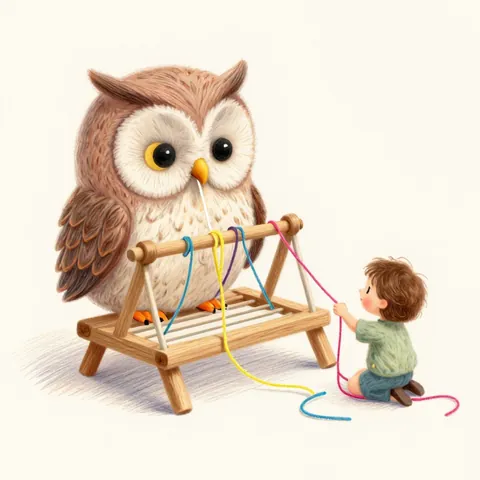
Threads of sound
A line in music is one string of notes, one after another, like the tune you hum. Texture asks two questions: how many lines are sounding, and how do they get along? Do they all sing the same tune, does one lead while the others help, or does each one have a tune of its own?
Musicians use three main names for this: monophony, homophony and polyphony. The words come from Greek. Mono means one, homo means same, poly means many, and phony means sound.
One line: monophony
Monophony is a single tune with nothing underneath: no chords and no second line. One person humming is monophony. A whole crowd singing the same tune is monophony too, even when men and women sing it an octave apart, because it is still one line.
Gregorian chant, the church singing of the Middle Ages, is a famous example: everyone sings the same melody, usually with no instruments (see the Early music lesson).
There is also a close cousin called heterophony: several musicians play the same tune at the same time, but each one decorates it a little differently. Many traditional styles work this way, for example Indonesian gamelan and Arabic classical music.
- A slow tune with nothing under it.
- The same tune doubled an octave lower: still one line.
A tune with helpers: homophony
Homophony means one main tune with other parts supporting it. Most songs you hear work like this: a singer has the melody, and a guitar or piano plays chords underneath. The chords follow the tune, but they do not have a tune of their own.
There is a second kind: all the parts move in the same rhythm, like a choir singing a hymn word by word together. The top part is the tune, and the parts below turn every note into a chord.
- The tune on top, soft chords on every beat below.
- Four parts, one rhythm: every note changes at the same moment.
Several tunes at once: polyphony
In polyphony there are two or more lines, and each one is a real tune. They do not move all at once: one moves while another holds a long note, one goes up while another goes down. You could sing any of them alone and it would still make sense.
Compare the two buttons below. The top tune is exactly the same both times. First, chords hold it up from below. Then a second tune walks along underneath and gets busy whenever the top tune rests on a long note. Johann Sebastian Bach was a master of this way of writing (see the Bach lesson).
- The tune with simple chords: homophony.
- A second line in the bass moves when the top stands still.
Follow the leader: canons and rounds
The easiest way to make polyphony is to copy. In a canon, one part starts a tune and another part starts the very same tune a little later, like an echo that keeps going. The first part is the leader; the others follow.
A round is a canon where everyone sings the same tune and, at the end, goes back to the beginning, so it can go round and round. Frère Jacques is a famous round, often sung in four parts. Nobody knows for sure who wrote it; the tune was already written down in France around 1780, and today it is free for everyone to use. In Chinese it is often sung with other words, as Two Tigers.
In the demo, each new part enters two bars after the one before. The parts are an octave apart so you can follow each one.
- Frère Jacques sung by one part only.
- The same tune, with a second and a third part following behind.
Try it: sing Frère Jacques and ask a friend to start from the beginning when you reach the words "Dormez-vous". You have made a round.
Two ways to think: harmony and counterpoint
You can look at the same music in two directions. Thinking in harmony means looking up and down: which notes sound together right now, and which chord do they make? Thinking in counterpoint means looking left to right: how does each line move, and does it still sound like its own tune next to the others?
The word counterpoint comes from the Latin punctus contra punctum, "point against point", or note against note. One of its oldest tips: when one line goes up, let the other go down. Lines that move in opposite directions are easy to hear as two. Lines that move together an octave or two apart melt into one thicker line.
Good music uses both ways at once. Even in a canon, the lines must make pleasing chords where they meet, and even simple chords sound better when each part moves smoothly.
- Two lines two octaves apart: they sound like one.
- One line climbs while the other falls: you hear two.
Listening for texture
Texture can change inside one piece. A song may open with a voice alone, add chords, and later bring in a second tune. Changing the texture is a simple way to make music grow without changing the tune.
The short example below does all three in four bars: one line alone, then the tune with chords, then the tune with a second tune.
- Bar 1 alone, bar 2 with chords, bars 3–4 with a second tune.
Try it: next time you listen to a song, count how many lines you can hear at the start, in the middle and at the end.
Piano sound: Salamander Grand Piano by Alexander Holm (CC BY 3.0).