 Sowlea
Intervals: how far apart two notes are
Two notes are always some distance apart, like two people standing on a staircase. Musicians call that distance an interval. Knowing intervals helps you sing in tune, find chords and hear what a melody is doing.
In this lesson
The smallest step: a half step
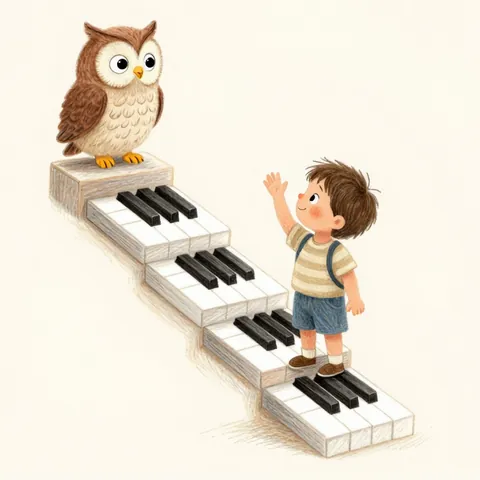
On a piano, going from one key to the very next key, black or white, is a half step (also called a semitone). It is the smallest step in most music, like moving to the very next stair.
Two half steps make a whole step (a tone). From C to D is a whole step, because the black key C♯ sits between them. From E to F is only a half step, because there is no black key between them.
Counting an interval: count both ends
To name an interval, count the letter names from the bottom note to the top note, and count both of them. From C up to E: C (1), D (2), E (3). That is a third.
Sharps and flats do not change the count: C to E♭ is still a third, because the letters are still C, D, E.
It is like counting the days from Monday to Wednesday on a calendar when you include both days: Monday, Tuesday, Wednesday is three days. From C to G is C D E F G, five letters: a fifth. From C to the next C is eight letters: an octave.
The same note played twice is called a unison, which means "one sound".
Big and small versions: major and minor
Seconds, thirds, sixths and sevenths come in two sizes. C to E is a major third (four half steps). C to E♭ is a minor third (three half steps). Major means bigger, minor means smaller, just by one half step.
Many people hear the major third as bright and sunny, and the minor third as softer or a little sad. Play them below and decide for yourself: there is no wrong answer, only your ears.
Best friends: the perfect intervals
The unison, the fourth, the fifth and the octave come in only one normal size, called perfect. Their two notes blend so smoothly that they almost sound like one rich note, like two best friends who get along perfectly.
The perfect fifth (seven half steps, like C to G) is the sound of many guitar "power chords" (a power chord is just a note and the note a fifth above it, played together). You can hear it at the start of "Twinkle, Twinkle, Little Star": the jump from the first "twinkle" up to the second one. You will meet it again in the circle of fifths lesson.
Every interval inside one octave
Here are all the intervals from one note up to its octave, all starting on C. Press Play to hear the two notes one after the other, then together.
- unisonP1
half steps: 0From C: C4 → C4
The same note twice: two voices singing as one.
- minor secondm2
half steps: 1From C: C4 → D♭4
Very close and rubbing, like the warning music of a shark film.
- major secondM2
half steps: 2From C: C4 → D4
A plain step, like Do to Re at the start of a scale.
- minor thirdm3
half steps: 3From C: C4 → E♭4
Soft and a little sad, like a gentle sigh.
- major thirdM3
half steps: 4From C: C4 → E4
Bright and happy, like a sunny morning.
- perfect fourthP4
half steps: 5From C: C4 → F4
Open and strong, like a call to gather.
- tritoneTT
half steps: 6From C: C4 → F♯4 / G♭4
Tense and unsettled, like a question still waiting for an answer.
- perfect fifthP5
half steps: 7From C: C4 → G4
Wide, strong and stable, like standing with feet apart.
- minor sixthm6
half steps: 8From C: C4 → A♭4
Wide and wistful, like looking out of a rainy window.
- major sixthM6
half steps: 9From C: C4 → A4
Wide and warm, like a friendly hello.
- minor seventhm7
half steps: 10From C: C4 → B♭4
Leaning and bluesy, as if it wants to keep moving.
- major seventhM7
half steps: 11From C: C4 → B4
Dreamy and almost touching the octave, a little bit sparkly.
- octaveP8
half steps: 12From C: C4 → C5
The same note, higher: like a man and a child singing the same tune together.
The tense one: the tritone
Six half steps, exactly half an octave, is called the tritone (three whole steps). It sounds tense and unsettled, like a question that has not been answered yet. In old times people even nicknamed it "the devil in music".
Composers use that tension on purpose: when the tritone moves to a calmer interval, the music feels like it has arrived home. It can be written as an augmented fourth (C to F♯) or a diminished fifth (C to G♭). "Augmented" means stretched one half step wider than perfect; "diminished" means squeezed one half step narrower.
Turn it upside down
If you move the bottom note of an interval up an octave, you get its partner. C up to E is a third; E up to C is a sixth. The two numbers always add up to nine (3 + 6, 4 + 5, 2 + 7), and major turns into minor, minor into major, while perfect stays perfect. This is called inverting an interval.
Little quiz: which interval?
Listen to two notes and pick the interval. Start with the four easiest: minor third, major third, perfect fifth and octave. Play each question as often as you like.
Piano sound: Salamander Grand Piano by Alexander Holm (CC BY 3.0).