
Rhythm: how long each sound lasts
Every song has a heartbeat: the steady beat you tap your foot to. Rhythm is how long each sound lasts compared with that beat. Learn five note shapes and their rests, and you can read the timing of almost any tune.
In this lesson
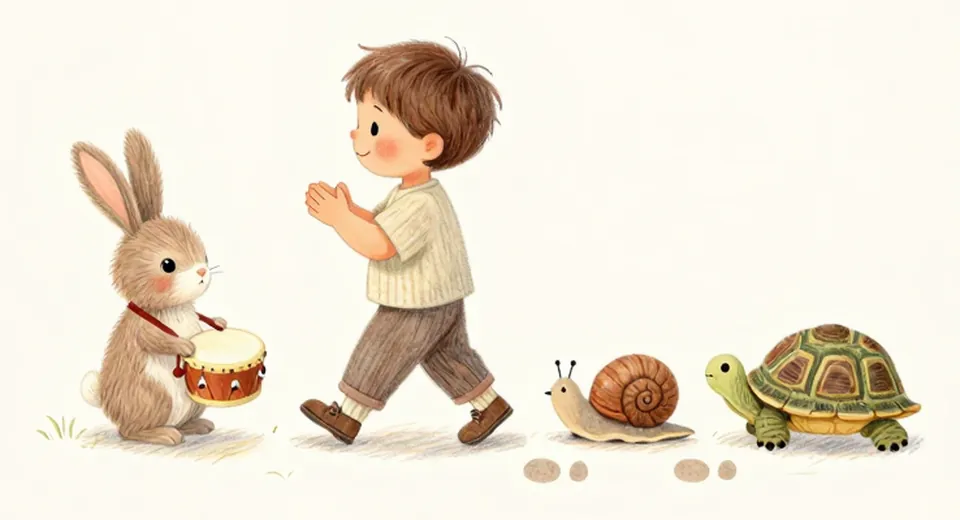
The beat: music's heartbeat
Tap your foot to a song you like. Those even taps are the beat. It works like a heartbeat or footsteps when you walk: steady, one after another, not rushing and not slowing down.
How fast the beat goes is called the tempo. We count it in beats per minute, written BPM. At 60 BPM there is one beat every second, like a ticking clock. At 120 BPM there are two beats every second, like walking briskly. The Sowlea metronome clicks on every beat so you can hear it.
A note's length is measured in beats. Some notes last one beat, some last longer, some are shorter. That is all rhythm is: the lengths of sounds and silences, measured against a steady beat.
Try it: clap four slow, even claps. Keep every gap exactly the same. That is a steady beat.
Note shapes: slicing a cake
Picture a whole cake that lasts four beats. A whole note is the whole cake: you play one sound and let it ring for four beats. (In most songs, a quarter note is one beat, so this is the usual way to count.)
Cut the cake in half and you have two half notes. The cake does not get bigger: two half notes take just as long as one whole note. Each lasts two beats. Cut each half in half and you have four quarter notes. Each lasts one beat, and this is the length most songs count as "one beat". Cut again and you get eighth notes, half a beat each, and again for sixteenth notes, a quarter of a beat each.
So every cut makes the note half as long. The shape tells you how long it is: a hollow note head means a long note (whole and half notes), a filled head means a shorter one, and each flag on the stem (or each beam joining notes together) makes it half as long again. Eighth notes have one flag or beam, sixteenth notes have two.
- Whole noteRest: Whole restBeats: 4
- Half noteRest: Half restBeats: 2
- Quarter noteRest: Quarter restBeats: 1
- Eighth noteRest: Eighth restBeats: ½
- Sixteenth noteRest: Sixteenth restBeats: ¼
Played at 80 beats per minute.
Names change from country to country. American English says whole, half, quarter and eighth note. British English says semibreve, minim, crotchet and quaver. They mean exactly the same lengths.
Try it: press play on each row and count the beats out loud while it sounds.
Rests: silence counts too
Music is not only sound. Silence is part of the rhythm, like the pause between words when you talk. A rest is a sign that means "stay quiet for this long".
Every note length has its own rest with the same number of beats. A quarter rest is one beat of silence, an eighth rest is half a beat of silence, and so on. The table above shows each rest next to its note.
A rest is not a mistake and not a gap to rush through. Count it like a note and keep the beat going in your head. Press the buttons below and listen for the silence.
- Four steady beats
- A rest on beat three
- Silence first, then three notes
- Sounds between the beats
Played at 80 beats per minute.
Try it: clap along with "A rest on beat three". On the silent beat, open your hands wide instead of clapping.
Dots and ties: a little extra
A dot right after a note adds half of that note's own length. A half note lasts two beats; with a dot it lasts 2 + 1 = 3 beats. A quarter note lasts one beat; with a dot it lasts 1 + ½ = 1½ beats.
A tie is a curved line that joins two notes of the same pitch. You play the first note and keep holding it through the second without playing again. A half note tied to a quarter note lasts 2 + 1 = 3 beats, the same as a dotted half note.
Why have both? A tie can join notes across the bar line (bars, also called measures, are the small boxes that music is divided into), which a dot cannot do.
- Half noteBeats: 2
- Dotted half noteBeats: 3
- Quarter noteBeats: 1
- Dotted quarter noteBeats: 1½
- Half note tied to a quarter noteBeats: 3
Played at 80 beats per minute.
How to count rhythms
Musicians count beats out loud: 1 2 3 4. Quarter notes land exactly on the numbers.
Eighth notes are two to a beat, so we squeeze the word "and" (written &) between the numbers: 1 and 2 and 3 and 4 and. Sixteenth notes are four to a beat: 1 e and a 2 e and a 3 e and a 4 e and a. (Say "e" like "ee".)
Say the counting out loud and tap along. Your voice keeps the beat steady while your hand plays the notes. When it feels easy, practise with the Sowlea metronome at a slow tempo.
- Quarter note1 2 3 4Beats: 1
- Eighth note1 & 2 & 3 & 4 &Beats: ½
- Sixteenth note1 e & a 2 e & a 3 e & a 4 e & aBeats: ¼
Played at 80 beats per minute.
Little quiz: how many beats?
Look at the note or rest. How many beats does it last?
Piano sound: Salamander Grand Piano by Alexander Holm (CC BY 3.0).