 Sowlea
Scales: a staircase of notes
A scale is a group of notes that climbs step by step from a starting note up to the same note an octave higher. Most melodies you know are built from one scale. Every scale follows a recipe of big and small steps, and if you know the recipe you can start it on any note.
In this lesson
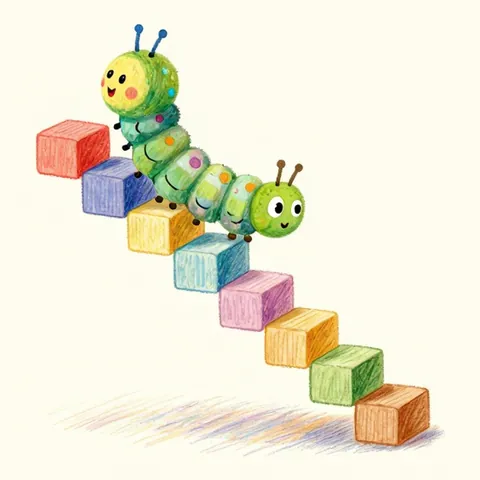
A scale is a recipe of steps
Think of a scale as a staircase where some stairs are tall and some are short. A tall stair is a whole step (W) and a short stair is a half step (H).
The major scale, the one that sounds like Do Re Mi Fa Sol La Ti Do, always uses this recipe: W W H W W W H. Start on C and follow it, and you play only the white keys: C D E F G A B C.
Start the same recipe on G, and one black key sneaks in: G A B C D E F♯ G. Why F♯ and not F? From the 6th note, E, the recipe needs a whole step, but E to F is only a half step, not far enough, so we go up one more half step to F♯. Then F♯ to G is exactly the last half step. So what makes a scale major is following the recipe, not the note you start on: start on C or on G, follow the recipe, and both sound major.
CDEFGABC
W W H W W W H
GABCDEF♯G
W W H W W W H
Major and minor: sunny and cloudy
The natural minor scale uses a different recipe: W H W W H W W. Start it on A and you again play only white keys: A B C D E F G A. Many people hear major as sunny and minor as cloudy or thoughtful.
A song whose notes come mostly from the C major scale, and which feels finished on C, is "in the key of C major". C major and A minor use exactly the same seven notes; they just feel at home on a different note. Musicians call them relative keys (A minor is the relative minor of C major), a bit like twins who share the same wardrobe.
Scale finder
Choose a starting note and a scale. You will see its notes, its step recipe and where it sits on the piano. Press "Play going up" or "Play going down" to hear it.
C major
CDEFGAB
Steps W W H W W W H
Bright and happy. The Do Re Mi scale, used in most children's songs and pop songs.
What each scale is good for
- Major
- Bright and happy. The Do Re Mi scale, used in most children's songs and pop songs.
- Natural minor
- Darker and thoughtful. The everyday minor scale (also called Aeolian).
- Harmonic minor
- Natural minor with the 7th note raised by a half step. That leaves a big gap of three half steps between the 6th and 7th notes, which sounds a little exotic and dramatic.
- Melodic minor
- Minor with raised 6th and 7th notes going up, smooth to sing. In classical music it usually turns back into the natural minor going down.
- Major pentatonic
- Five friendly notes with no half steps. Very hard to make it sound wrong.
- Minor pentatonic
- Five notes that sound great for rock and blues solos on guitar.
- Blues
- The minor pentatonic plus one extra "blue note" that adds a cool, crunchy colour.
- Dorian
- A minor-sounding mode whose 6th note is a half step higher than in natural minor, which makes it brighter. Common in jazz, funk and folk.
- Phrygian
- A minor mode with a half step right after the first note, giving a Spanish or flamenco flavour.
- Lydian
- A major mode with a raised 4th note. Dreamy and floating, often heard in film music.
- Mixolydian
- A major mode with a lowered 7th note. Relaxed and rocking, common in rock and folk.
- Locrian
- The most unsettled mode, because its 5th note is lowered. Used rarely, mostly for special effects.
- Whole tone
- Only whole steps, six notes. Floating and dreamy, like the music when a cartoon goes into a dream.
- Chromatic
- All twelve notes, every half step. Like climbing every single stair.
The five-note scale you cannot get wrong
Pentatonic means "five notes". The major pentatonic is the major scale without its 4th and 7th notes (Fa and Ti). Those two sit only a half step from a neighbour, and half steps can rub. Take them away and almost any order of the notes sounds pleasant.
Try this: play only the black keys of a piano, in any order you like. That is a pentatonic scale, and it is very hard to make it sound wrong. Many folk songs and children's songs around the world use it.
Modes: same notes, different home
Play the white keys from D to D instead of C to C. You use the same notes, but the music now feels different, because the home note changed. That is the Dorian mode.
Each white key gives one mode: C Ionian (the major scale), D Dorian, E Phrygian, F Lydian, G Mixolydian, A Aeolian (the natural minor) and B Locrian. It is like a week: a week that starts on Monday and one that starts on Sunday have the same seven days, but they feel different.
All major and minor scales
Here are all twelve major scales and their relative minor scales, written with the usual sharps and flats.
- C majorCDEFGABA natural minorABCDEFG
- G majorGABCDEF♯E natural minorEF♯GABCD
- D majorDEF♯GABC♯B natural minorBC♯DEF♯GA
- A majorABC♯DEF♯G♯F♯ natural minorF♯G♯ABC♯DE
- E majorEF♯G♯ABC♯D♯C♯ natural minorC♯D♯EF♯G♯AB
- B majorBC♯D♯EF♯G♯A♯G♯ natural minorG♯A♯BC♯D♯EF♯
- F♯ majorF♯G♯A♯BC♯D♯E♯D♯ natural minorD♯E♯F♯G♯A♯BC♯
- D♭ majorD♭E♭FG♭A♭B♭CB♭ natural minorB♭CD♭E♭FG♭A♭
- A♭ majorA♭B♭CD♭E♭FGF natural minorFGA♭B♭CD♭E♭
- E♭ majorE♭FGA♭B♭CDC natural minorCDE♭FGA♭B♭
- B♭ majorB♭CDE♭FGAG natural minorGAB♭CDE♭F
- F majorFGAB♭CDED natural minorDEFGAB♭C
Piano sound: Salamander Grand Piano by Alexander Holm (CC BY 3.0).