
The staff: how music is written
Music can be written down, so a person far away, or many years later, can play it exactly as it was meant to be played. The writing uses five lines, a few signs and notes placed high or low. It looks like a secret code, but it is really a picture of how high each note sounds.
In this lesson
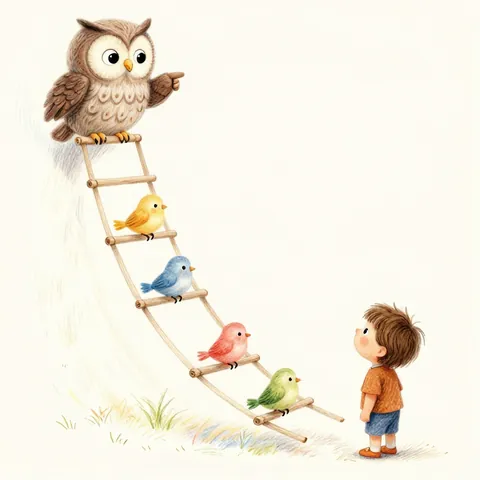
The staff: a ladder for notes
Music is written on a staff: five lines with four spaces between them. Think of a ladder lying on its side. Each line and each space is one step of the ladder. We count the lines from the bottom: the lowest line is line 1.
A note sits either on a line or in a space. The higher the note sits, the higher it sounds. Press the button to hear nine notes climb the ladder one step at a time.
Try it: tap any note to hear it. Is a note that sits higher also higher in sound?
The clef: which notes live where
The curly sign at the start of the staff is called a clef. It tells you which note each line stands for. Without a clef, the lines could mean any notes.
There are two clefs you will meet most. The treble clef is for higher notes. The bass clef is for lower notes. Piano music uses both: the right hand usually reads the treble clef and the left hand reads the bass clef.
Tap a note to hear it.
Reading note names on the staff
Each line and each space has a note name, and the names climb through the alphabet: A B C D E F G, then A again. Move up from a line to the next space, and you move to the next letter.
In the treble clef the lines, from the bottom to the top, are E G B D F. The spaces are F A C E. In the bass clef the lines are G B D F A and the spaces are A C E G.
You do not have to learn them all at once. Learn the line where your clef starts (G in the treble clef, F in the bass clef) and count up or down from there.
Tap a note to hear it.
Middle C and ledger lines
What if a note is higher or lower than the five lines? Then we add a short extra line just for that note. It is called a ledger line.
The most important ledger-line note is middle C, the C near the middle of the piano. It sits on one ledger line below the treble staff, and on one ledger line above the bass staff. It is the same key on the piano. It is the meeting point of the two clefs.
Sharps, flats and naturals
A sign in front of a note can change it by a half step. A sharp (♯) makes the note one half step higher. A flat (♭) makes it one half step lower. A natural (♮) cancels a sharp or a flat and takes the note back to its plain name.
On the piano, sharps and flats are mostly the black keys. They are written before the note they change.
Little quiz: name the note
Look at the note on the treble staff and pick its name. Use the lines (E G B D F) and the spaces (F A C E) to find it.
Piano sound: Salamander Grand Piano by Alexander Holm (CC BY 3.0).