
Felix Mendelssohn: the Boy Who Wrote Fairy Music
Felix Mendelssohn was a composer, pianist and conductor from Germany. He started making music as a child, and at 17 he wrote a sparkling overture for A Midsummer Night's Dream, a play full of fairies.
In this lesson
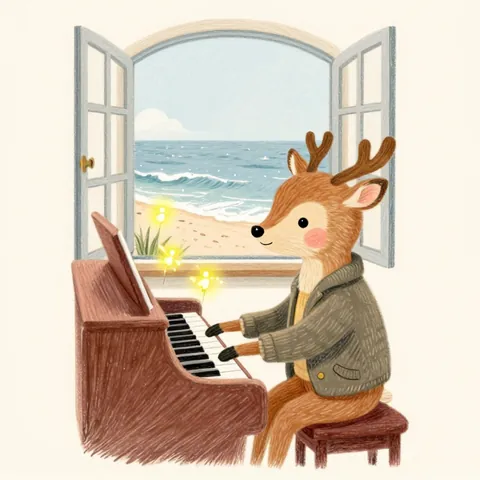
A musical childhood
Felix Mendelssohn was born in Hamburg, in Germany, on 3 February 1809. He grew up in Berlin. His older sister Fanny loved music too, and the two of them studied piano and composing.
Felix played in public for the first time when he was about nine years old. In 1835 he became the music director of the Gewandhaus Orchestra in the city of Leipzig. He died there on 4 November 1847, at the age of 38.
Bringing Bach back
In Mendelssohn's time, the great composer Johann Sebastian Bach had died long before, in 1750, and many of his big pieces were hardly ever played.
On 11 March 1829, Mendelssohn, aged 20, conducted Bach's St Matthew Passion in Berlin. It was one of the very few times it had been performed since Bach's death.
After that, more and more people wanted to hear Bach's music. In 1843 Mendelssohn also started a music school in Leipzig, the Conservatory, which still teaches students today under a newer name.
Light, clear and full of tunes
Mendelssohn's music is often lively and neat, with melodies that are easy to remember. Many pieces sound like pictures: fairies, waves, or a sunny trip.
He also loved writing for the piano. Some of his piano pieces sound like a song with no singer, so he called them "songs without words".
Try listening for
These four pieces show how Mendelssohn made music that sounds like pictures.
- A Midsummer Night's Dream, overture
- Listen for the quick, light notes in the strings that sound like tiny fairies flitting about.
- Wedding March
- Listen for the loud, happy trumpets at the start. It comes from his later music for the same play, written in 1842 and first performed in 1843.
- The Hebrides
- Listen for the rolling tune that sounds like waves. He began it after visiting a cave on the island of Staffa, in Scotland, in 1829.
- Violin Concerto in E minor
- Listen for how soon the violin starts singing, almost right away. It was first played in Leipzig in 1845.
Listen to the start of the Wedding March and march along to its steady beat. Then listen to The Hebrides and sway slowly like the sea.
Some pieces to know
Mendelssohn wrote music for orchestra, piano, choirs and many other groups.
- A Midsummer Night's Dream
- Music for a play full of fairies. He finished the overture on 6 August 1826, when he was 17.
- Italian Symphony
- A bright symphony inspired by his travels in Italy, first played in 1833.
- Songs Without Words
- 48 short piano pieces, collected in eight books of six, each with a singing tune.
- Elijah
- A big piece for choir, singers and orchestra, first performed in Birmingham, in England, on 26 August 1846.
Meanwhile, around the world
- 1809A great composer says goodbye
Joseph Haydn died in Vienna, in the same year Mendelssohn was born.
- 1824A choir joins a symphony
In Vienna, Beethoven's Ninth Symphony was first played, with singers in the last part.
- 1825A railway with steam engines
In England, the Stockton and Darlington Railway opened, with steam engines pulling coal wagons.
- 1830A story in sound
In Paris, Berlioz's Symphonie fantastique was first performed, telling a story through music.
- 1846The saxophone is patented
In Paris, the Belgian inventor Adolphe Sax received a patent for the saxophone.
Piano sound: Salamander Grand Piano by Alexander Holm (CC BY 3.0).