
Franz Liszt: the Piano Superstar
Franz Liszt was a pianist and composer who lived in the 1800s. He played so fast and so well that crowds cheered like fans at a pop concert, and he wrote piano pieces that sound like bells, dances and dreams.
In this lesson
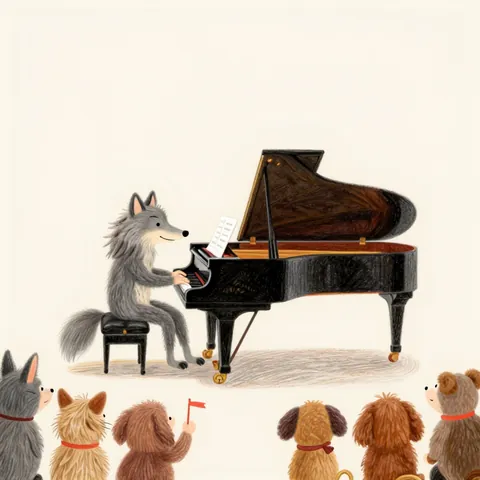
A boy who played the piano like magic
Franz Liszt was born on 22 October 1811 in a small village called Raiding, which is now in Austria. His father, Adam, loved music and played as a hobby, and he helped young Franz learn the piano.
Franz grew up to travel and play concerts in many cities. He died on 31 July 1886 in Bayreuth, in Germany, at the age of 74.
The superstar and his students
Franz started lessons with his father and later studied with a famous teacher in Vienna, Carl Czerny, who was so impressed that he taught the boy for almost nothing. He gave his first public concert at the age of nine, in 1820, and in 1823 he went to Paris.
In the 1840s his concerts were so exciting that a poet, Heinrich Heine, wrote about "Lisztomania" in 1844. The word means that everyone was crazy about Liszt!
Later in life, Liszt gave lessons for free and taught hundreds of students. In 1875 Liszt helped start a music school in Budapest, in Hungary. Today the school carries his name.
Fast fingers and big feelings
Liszt was a virtuoso, which means a player with amazing skill. His music has quick runs, big jumps from one end of the piano to the other, and strong feelings that go from soft to loud.
He often played from memory, with no music in front of him. He also wrote pieces for orchestra that tell a story or paint a picture, and he is often called the inventor of the "symphonic poem".
Try listening for
These four pieces show different sides of Liszt's music.
- Hungarian Rhapsody
- Listen for a slow, singing part that suddenly turns into a fast, bouncy dance. Many of the rhapsodies are built like this.
- La campanella
- Listen for high, tiny notes that jump up and down like a little bell ringing.
- Liebestraum No. 3
- Listen for one gentle tune that comes back again and again, each time dressed a bit differently.
- Les préludes
- Listen for an orchestra that plays one long piece in one go, with the same musical ideas changing as it goes.
Listen to a Hungarian Rhapsody. Tap a slow, calm beat on your knees for the slow part, then tap twice as fast when the dance begins.
Some pieces to know
Liszt wrote a lot of music, and much of it is for the piano.
- Hungarian Rhapsodies
- Nineteen piano pieces based on Hungarian tunes. The first ones were published in the early 1850s.
- La campanella
- A piano piece whose name means "the little bell". It is based on a tune by the violinist Niccolò Paganini.
- Liebesträume
- Three piano pieces published in 1850. The name is German for "Dreams of Love".
- Les préludes
- A symphonic poem for orchestra, first played in 1854 with Liszt himself conducting.
Meanwhile, around the world
- 1825The first steam railway for everyone
In England, the Stockton and Darlington Railway opened. It was the world's first public railway to use steam locomotives.
- 1830An orchestra tells a story
In Paris, Hector Berlioz's Symphonie fantastique was played for the first time.
- 1832A new pianist in Paris
Frédéric Chopin gave his first concert in Paris, and Liszt was in the audience.
- 1840The first postage stamp
In the United Kingdom, the Penny Black went on sale. It was the world's first stamp stuck on letters to pay for the post.
- 1876A festival for Wagner's operas
Richard Wagner's opera festival began in Bayreuth, in Germany.
Piano sound: Salamander Grand Piano by Alexander Holm (CC BY 3.0).